Brick end-of-terrace gable beside a limestone house, slate roofs

Roofers in Nettleton, Wiltshire

Repairs, re-roofing, ridges and chimneys for houses in Nettleton and its neighbours Burton and West Kington, on the Wiltshire side of the Cotswolds National Landscape where the Fosse Way runs through.

Nettleton's roofs, from Fosse Way to chapel

Stone-roofed farmhouse and outbuildings
Old houses and farm buildings on the Cotswold edge

Nettleton is a parish on the north-western edge of Wiltshire, with Burton and West Kington inside it and the Fosse Way crossing it. Traditional stone slate roofing is recorded from Chipping Campden down towards Bath, so a house in this corner may well have a roof of that kind, though plenty of local roofs have since been re-covered in tile. Where genuine stone slate survives, it is laid in graded courses, heavy and pegged, and its repair is specialist work: slipped stones refixed, tired pegs and battens renewed, and the courses re-laid so the slope keeps its texture. Barns, stables and outbuildings of similar age often share the same covering and the same problems at the eaves, valleys and verges. The verge, the angled edge of the slope above a gable wall, is where wind gets under old stone courses first.

Small chapel with a steep pitched roof
The chapel and the church

A Baptist chapel has served Nettleton since 1823, and St Mary's at Burton, the Anglican church for the parish, carries a Grade I listing. Places of worship have roofs with demands of their own: steep pitches, high gutters, parapets and valleys that need proper access, and lead that works hard to keep the weather out. Faults usually begin at the abutments and the gutter lines, so those are the places we check first, and a survey from a tower or ladder shows what the ground cannot. Gutters count for as much as the covering here, because an overflowing one soaks the wall head and the timbers behind it. Both are in use by denominations covered by the ecclesiastical exemption, so roof work on St Mary's goes through the diocesan faculty system, and on the chapel through the Baptist denomination's own procedure, not through listed building consent from the council.

Tiled village houses beside a country lane
Village houses and later builds

Nettleton is a small parish, and its homes range from old cottages to twentieth-century houses and extensions. On the later ones the covering is more likely to be clay or concrete tile, or slate brought in during the nineteenth century, and the repairs are familiar: ridge tiles worked loose, cracked tiles, torn underlay and tired lead beside a chimney. Porches, garages and conservatories bring flat roofs and polycarbonate sheets into the mix, and these often call for work sooner than the main roof. A flat roof is lined with felt, EPDM rubber or fibreglass, and each has its own failure points at edges and upstands. Here the right answer is usually a tidy repair of what has failed and a note of what will need attention next, not a whole new covering. Where a repair would only postpone the problem, the quote spells that out.

Out to the Cotswold edge

Map showing Nettleton and central Swindon. 25 road miles west-south-west of central Swindon.

Distance
25 road miles west-south-west of central Swindon
Council
Wiltshire Council
Council
Wiltshire Council
Landscape
Cotswolds National Landscape
Parish
Includes Burton and West Kington

Nettleton roof questions

Does the Cotswolds National Landscape affect roof work in Nettleton?

Planning is Wiltshire Council's call, with the landscape body giving advice only. Repairs in the existing material seldom raise anything; ask before changing the covering or adding a roof window.

Can a stone slate roof near the Fosse Way be repaired in part?

Usually. Slipped stones can be hung again and rotten pegs or battens renewed in the affected area, without taking the whole slope apart.

Who covers building control in Nettleton?

Wiltshire Council's building control team, or a registered building control approver if you prefer a private one. On notifiable work we explain the steps and send in the notice.

Q1

Is my Nettleton roof real stone slate or a lookalike?

Reclaimed Cotswold stone slates sorted by length beside a limestone wall
Brick and limestone cottages around a small village green

The short answer

Look at the stones themselves. Real stone slate is thick and uneven, graded from the largest at the foot of the slope to the smallest by the ridge. Concrete lookalikes are regular in thickness and usually identical in colour. If you cannot tell, a close-up survey photograph will settle it.

Cotswold District Council's technical guidance names two limestones behind the traditional stone slate, Forest Marble and Stonesfield Slate. A house on the Wiltshire edge of that tradition may carry a true stone roof, a later tile, or a mixture of both on different slopes. The first job is to know which you have, because everything else follows from it.

How can I tell real stone from a copy?

Real stone slates have rough, uneven edges, vary in colour from one stone to the next, and get visibly smaller as they climb the slope. That gradation gives an old roof its texture from across a field. Reconstructed products imitate the look but are cast in concrete, with crisp edges, a flat even tone and a fixed set of sizes. Moss and lichen settle differently on each, too, and an old stone roof with lichen on it is not necessarily a roof in trouble.

Why does the difference matter in practice?

The repair methods are different. Real stone slates are hung on a peg, whereas concrete slates are nailed or clipped. Stone is also very heavy. The district guide puts it at around 1000 kg for every 10 square metres of roof, so the roof timbers and the walls beneath them matter as much as the covering itself.

What does our survey record?

We photograph the slope, note the pitch and the size of the stones at the eaves and the ridge, and look at the timbers from the loft. That shows whether the roof wants a few refixed stones, a section re-laid, or something wider. The Cotswold stone roofing page describes the methods in detail.

Q2

Should a Nettleton stone roof be re-hung or replaced?

The answer

Re-hanging is usually better when the stones are sound and only the pegs, battens or fixings have failed. Replacement makes sense where the stones themselves have perished. The district guide notes that a good share of stones are commonly found to have gone soft when an old roof is stripped.

On a leaking stone roof, the stones are rarely what has failed first. Oak pegs rot, battens go soft and the bedding between courses breaks down. Stones slip because what held them has gone, and the stone itself may be perfectly good. That distinction decides the whole job, and it is usually possible to make it from a survey rather than from a guess. Tapping a stone, checking its thickness at the edge and looking at the underside from the loft will normally answer the question.

When can the existing stones be saved?

Stones that are laminating or flaking underfoot are finished. Stones that ring true when tapped and hold their thickness can be lifted off, sorted by size, and laid again on new battens with fresh pegs. A roof stripped and re-hung this way keeps its pattern and its character, and often keeps its value as well. Photographs taken before the first stone is lifted let each course return to its place.

What should replacement stones be?

The advice quoted by the district council prefers new stone slates to old ones taken from elsewhere, and reserves reclaimed slates for the very building that supplied them. Concrete or resin copies are ruled out on old buildings, and sandstone should never share a roof with limestone. We follow that approach on any old stone roof and talk it through with the owner.

Is there anything to do between big jobs?

The same guide observes that a roof scraped clear each year could last twice as long. Clearing moss by hand, keeping gutters flowing and watching the valleys cost little beside a re-lay. For the wider question of when a full re-cover is justified, our roof replacement page sets out the reasoning.

Our view

Save the sound stones, replace what holds them up, and put them back in order.

Q3

Do I need approval for roof work near the Fosse Way?

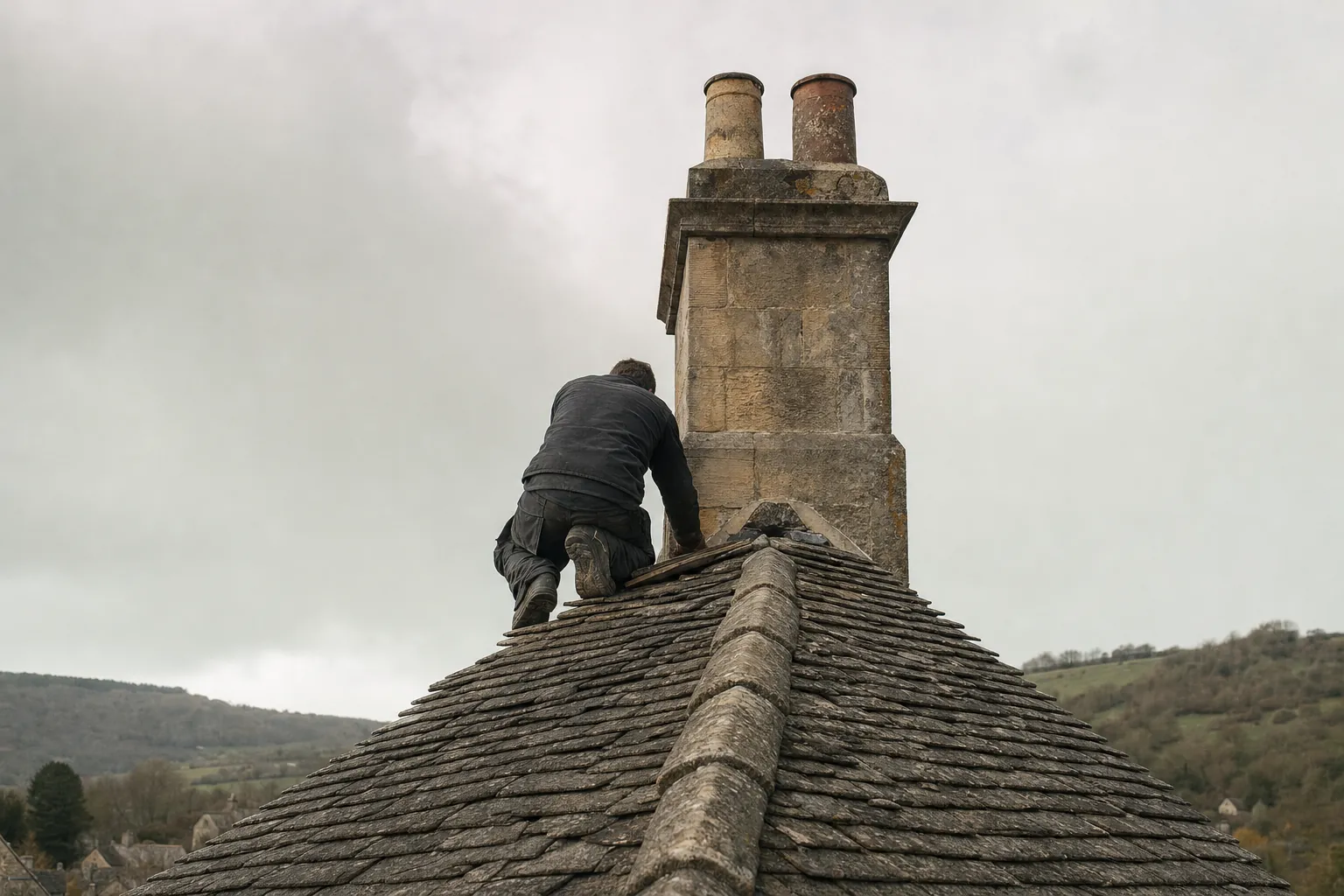
Roofer on a stone slate ridge beside a stone chimney
Roofer repointing a stone chimney stack above lead flashing

The short answer

Repairs in the existing material usually need none. A bigger re-roof can need a building control application, and a listed house or an altered look can bring in the planning or conservation officers at Wiltshire Council. The Cotswolds National Landscape body advises, but the council decides.

Most roof work in Nettleton is upkeep and needs no consent. Refixing stones, replacing a cracked tile, renewing lead beside a chimney and re-fixing a ridge are all in that group. Three things can change the picture, and they are worth looking at before a quote is signed, because a delay for consent after the scaffold is up costs more than a call beforehand.

How big is the job?

The Planning Portal sets the building control threshold at 25 per cent of the total building envelope and 50 per cent of the roof. Planning Portal guidance: staying below both figures means no application as a rule, while exceeding either one calls for approval and better insulation may follow. Fifteen per cent or more extra weight in the covering needs approval too, which matters when moving between tile and stone. Wiltshire Council's building control team handles applications in Nettleton, and a registered building control approver is the other route.

Is the house listed or in a protected area?

Nettleton village itself has no conservation area, but West Kington, within the parish, has one of its own. Whether your house is listed, or lies inside that boundary, is something Wiltshire Council can confirm for your address. If it does, changing the roofing material needs the council's agreement first.

Does the landscape designation matter?

The Cotswolds is a National Landscape, the name in use since November 2023 for what is legally still an AONB. The body that speaks for the landscape advises; the council makes the decision. Our page on dormer planning rules explains how such designations affect what can be added to a roof slope.

If you are unsure, send us your address with a photograph of the roof, and we will work out which of these applies before a price is given.


MythA National Landscape designation means the landscape body must approve any roof work.

FactThe council decides planning questions; the landscape body only gives advice.

Questions from the Fosse Way villages

Do you cover Burton and West Kington as well as Nettleton?

Yes. Burton and West Kington share a parish with Nettleton, and all three sit within our working area. If you are unsure about a hamlet nearby, the page of areas names every place we cover, and one call to 01793 626096 settles the question.

My Nettleton roof has moss growing between the stones. Does it need action?

Moss holds water against stone and can lift stones when it dries and shrinks. It is best removed gently by hand, because a pressure washer can damage old stone and wash out the bedding around the pegs. A survey will show whether anything underneath has already given way.

Is a chapel roof repaired like a house roof?

The methods are alike, but access, height and consent differ. Gutters and valleys on a chapel are often hard to reach and call for scaffold or a tower. A chapel or church still in use by an exempt denomination, such as the Baptist chapel here, follows its denomination's own approval process rather than the council's listed building consent, so the trustees settle that before work is booked.

Do ridge tiles on an older Nettleton cottage need more than mortar?

Yes. Since BS 5534:2014, ridge and hip tiles cannot depend on bedding mortar alone; clips or screws hold them as well. On a high position at the edge of the Cotswolds, extra fixings are a sensible addition whenever a ridge is re-bedded.

Ask us about your roof

Tell us what’s happening and we’ll call you back.

  • Photos of what we find
  • A written quote
  • 10-year workmanship guarantee

Or call 01793 626096

Call Get a quote