Row of stone cottages with steep stone slate roofs

Roofers in Yatton Keynell

Repairs, re-roofing, chimney and lead work in Yatton Keynell, where rubble stone houses sit under tile, slate and stone-tiled roofs on the southern tongue of the Cotswolds.

Yatton Keynell's roofs on the Cotswold edge

Rubble stone house with a tiled roof
Rubble stone houses

Wiltshire Council's community history describes most houses in Yatton Keynell and the villages around it as rubble stone with a tile or slate roof. Rubble walls are built from irregular stones set in lime mortar, thick and slow to dry, and the roof above them has to shed water clear of the wall face. That makes eaves, verges and gutters more important than they look. A gutter leaking against a rubble wall soaks the stone and the lime beneath it, and a dripping verge does the same down a gable. When we survey one of these houses we check the roof and the wall together, because a damp wall inside is often a roof or gutter fault outside. Matching tiles or slates by size, colour and age keeps repairs from showing on a street of similar houses.

Stone-tiled roof on a seventeenth century manor
The Manor House and stone-tiled roofs

The Manor House in West Yatton Lane, dated 1659 and listed Grade II*, is one of the buildings the council's history singles out for stone-tiled roofs. Stone tiles are laid in graded courses, starting with the biggest pieces at the lowest course and shrinking to small ones near the top, every piece pegged to the batten. Such a roof is heavy, durable and demanding to repair, since the stone will often outlast the timber and metal that support it. The work on a roof like this is careful and slow: refix what has slipped, renew what has rotted, and keep the old stone in place wherever it is sound. A roof of this age and standing is also a matter for the conservation team, so repairs are planned with that in mind.

Village roofs around a Cotswold-edge church
Church and village centre

St Margaret's, the Grade I parish church, was drastically restored by G.E. Street in 1868 and stands at the heart of a conservation area designated in May 1991 around the village centre. Buildings near a church of that scale often share high gables, steep slopes, tall chimneys and lead valleys that carry plenty of rain. Newer houses and bungalows on the village edge have different roofs again, usually concrete or clay tiles with ridge and hip tiles that need checking after a rough winter. Flat or shallow roofs over garages, porches and extensions wear out on a separate timetable. Whatever the age, the survey records each part of the roof separately, so the quote reflects the real condition of each slope and nothing more.

From Swindon to the Cotswold edge

Map showing Yatton Keynell and central Swindon. 22 road miles west-south-west of central Swindon.

Distance
22 road miles west-south-west of central Swindon
Council
Wiltshire Council
Conservation area
Yatton Keynell, designated May 1991, around the village centre
Council
Wiltshire Council
Landscape
Southern tongue of the Cotswolds National Landscape

Yatton Keynell householders ask us

Can the stone-tiled roof of a Yatton Keynell manor be repaired?

Yes. Slipped stones are refixed, rotted pegs and battens renewed, and sound stone kept in place. For a listed building we agree the approach with the council first.

Is Yatton Keynell inside the Cotswolds National Landscape?

The village and western parish lie in its southern tongue. Wiltshire Council still decides planning matters, and the National Landscape body only advises.

Why does damp appear inside rubble stone houses here?

Often a roof or gutter fault outside. A rubble wall drinks from a dripping gutter or verge and gives the water up slowly indoors, so we inspect both together.

Q1

What are Yatton Keynell's roofs made of?

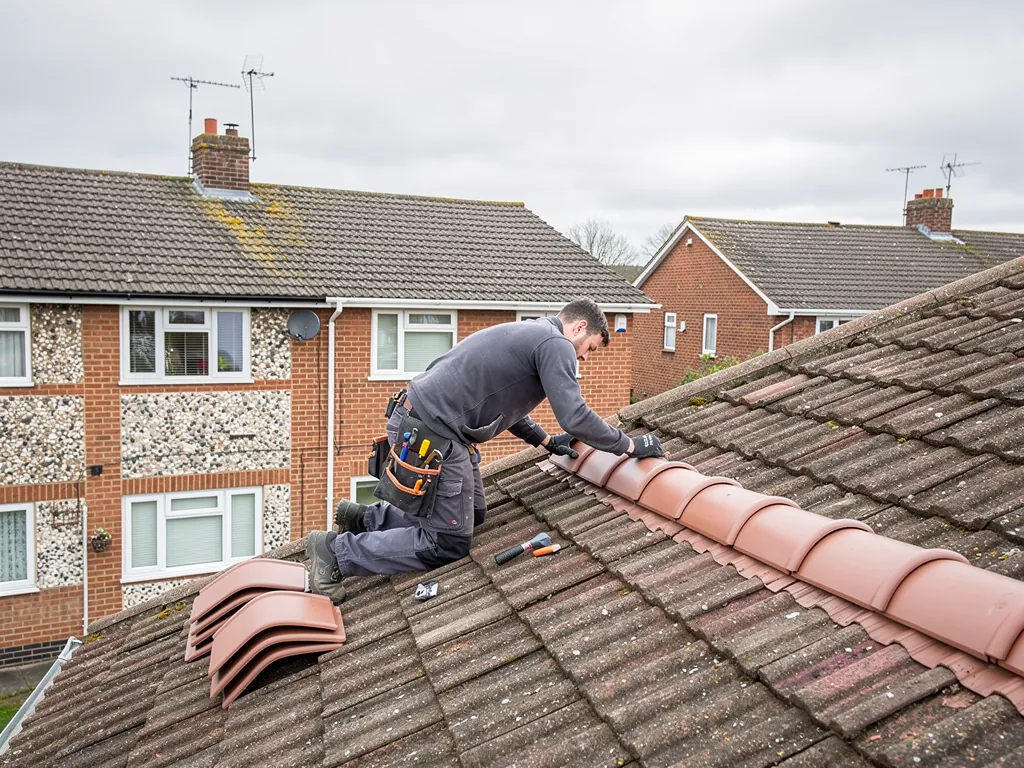
Roofer fixing new red ridge tiles along a concrete tile roof
Roofer repointing a stone chimney stack above lead flashing

The short answer

Wiltshire Council's community history describes most houses in the village and surrounding villages as rubble stone with a tile or slate roof, with stone-tiled roofs on the Manor House in West Yatton Lane. Newer homes add concrete and clay tiles, so the work ranges from slate repairs to stone tile refixing.

Yatton Keynell lies about four miles north-west of Chippenham, on the southern tongue of the Cotswolds. The building stock reflects that edge position: Cotswold stone traditions, but with tile and slate alongside the stone tiles.

How does a tile or slate roof on rubble walls age?

Both coverings last a long time while the fixings behind them hold, and many of the faults we are called to are really fixing faults rather than covering faults. The trouble tends to be nails that rust through, battens that soften, and lead flashings at chimneys that crack. On a slate roof, a slate slides when its nail fails. On a tiled roof, tiles crack or lift where frost has got behind them, and ridge tiles loosen when old bedding crumbles. Our slate roofing page covers the slate side in more depth.

What sets the stone-tiled roofs apart?

A stone-tiled roof is far heavier than slate or tile, and it is laid in diminishing courses. Cotswold District Council's stone slate guidance gives about 1000 kg per 10 square metres. The roof structure is built for that load, so changing to a lighter material alters how the frame behaves, while laying stone on timbers designed for slate risks overloading them. Either way, we check the timbers first.

What do we look at on a first visit?

We look at the ridge line, the verges, the valleys and the chimney flashings, then the underside from inside the loft if we can reach it. Daylight through the covering, stained rafters and softened battens tell us more than the surface does, and we note each one down with a photograph so you can see exactly what we saw.

Our aim is the minimum work that genuinely stops the leak. Where a section of covering is beyond saving, we replace that section in a matching material and leave the rest of the roof alone.


Q2

How does a rubble stone wall affect roof repairs?

The answer

Rubble walls are thick, irregular and absorbent, so water from a failed gutter, verge or flashing soaks in and shows up inside weeks later. Repairs therefore start at the roof edge. Fixing the water path outside usually does more for a damp wall than anything done to the plaster within.

Rubble stone is built from uneven stones packed into thick walls with lime mortar. It breathes, which is part of why these houses have lasted, but it also means a wall takes water in readily and gives it up slowly.

Where does the water usually enter?

On a village house like this the common routes are the eaves, where a gutter overflows against the wall; the verge, where mortar has crumbled and rain runs down the gable; the chimney, where flashings have lifted; and the abutment with a lean-to or porch. Each of those puts water straight onto the wall face. The sign indoors is a patch of damp plaster, often well below the actual leak.

Should I use cement or lime?

Hard cement repairs on a lime-built wall trap moisture and push it into the softer stone. Lime mortar is the right partner for the walls here, and we use it for verge bedding and flaunching where the wall calls for it. Flaunching is the sloping mortar bed around a chimney pot, shaped to throw rain clear of the pot and the stack.

What about gutters?

Gutters and downpipes deserve as much attention as the covering. Cast iron, aluminium or plastic, they need to be falling correctly, with joints sealed and brackets sound. Our gutters, soffits and fascias page explains the options.

When the roof edge is right, the wall dries over months rather than days, and a lime-built wall in particular takes its time. We tell you that up front, because plaster stays damp for a while after a fault is fixed and it is not a sign the repair has failed.

MythDamp patches inside an old stone house mean the walls need treating.

FactWater arriving from a roof edge or gutter fault is a common cause, so fix that first.

Q3

Who approves roof work in Yatton Keynell conservation area?

Brick and limestone cottages around a small village green
Roofers on a slate roof along a limestone village street

The short answer

Wiltshire Council deals with planning, conservation and building control here. The village conservation area was designated in May 1991 around the centre. Matching repairs seldom need permission, but listed buildings, including the Manor House and St Margaret's, have extra protection, and we explain any consent before work starts.

Yatton Keynell is in Wiltshire, so the council that matters is Wiltshire Council. Its community history says the conservation area was designated in May 1991 and takes in the centre of the village.

Does a matching repair need an application?

Replacing like with like, in an identical material, counts as maintenance, and the house looks the same afterwards, so planning permission is seldom an issue. A different covering or a visible alteration to the roofline is another matter and deserves a word with the council beforehand. Whether an Article 4 direction touches your street is a question for Wiltshire Council, so put it to them before work is priced.

What extra protection do listed buildings have?

The Manor House of 1659 is Grade II* and St Margaret's is Grade I. Listed building consent is required for alterations that would alter what is special about the building, and the roof covering is one of those things. For a church where Church of England worship continues, a faculty replaces consent from the council, and the parish deals with that process.

Will a big re-roof at Yatton Keynell need building control sign-off?

Large re-roofs may fall under Building Regulations. The Planning Portal puts the line at 25 per cent of the total building envelope or 50 per cent of the roof, past which approval applies. For that, Wiltshire Council's building control team or a registered building control approver is the route. You are told which of the two applies, and we make the notification ourselves when the work requires it.

Does the National Landscape change anything?

The village lies in the southern tongue of the Cotswolds National Landscape. That status advises; the council decides.

Our roof replacement page sets out the point at which stripping a whole roof makes sense.

Roofing services in Yatton Keynell

Questions from West Yatton Lane and the village centre

Why do slates slip on older Yatton Keynell houses?

Usually because the nails holding them have rusted through. The slate itself is fine, but it slides out of its course and leaves a gap. Refixing with fresh fixings, or re-slating a slope with the old slates sorted and put back, is normally enough, and we photograph the fault so you see it.

Can a listed church or manor roof in the village be worked on?

Roofs of that standing need agreed methods: the owner and the council define the limits, and we stay inside them with matching stone, slate or tile. A Church of England church follows the faculty route through the parish. We explain the steps before any quote is written.

Do you cover Yatton Keynell and the nearby villages?

Yes, as part of the ground within 30 road miles of Swindon, which takes in the villages near Chippenham and along the Cotswold edge. Our areas page names every place, and a phone call, WhatsApp message or the enquiry form starts a survey.

What guarantee do you give on a Yatton Keynell roof?

A 10-year workmanship guarantee in writing. Pictures of your own roof come back with a written quote at one total price, and afterwards we tidy the site and take our rubbish with us.

Ask us about your roof

Tell us what’s happening and we’ll call you back.

  • Photos of what we find
  • A written quote
  • 10-year workmanship guarantee

Or call 01793 626096

Call Get a quote