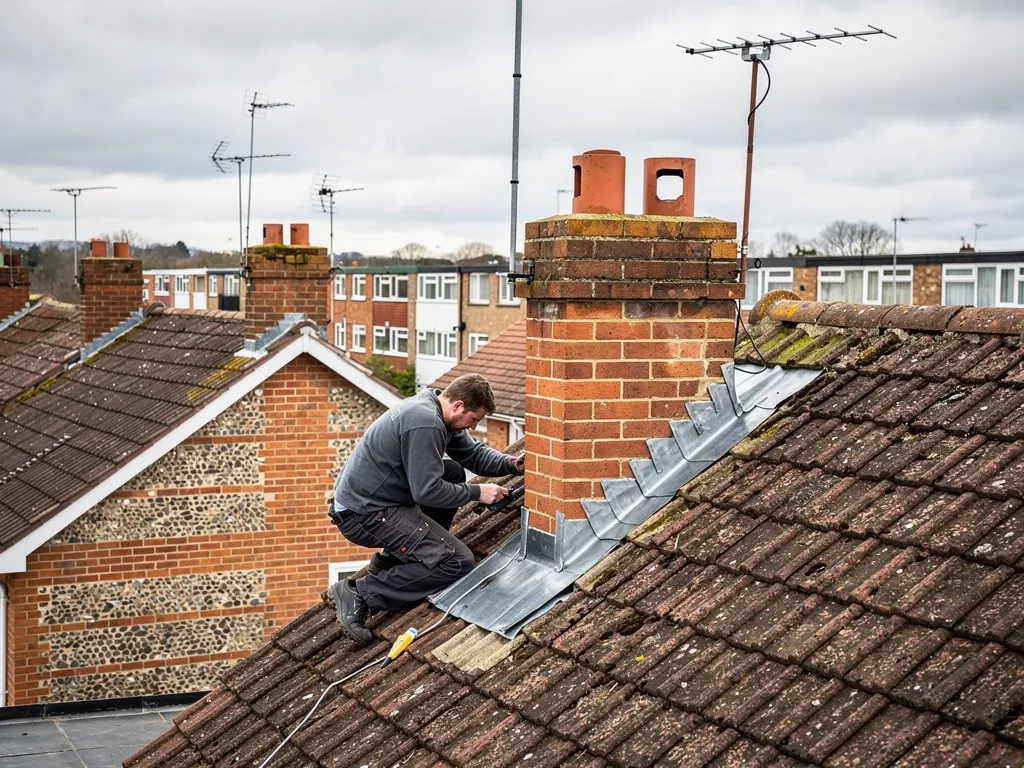
Brick end-of-terrace gable beside a limestone house, slate roofs

Roofers in Corsham

Stone tile repairs, slate re-covers, leadwork, chimneys and flat roofs in Corsham, from the listed buildings along the High Street to the Victorian terraces and the modern estates that have spread beyond the old centre.

Corsham's roofs, High Street to quarry face

Stone-tiled gables on a historic high street
The High Street and the Flemish Weavers Houses

Numbers 94 to 112 High Street, known as the Flemish Weavers Houses, are Grade II* listed, and they are among more than 60 listed buildings on the street. Roofs on a run like this are never an afterthought. Historically, stone tiles covered buildings along this stretch: an appraisal for neighbouring Pickwick says they were everywhere on roofs along the A4 Bath road, with a little thatch, until Welsh slate began arriving around 1790. Tall gables, steep pitches and heavy chimney stacks mean verges, valleys and lead flashings carry much of the detail. Repairs here have to respect what is already on the building, and listed status adds a consent step before any change.

Slate-roofed stone terraces on a town street
Quarry-era terraces and stone houses

Corsham earned its living from Bath stone. The oolitic limestone has been quarried here since at least the seventh century, but production on a large scale only began once the Box Tunnel of 1840 had revealed fine stone, and output peaked in 1901. That wealth shows in the town's streets, where stone walls may carry roofs of slate or tile laid in later years. Victorian stone terraces bring their own repair list: slipped slates, rusted nails, lead gutters between neighbouring roofs, and chimney stacks whose stone has been eaten by weather. Matching a replacement to the existing colour and texture matters a great deal in a stone town.

Modern housing under interlocking concrete tiles
Corsham Court, St Bartholomew's and the newer town

Corsham Court and the Church of St Bartholomew sit at the heart of the old town. The church has twelfth-century origins, is Grade I listed, and was restored by the architect G. E. Street in the late 1870s. Around them the town has grown to some 13,400 people at the 2021 count, with later housing estates, shops, workshops and extensions in every material from concrete tile to single-ply flat roofing. On those newer buildings the faults are practical ones: tiles that have slipped, mortar-only ridges, flat roofs near the end of their life and gutters out of fall. We treat each building on its merits, whatever its age.

Corsham on the Cotswold edge

Map showing Corsham and central Swindon. 25 road miles west-south-west of central Swindon.

Distance
25 road miles west-south-west of central Swindon
Council
Wiltshire Council
Conservation area
Corsham, recorded by Wiltshire Council
Council
Wiltshire Council
Setting
Bath stone quarrying town on the south-western edge of the Cotswolds

Roof questions in the Bath stone town

Do Corsham's listed High Street roofs need consent for repairs?

Matching repairs rarely do, but a change to how a listed roof looks and behaves does. Wiltshire Council can confirm the position for your building before a price is agreed.

Why is there Welsh slate on a Corsham stone house?

Slate reached the area late. Stone tiles were traditional, and slate only began arriving around 1790, so slate on a Corsham house points to a roof laid or renewed after that.

Can you match Bath stone colour on a chimney stack?

We match by tone, grain and weathering, and say plainly when stone has weathered too far to patch. A stack may need partial rebuilding rather than a colour-matched repair.

Q1

What covers the roofs on Corsham's High Street?

Roofers on a slate roof along a limestone village street
Long flat roof on a 1960s brick building being re-covered

The short answer

Stone tiles on the oldest buildings, Welsh slate on many later ones, and tile or modern materials on the newest. A local appraisal says stone tiles were everywhere on the A4 corridor until slate began arriving around 1790, so what is on a given roof often hints at its age.

Reading a Corsham roof is a little like reading a page of local history. The covering suggests when the building went up, or when the roof was last renewed, and that shapes how we approach a repair.

Why were stone tiles so common here?

Stone was on the doorstep, heavy goods were costly to move, and the district had skilled quarrymen and masons already on hand to cut and lay it. A conservation area appraisal for Pickwick, next door, says stone tiles were found everywhere along the A4 Bath road from Calne to the centre of Bath until about 1790. Slate arrived with imports and then with the canal, and the same document says very little reached Corsham until the canal came as far as Lacock. Those are regional statements, but they fit what a roofer sees on older buildings here.

What happens when slate replaced stone?

A roof structure designed for stone is heavy and strong, so it can carry slate easily; the reverse is not true. Slate is lighter, thinner and laid in even courses. Where a historic stone roof has been swapped for slate, the rafters can be more than strong enough, but the look of the street has changed. Our slate roofing page sets out what we check on those roofs.

How can you tell which covering you have?

Stone tiles are thick, uneven and laid so the biggest sit at the eaves. Slate is thin, flat and uniform. Concrete and clay tiles are interlocking or plain, with a regular profile. If you are unsure, a photograph sent by WhatsApp is enough for us to give you a first opinion.

Knowing the covering matters because each one fails in its own way and needs its own repair. A cracked stone tile, a slipped slate and a split concrete tile call for different materials and fixings, and the quote reflects whichever of them your roof actually needs.


Q2

Is re-laying better than renewing a Corsham stone roof?

The answer

Repaired, whenever the stone itself is sound. Traditional guidance says a roof of this kind, looked after, can easily reach 100 years, and the tiles usually outlive their fixings. Stripping, renewing the battens and pegs, and hanging the same stone again in graded courses is normally wiser than buying a new covering.

Stone tile roofs are among the longest-lived coverings in the country. Cotswold District Council's technical guidance of 2000 reckons a well-maintained Cotswold roof can easily last a century. It also notes that the south of that district says stone tile where the north says stone slate, a distinction worth knowing when you read old papers about your own house.

What actually fails first?

The fixings. Traditional stone tiles hang by oak or similar pegs from timber battens. The pegs go soft, the battens decay, and tiles slip while the stone is still good. A leak does not mean the stone has run out of life. A roof can look dreadful and still be a sound candidate for re-laying.

What does a proper re-lay involve?

The slope is stripped, the stone sorted by size, the battens and fixings renewed, and the tiles hung again in graded courses, the biggest at the lowest edge and shrinking steadily as they climb. The guidance warns against substitutes such as concrete tiles on historic buildings and says sandstone and limestone slates should never be mixed. Our Cotswold stone roofing page explains how that works in practice.

What about weight and the roof structure?

Stone roofs are very heavy, at about 1000 kg per 10 square metres, so the timbers beneath were built to take the load. Changing to a lighter covering is possible but alters the building, and a heavier one needs the structure checked. The first step is always a survey that records what is up there, and the photographs go with the written quote. When the roof belongs to a listed building, that record also helps in any talk with the council about what is proposed.

Q3

Who decides on roof work in Corsham's conservation area?

Roofer repointing a stone chimney stack above lead flashing
Roofer dressing stepped lead flashing around a brick chimney

The short answer

Wiltshire Council settles planning matters, listed building and conservation area questions among them, and its building control team, or a registered building control approver, covers notifiable roof work. Many repairs need no application, but changes to a listed roof need consent, and churches follow separate rules.

Corsham is a conservation area, and a long list of its buildings are individually listed. That sounds forbidding, but most everyday roof work still goes ahead without any application, and Wiltshire Council is the body to ask when there is doubt.

What can go ahead without asking?

Fixing a few slipped tiles, renewing a flashing or repointing a ridge is upkeep, provided the roof looks the same afterwards. If the building is unlisted and the work matches what is there, an application is rarely needed. A different material, a new opening or a reshaped chimney is a question for Wiltshire Council before work starts.

What changes for a listed building?

Listed building consent is required for work that touches a listed building's special character, and a roof is part of that. Numbers 94 to 112 High Street are Grade II* listed, and the High Street has more than 60 listed buildings. If yours is one of them, we plan the work around what the council will accept and talk it through with you first.

Where does the church fit?

St Bartholomew's is Anglican, and an Anglican church that is still used for services sits under the ecclesiastical exemption, so alterations go through the faculty system instead. That route differs from a house, and a churchwarden would take advice from the diocese.

And what about a bigger re-roof?

A re-cover affecting less than 25 per cent of the total building envelope and less than 50 per cent of the roof generally needs no building control approval. Exceed either and approval is needed, through Wiltshire Council's building control team or a registered building control approver, and we explain which route applies and look after the notification.

Our view

In a listed Bath stone street, ask first, match everything, and keep what can be saved.

Questions from the Bath stone streets

Why do lead gutters between Corsham's stone terraces cause leaks?

Terraces share roof edges, and a lead-lined gutter between two slopes carries the water from both. Lead cracks where it was folded too tightly or has crept loose, and a small split under slate or stone is easy to miss from below. We trace the stain, lift a section of covering if we must, and photograph the lead before suggesting any repair. Often a gutter can be relined in a section rather than renewed along the whole terrace.

Is repointing a stone chimney in Corsham a job for lime mortar?

On old stone it usually is. A hard cement mortar can trap moisture and speed up the decay of the stone around it, whereas a softer mix lets the wall breathe. We look at the stack from the roof, note how the stone is weathering, and say whether repointing is enough or whether a few stones need replacing.

Do you cover Box, Lacock and the villages around Corsham?

We do. Corsham is inside the 30 road mile circle round Swindon that we work across, and the surrounding villages are within reach as well. The areas page lists every place on our map, and the 10-year workmanship guarantee comes in writing.

Are mortar-bedded ridges on older Corsham roofs still sound?

Some are, but under BS 5534:2014 ridge tiles are no longer entrusted to mortar by itself. A ridge we bed again is held down with clips or screws, or replaced by a tested dry-fix system, so it stays put in strong wind and does not depend on old mortar.

Ask us about your roof

Tell us what’s happening and we’ll call you back.

  • Photos of what we find
  • A written quote
  • 10-year workmanship guarantee

Or call 01793 626096

Call Get a quote