
Think of a terraced roof as a single long structure sliced into house-sized lengths. The slope you see from the street carries on, unbroken or almost, past the party wall and over the next house, and the timbers, the chimney stacks and sometimes the gutters are shared in all but name. When your roof wears out, work on it touches theirs.
Swindon has plenty of terraces to think about: the railway streets, the Victorian rows near the Old Town and the later runs of houses that spread out around them. The roofs differ, but the questions repeat. This guide covers the party wall points, shared chimneys and gutters, how materials reach a roof that has no side passage, and how to match your roof to the neighbours' without copying their problems. It belongs with our roof replacement service.
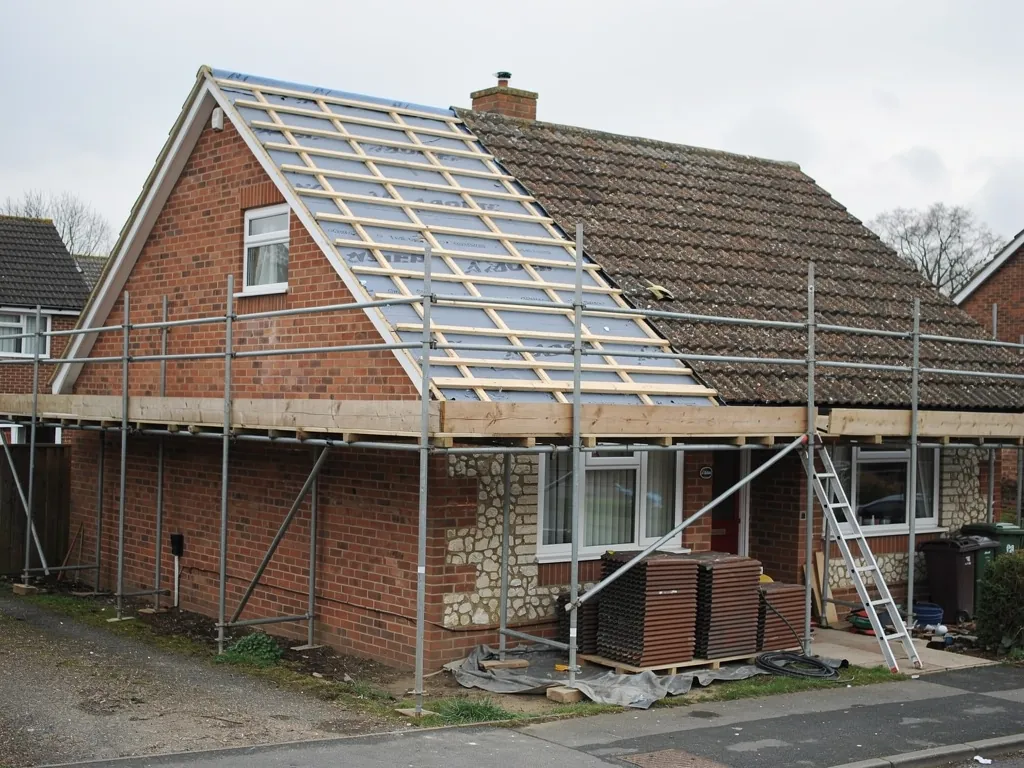
Where your roof ends and theirs begins
On paper, a terraced house is its own property and the party wall marks the boundary. On the roof, nothing so tidy exists. Slates or tiles run unbroken across the line, battens and rafters lie side by side, and the join between two houses is usually a flashing or a coping on top of the wall.
That is why replacing one roof means working right up to a neighbour's. The new covering must stop at a clean edge on the party wall, finished so that water cannot slip under it, and the old roof next door must be left weathertight when yours is stripped. Whoever does the work needs to protect that edge each evening, because the neighbour's loft sits just the other side of it.
Does my neighbour have to agree to my new roof?
Not for the roof covering on your own house. You own it, and re-covering it is your decision. But they are affected, and a conversation before the scaffold goes up is both polite and practical. Dust and noise carry along a terrace, and a neighbour who knows what is coming is a good deal more relaxed when tiles start being lifted.
What if their roof is in worse shape than mine?
That happens often. Your new roof can still be finished properly at the boundary, but it cannot repair the neighbour's side. If we see slipped slates, broken flashings or a bulging gutter next door when we survey, we tell you what we can see from your roof. It is up to the neighbour to decide what to do about it.
Photograph the boundary before work starts, from the street and from the loft. If a question arises later about the condition of the shared edge, you will have the evidence.
Party wall points to know
The Party Wall etc. Act 1996 covers some building work on or near a wall shared between two owners. The government's guide for homeowners lists the kinds of job that need a notice to the neighbour, including cutting into the wall itself, or taking chimneys out of it. A plain re-covering of your own slope does not usually come into that category.
Where it can start to matter is the detail on the wall itself. A new stepped flashing or an abutment that is cut or chased into the party wall is the sort of thing worth checking against the guidance, as is any plan to raise or reshape the wall's top. We discuss this at survey so that it is settled before the quote, not found on the day.
What does a notice actually involve?
The government guide says notice goes to the neighbour at least two months, and no more than a year, before building work begins. The neighbour must tell you in writing within 14 days if they consent, and you cannot assume that silence means agreement. The Act itself provides for an earlier start with the written consent of the adjoining owners and occupiers.
Is this legal advice?
No. It is a pointer to the right questions. If your roof job involves cutting into the wall, or if you are unsure, read the government's party wall guidance and, where needed, take advice from a surveyor with party wall experience. We tell you what we plan to do to the wall so you can judge.
The same applies if the roof job is part of something larger, such as a loft conversion or a chimney breast removal. Our guide to neighbours and a re-roof covers the wider relationship, including noise, access and keeping people informed.
Shared chimneys and stacks
Many terraces have chimney stacks that sit astride the party wall, one flue for each house on either side, so that a single stack serves two properties. Others have stacks at the ridge on the line of the wall, or at the end of the row, with a flue for each room.
Re-roofing around a stack means new flashings and a check of the flaunching, the sloped mortar collar round the pots that throws water off. A shared stack therefore ties the two houses together: a poor repair on one side will drain onto the other. If the stack is to be rebuilt or taken down, that is a larger operation with its own rules. According to the Planning Portal, Building Regulations approval is always required to remove a chimney breast, and the government's party wall guide counts chimney removal from a shared wall as notifiable work.
Should the stack be done at the same time?
Usually yes. Scaffold is up, the roof is open, and flashing work is easier before the covering is finished. A stack that is leaking or crumbling is a poor thing to leave beside a brand new roof. Our page on re-roofing and chimneys sets out the sequence.
What if my neighbour will not pay?
If the stack is shared and both houses benefit, it makes sense for both to contribute, but there is no obligation to agree on that. We can price the work to your half of the stack and finish the flashings so your side is watertight whatever happens next door. A flue no longer in use should be capped with a vent, so rain does not soak into the stack.
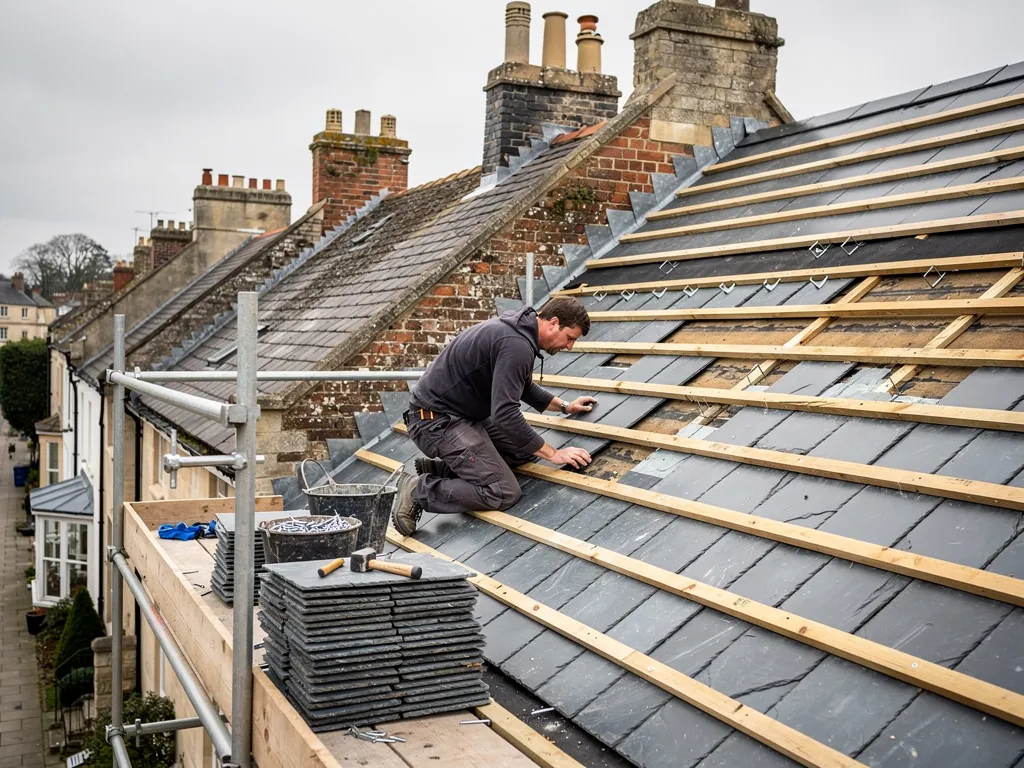
Gutters, valleys and parapets between houses
On some terraces, especially older ones, the roofs are built as a series of parallel pitches with a gutter running between them, or they sit behind a parapet wall with a gutter set behind it. Water from several houses then runs to a common outlet. Our guide to fascias and gutters when you re-roof looks at the ordinary eaves case. The terrace version has added complications.
Who owns a gutter that runs along the party line?
It depends on the deeds and on how the row was built. Neighbours usually settle it practically: whoever spots the problem raises it, and the cost is split fairly. Where the gutter sits entirely on one side, it usually belongs to that house. Where it straddles the wall, it is shared in practice.
What happens to a lead-lined channel when I re-roof?
Lead lining in a parapet or valley gutter often lasts through more than one roof covering, but the junctions to the new slope need relining or at least checking. If the lead has cracked, patched or pulled away, we show you photographs at survey. A temporary fix that works for the old roof may not suit the new one.
Can I change the gutters to modern ones?
Only if the building allows it. On a terrace in a protected area, the gutter type can be part of the street's character, and our page on re-roofing in a conservation area covers when the council expects like-for-like. In an unprotected row the choice is yours, though a mismatch with the neighbours will show.
Where gutters are shared, tell the neighbours when the water will be disconnected. A day with the downpipe off during heavy rain is not welcome next door.
Getting materials in when there is no side passage
Many terraced houses have no side access at all. Everything goes through the front door or over the wall from a back lane, and tiles are heavy. Marley lists its concrete plain tile at about 74 kg per square metre once laid, so a whole roof is a lot of pallets.
The usual answers are a tile hoist or elevator from the street, a lorry-mounted crane that lifts packs straight onto the scaffold, or carrying through the house on protected floors. Each has a cost and a risk. A hoist on the pavement needs the highway licence we discuss in our scaffolding guide. A crane needs a clear spot for the lorry. Carrying through takes time and needs sheeting down the hall.
Where does the waste go?
Old slate, battens and felt come off the roof and need a skip or a grab lorry. On a street with no driveway, that means parking outside, with permission if the skip stands on the road. Our guide to waste when you re-roof covers disposal. We take the waste away and leave the site clean.
Can the back of the roof be reached from the lane?
Often. Where a back lane runs behind the row, a lorry can sometimes get closer to the rear scaffold than to the front. The survey records which side has better access, so the order of work can follow it.
For long terraces, parking is another puzzle. Give your neighbours a day's notice of lorry deliveries so cars are not blocking the pavement.
Matching the neighbours without copying their roofs
A terrace is read as a whole. A new roof in a different colour or a different tile profile on one house in a row stands out from the street, and it may attract comment even when no rule has been broken. In a conservation area the question is formal; elsewhere it is a matter of taste and of what the neighbours will tolerate.
Matching means looking at the right things. Ridge height and line should continue along the terrace, so the new roof is not higher or lower than the next. The size of the slates or tiles, the colour, the verge finish and the eaves overhang all contribute. Swindon has railway terraces where the council's own appraisal records slate roofs in the Railway Village, and for houses there we apply the like-for-like approach in our conservation page. Elsewhere, the choice is wider.
What if the neighbours still have old roofs?
The new roof will look sharper for a time, and that is fine. Natural slate weathers; concrete tile fades more slowly. Pick the covering that suits your house, not one that attempts to disguise it.
Should I fit solar panels at the same time?
If you have a roof slope that suits them, a re-roof is a good moment to decide. Panels on a terrace affect the street view and may touch the neighbours' light, so our page on re-roofing with solar shows how to plan it.
Can the neighbours join in and share costs?
It is possible. A shared scaffold can serve two or three houses, and the time on site may be shorter. Each house still needs its own survey and quote, and the sums depend on timing. If you want to explore it, tell us before you settle on dates. Our guide on what a new roof costs sets out what drives the price, and the best season is covered in when to re-roof.