
Nobody can honestly price a roof they have not seen, and the cost guides that try disagree with each other by thousands of pounds. They are still worth reading, because the gaps between them point at the questions that matter: how large the roof is, whether it is a plain gable or a hip with four slopes, how awkward the scaffold will be, and what goes back on top once the old covering is stripped.
This page sets out the two national ranges we rely on, MyBuilder and Checkatrade, shows how scaffold, waste and VAT sit around them, and then looks at what pushes a price up or down on a Swindon terrace, semi-detached or detached house. Treat every figure as a typical national number from a third party, not a price from us. Our own figure comes only with the survey, in writing. If you are still weighing up whether the roof needs replacing at all, start with our guide to repairing or replacing a roof.
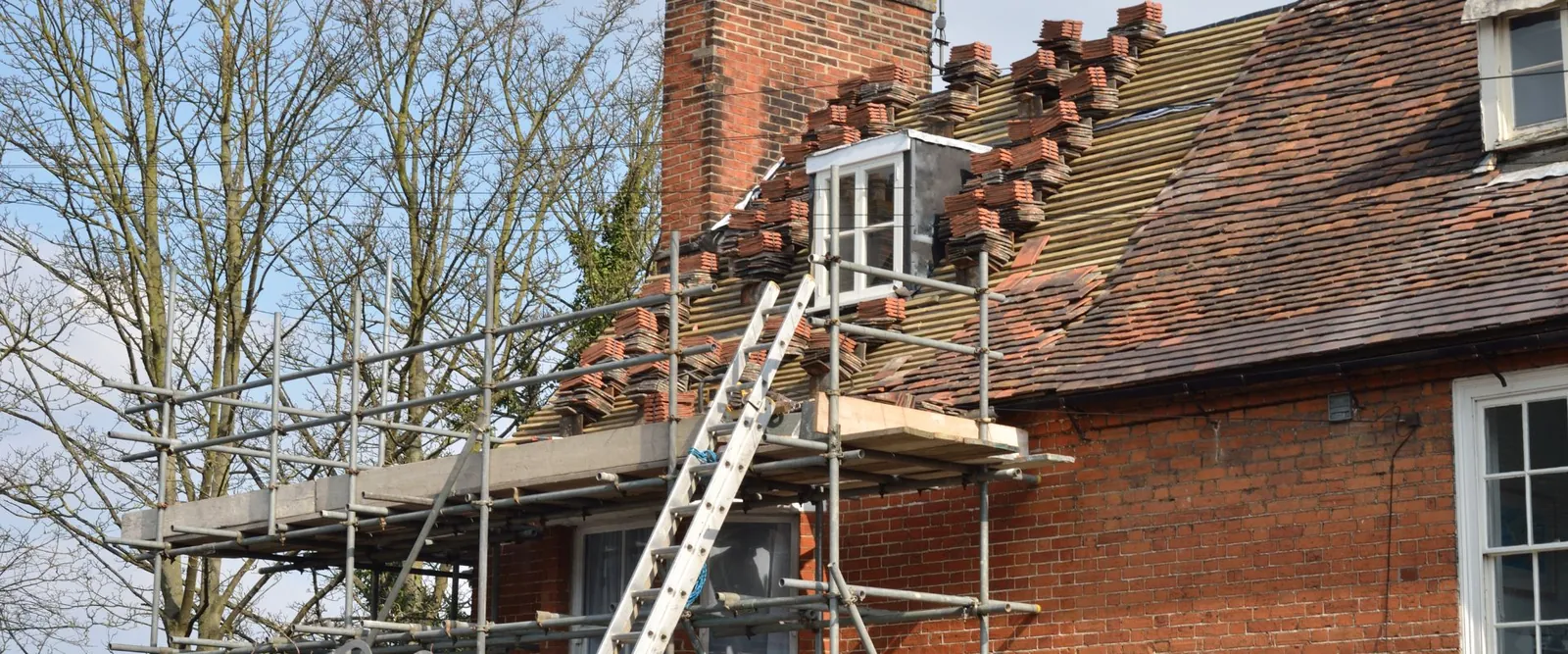
What the published national ranges say
MyBuilder's new roof guide, updated on 21 August 2026, says roof replacements typically cost £5,000 to £12,000. Its worked examples cover a semi-detached house whose roof measures 50 to 80 m², and it gives £5,000 to £8,000 for a gable roof, £8,000 to £12,000 for a hipped roof, £2,500 to £6,000 for a flat roof and £3,000 to £5,500 for a lean-to.
Checkatrade's roof replacement guide, updated in October 2026, is wider. It puts the UK average at around £8,000 and says most jobs fall between £4,000 and £19,000. Its tables are based on 64 m² for a hip or gable roof and 32 m² for a flat one, and the figures exclude VAT.
| Roof type | MyBuilder (semi-detached, 50 to 80 m²) | Checkatrade (excluding VAT) |
|---|---|---|
| Gable | £5,000 to £8,000 | £7,000 to £16,250, or £110 to £260 per m² |
| Hip | £8,000 to £12,000 | £9,250 to £18,000, or £145 to £285 per m² |
| Flat | £2,500 to £6,000 | £2,800 to £7,500, or £45 to £120 per m² |
The two guides do not line up, and they are not meant to. Different sample sizes, different assumed coverings and a VAT difference all sit inside those numbers. Read them as a corridor, not a target.
Why a hip costs more than a gable
A gable roof has two slopes and a vertical triangle of brickwork at each end. A hipped roof falls away on every side, so a hip line runs from the ridge down to each corner of the house. Both guides price the hip higher, and the reasons are mechanical rather than mysterious.
Each hip is a sloping join where two planes meet, and every tile or slate along it has to be cut to the angle. The hip itself is capped with its own run of hip tiles, which is more material and more labour than a plain gable verge. More cutting also means more waste, because offcuts from an angle cut rarely suit the next course.
What is a hip, and what is a verge?
The hip is the sloping outside corner where two slopes of a hipped roof meet. The verge is the finished edge along a gable end, where the covering stops at the brickwork or an overhanging barge board. Both need a firm finish, and since the 2014 revision of BS 5534 hip and verge tiles get clips or screws in addition to any mortar bed.
Does a bigger roof always cost proportionally more?
Not exactly. Checkatrade's per square metre figures are a guide to scale, but the first metres of a job carry set-up effort that a larger roof spreads more thinly. A small hip roof can end up costing more per square metre than a long, plain gable, because the cutting and the number of junctions do not shrink in step with the area.
Scaffold, waste and VAT around the roof
Some of the largest differences between quotes come from what sits around the roof rather than the roof itself. MyBuilder gives scaffolding for a re-roof as approximately £1,125, and its separate scaffolding guide says around £850 to £1,200 for a standard two-storey house. Checkatrade gives scaffold at £700 to £1,300. Those numbers describe a typical house nationally, and a long terrace, a corner plot or a house with a conservatory in the way can sit above them.
Disposal is the other large item. MyBuilder puts disposal at £100 to £1,000, which is a wide spread because it depends on how much old covering and timber comes off and how heavy it is. A roof with several layers of old felt or a heavy concrete covering produces a lot more weight to carry away than a light, single layer of slate.
Before you set two prices side by side, find out whether each carries VAT and whether each covers the scaffold. A figure that leaves both out can look a thousand pounds or more cheaper than it really is.
Checkatrade states that its roof replacement figures exclude VAT, so a quote that adds VAT will land noticeably higher than the headline range. Labour rates matter too. MyBuilder cites labour at £50 to £130 per m² and a roofer's day rate of £250 to £300, which shows why a job that runs a day or two over, because of weather or a surprise under the old covering, moves the total.
After the visit our contractor puts the figure in writing as a single total, with a note of what that total takes in. Clearing the site and taking the waste away is part of every job, and the survey shows us beforehand roughly how much old material is coming off.
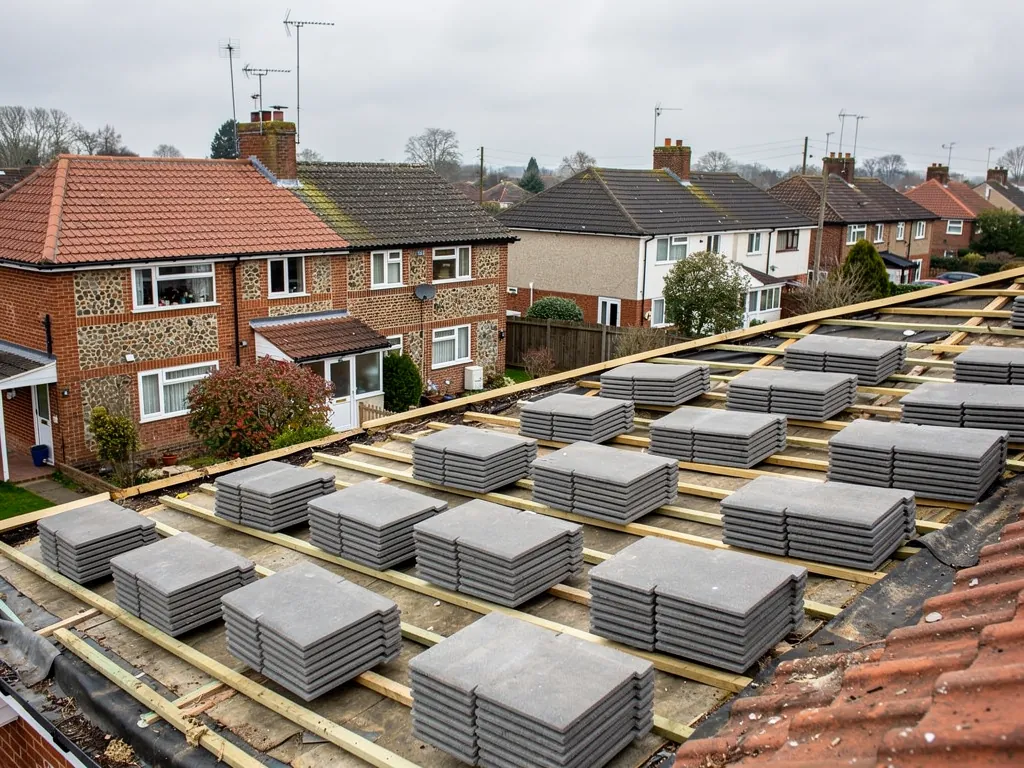
Terrace, semi or detached: what moves a Swindon price
House type matters less for the covering than for the way the roof has to be reached and finished. The same tile costs the same on every street. What changes is everything around it.
What changes on a terrace?
A terraced house has a narrow frontage, party walls on both sides and, often, a roof that carries on unbroken along the row. That keeps the area modest, which helps, but reaching it is the difficulty. Scaffold has to run along the front and sometimes the back, a rear lane or narrow yard may stop deliveries, and the party wall flashings against the neighbouring house need renewing at the same time. Where a terrace has a rear outrigger, the narrow wing built out behind the main house, that wing adds a valley and an extra run of leadwork to the job.
What changes on a semi-detached or a detached house?
A semi-detached house has one party wall and open sides, so scaffold goes up more easily, but the area of roof is generally larger than a terrace's, and some semis have a hipped end that adds cutting. A detached house has the most open access and the most roof. It also tends to have the most features: a chimney or two, a garage roof running into the main slope, a porch, a bay. Every junction is a piece of lead, a flashing and a detail to get right, and they add up even where the bare slopes are simple.
Height counts as well. A tall three-storey house needs more scaffold lifts than a bungalow. A chimney stack in the middle of a slope means working around it, not simply past it, and our page on re-roofing around a chimney shows what that involves.
How the covering and what lies underneath it change the total
The covering is the choice most people expect to drive the price, and it does, though less than the hidden work. MyBuilder's slate guide gives natural slate at £100 to £180 per m² installed, with Spanish at £100 to £130, Welsh at £140 to £180 and reclaimed at £110 to £150. Concrete and clay tiles have their own bands in the same guides, and the Checkatrade table above already folds an assumed covering into its range.
Underneath the covering sit the parts a quote cannot know until the old roof is off: the battens, the underlay and the rafters. If battens are rotten or rafters have decayed at the eaves, they need replacing before anything new goes on. Underlay is the waterproof membrane beneath the covering, and many older Swindon roofs have felt that has perished or none at all. Fitting new battens and a breathable membrane is a normal part of a proper re-roof rather than an extra, but badly decayed timber is the kind of discovery that can change the total.
It also helps to think about the price per year of use. MyBuilder's slate guide describes a well-installed slate roof lasting 80 to 100 years or more, while concrete tiles are often put at 30 to 60 years depending on the source. Treat such figures as typical spreads and never as promises, because exposure, workmanship and upkeep all move them. A covering that costs more on day one may still be the cheaper roof over decades, provided the battens, fixings and flashings around it are done properly too.
What if I want solar panels on the new roof?
Adding panels while the roof is open can save a second round of scaffold, and the order of work matters. Our guide to re-roofing with solar panels covers the sequence.
Does insulation add to the price?
It can. If more than a certain share of the roof is renovated, Part L of the Building Regulations can require the roof to be upgraded for thermal performance, which affects the build-up. Our page on re-roofing and the Building Regulations sets out when that applies.
Reading a quote when the prices differ
When two quotes for the same house differ by a few thousand pounds, the roof is rarely the reason. Look first at what each one assumes. Is scaffold included? Is VAT? Does the quote cover new battens and underlay, or only the covering? Is the chimney flashing renewed, and are the ridge and hip tiles fixed mechanically? Does it say who removes the old material?
When the written quote arrives with pictures from the survey, you can ask those questions about specifics. The pictures show the battens, flashings and ridge as the surveyor found them, and the total ties back to what they show. Where a repair would cure the fault, the paperwork says that plainly rather than steering you towards a bigger job.
What does the guarantee cover?
Ten years on workmanship, in writing. It speaks to how the roof was fitted, and no insurer stands behind it. Material warranties come from the manufacturer and are a separate matter.
Should I book in winter to get a better price?
Seasonality can affect lead times more than prices, and our page on the best time of year to replace a roof sets out the trade-offs. If the loft is empty and you plan to convert later, our guide to a new roof over an empty loft explains what to do while the roof is open.
The overall roof replacement page covers the whole job from survey to clear-up.