
Most people think about their roof and their insurer at the same moment: after a storm, with a stain spreading across a bedroom ceiling. That is the worst time to discover that nobody has written down what the roof looked like beforehand. Insurers and the Financial Ombudsman Service both ask a version of the same question, whether the damage came from a storm or from a roof that was already worn, and a record made before the event is the easiest way to show what state it was in.
This guide explains what a roof report for insurance purposes should contain, when to get one, and where its usefulness stops. Only your insurer can say what it will decide. What we can do is describe what is on the roof, in writing and in photographs, so you have something firm to point to. For how the survey itself works, see our guide to what a roof survey covers, or browse the wider roof inspections and surveys section.
Why insurers look at the condition of the roof
Home insurance is written to cover sudden, accidental damage, not the gradual ageing of a building. Many policies exclude gradual deterioration, and the Financial Ombudsman Service points out that an insurer leaning on an exclusion has to show that it applies. That puts the condition of your roof at the centre of any storm claim. If a gale strips a dozen tiles from a sound roof, that looks like storm damage. If it blows tiles off a roof whose fixings had already rusted through, an insurer may say the roof would have failed anyway.
The Ombudsman sets out the questions it asks in these cases. Did a storm actually occur on the day the damage appeared? Is the damage typical of storm damage? Was the weather the main cause, or might the damage have happened regardless? A complaint from someone whose roof was already in bad shape, and who knew it, rarely gets far, nor does one where a gale merely exposed an old defect.
Which? reported in November 2025 that insurers often lean on the industry definition of a storm, which includes gusts of at least 55mph, and that a standard policy may not pay out where water enters through a poorly maintained roof. Nothing here means a claim will fail. It does show why the roof's history matters, and why a record of its condition is worth having.
What a useful roof report contains
A report is only as useful as its detail. The most important element is a date: a document that says when the roof was inspected and by whom. After that comes a description of the roof itself, covering the type of covering (clay, concrete, natural slate, or felt and single-ply on any flat section), its approximate age if it can be judged, and the number and layout of the slopes.
Next are the findings, and each should be tied to a photograph. A good report records the sound areas as well as the defects, because showing that the ridge, the valleys and the main slopes were in good order on a given day is what makes a later storm claim easier to understand. Loose or cracked tiles, rusted nail heads, lifted flashings, moss build-up and blocked gutters are all noted with their position on the roof.
Lastly there is a short statement of condition and any recommended work, written in plain English. The report should not be a sales document. It should say what the surveyor saw, what it means and what, if anything, needs attention. Our guide to roof condition reports sets out the format in more detail.
How a recorded condition helps with wear-and-tear arguments
When an insurer disputes a claim on wear-and-tear grounds, the argument comes down to evidence. A homeowner who can only say the roof was fine has a recollection. A homeowner with a report from six months before the storm has a dated description and photographs of the same slope, and that is a different thing to put in front of a loss adjuster or, if it ever goes that far, the Ombudsman.
The report helps in two directions. If it shows a sound roof that was then damaged, it supports the case that the storm was the cause. If it flags existing defects, it still has a use, because it gives you a reason to fix them before they get worse and makes it clear which damage is old and which is new. Many people prefer to know the answer in advance than to find out during a claim.
A report does not decide a claim. The insurer does, applying the policy wording to the facts, and the report is one piece of evidence among others.
It also helps to separate two ideas that often get tangled. Age is not the same as neglect. A forty-year-old roof with a record of upkeep and a clean bill on the day it was checked is in a very different position from a younger one with moss in the valleys, cracked flashings and gutters that have not been cleared in years. A report that records upkeep, such as a gutter clean or a repaired ridge, shows a roof that has been cared for, and that matters when the question is whether a problem was foreseeable.
Photographs you take yourself have a place too. A clear shot of the roof from the garden every year or so, saved with the date, costs nothing and builds a useful timeline. A surveyor's close-up images add detail you cannot get from the ground.

When to commission one
There is no rule on timing, but a few moments make a report more useful than at other times. The first is before a winter when you are worried about an older roof, so that its condition is written down while it is still unaffected by anything dramatic. The second is when you have just bought a house and want a baseline, a point covered in our guide to a mortgage roof report. The third is when you renew a policy and the insurer asks about the roof, and it helps to answer from a document instead of from memory.
A report is also worth having before a major repair, since it records the state of the roof before work begins, and after one, since it confirms what has been done. If you are replacing the roof, the survey before a re-roof does that job and doubles as the starting record for the new covering.
Should I get a report after storm damage?
Yes, but that is a different job. After a storm the priority is a roof that is secure and no longer taking in water. Tell your insurer promptly. Advice from the Association of British Insurers during Storm Eunice in 2022 was to get in touch quickly, to check with the insurer before arranging emergency repairs that stop things worsening, and to keep every receipt. If your roof is leaking, we make it safe first, then photograph what we find so that you have pictures to hand on.
What a report cannot do
It cannot guarantee a payout. Insurers decide claims on the policy wording, the circumstances and their own assessment, and a report does not bind them. Which? quoted Financial Conduct Authority figures: only 32% of storm-related claims made in 2024 ended in a payout. The reasons vary, from policy wording to cover to evidence, but it shows why nobody should treat a claim as certain.
It cannot flatter a roof. A careful surveyor will not stretch a description to help you. Insurers read many reports and quickly spot one that has been written to please. A plain, cautious record, with the doubtful areas marked as doubtful, carries more weight than a glowing one.
Nor can it turn old damage into new. If the roof had a long-standing defect at the time of the survey, the report will say so, and that is precisely what an honest record should do. It also cannot predict the future. A roof that was in good order in March can still be damaged in a storm in November, and the report will then support the case that the damage was recent and not that the roof was neglected.
It does not replace advice from your insurer, your broker or the Ombudsman. If a claim is declined and you disagree, complain to the insurer first. The Financial Ombudsman Service says you can take the matter to it if you receive no final response within eight weeks or are unhappy with the one you get. The Ombudsman's storm damage guidance explains how it looks at these complaints.
What the survey for a report involves
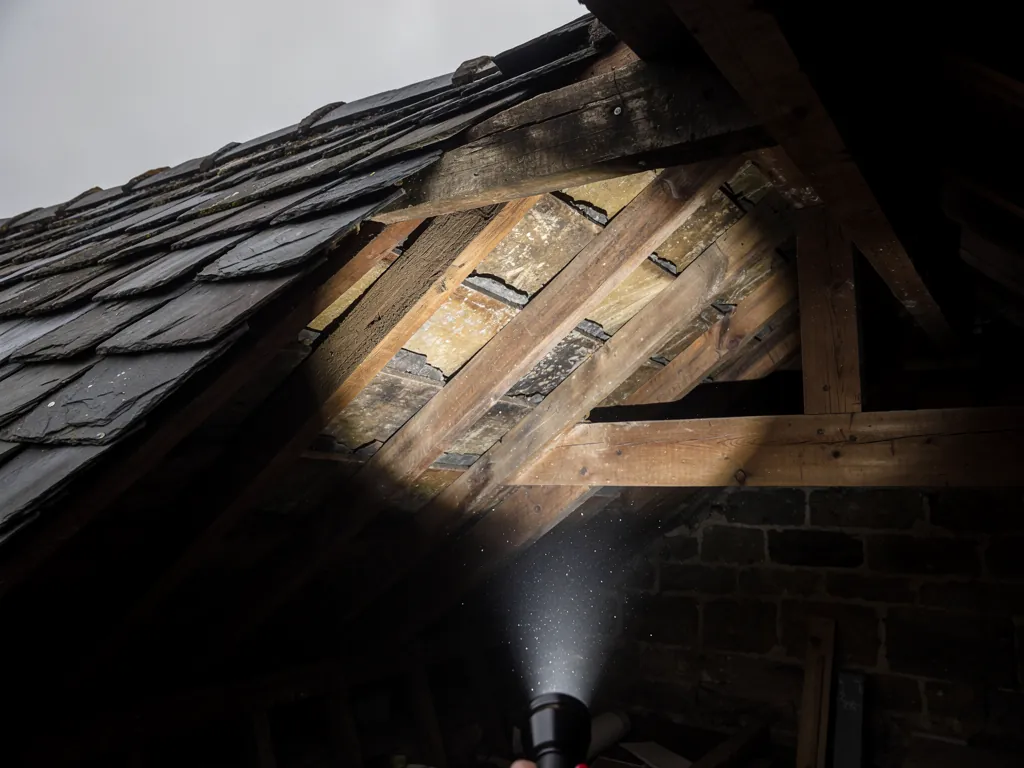
The visit follows the same pattern as any thorough roof inspection. We begin at ground level, then move closer wherever it is safe, using a ladder or a pole-mounted camera if that helps. We check the covering, ridge and hips, valleys, chimneys, flashings, gutters and, where it is accessible, the loft for signs of water, daylight and condition of the timbers and underlay. Our guide to roof inspection methods shows how those techniques differ.
Each finding is photographed, and the photographs sit alongside the written notes. The written quote for any recommended work follows the survey; the report itself is a statement of condition and does not commit you to anything. We suggest the smallest job that properly fixes a fault, and where a roof needs nothing, the report says that, because a clean record is also worth having.
Cost follows the roof's size, its complexity and the type of survey. MyBuilder's roof inspection guide, updated on 21 August 2026, gives typical UK prices of £150 to £500 overall, with a standard inspection at £150 to £250. Our page on roof survey cost explains what moves the figure. Those are national typical ranges and not a price from us.
Ask for the photographs as separate image files as well as inside the report. Insurers sometimes want to enlarge a picture or check its date, and a file that carries its original time stamp is easier to rely on than a screenshot of a page. Ask, too, that every image says which slope or elevation it shows, so a reader who has never seen your house can follow where each defect sits.
Keep the report somewhere safe, with the photographs, in more than one place. A copy on your phone, one in an email account and a paper copy with the house papers will do. Updating it every few years, or after major work, keeps the record current and gives you a series of dated snapshots over time.