
Cost is the first question about a flat roof and the hardest to answer in a sentence. A garage roof and a large kitchen extension are different jobs; a roof on sound joists and one on rotten decking are different jobs again. What the published cost guides do give is a spread, which is a useful way to check that a quote is in the right area before you read the detail.
This guide sets out the ranges from MyBuilder and Checkatrade, both dated, for the main flat roof coverings. It then explains what changes a price on a Swindon house: the deck, the insulation, access, the waste and the scaffolding. None of the figures below are Skyline prices. To see how the materials compare on life and looks, read the modern flat roof options guide, and the flat roofing page explains how we survey.
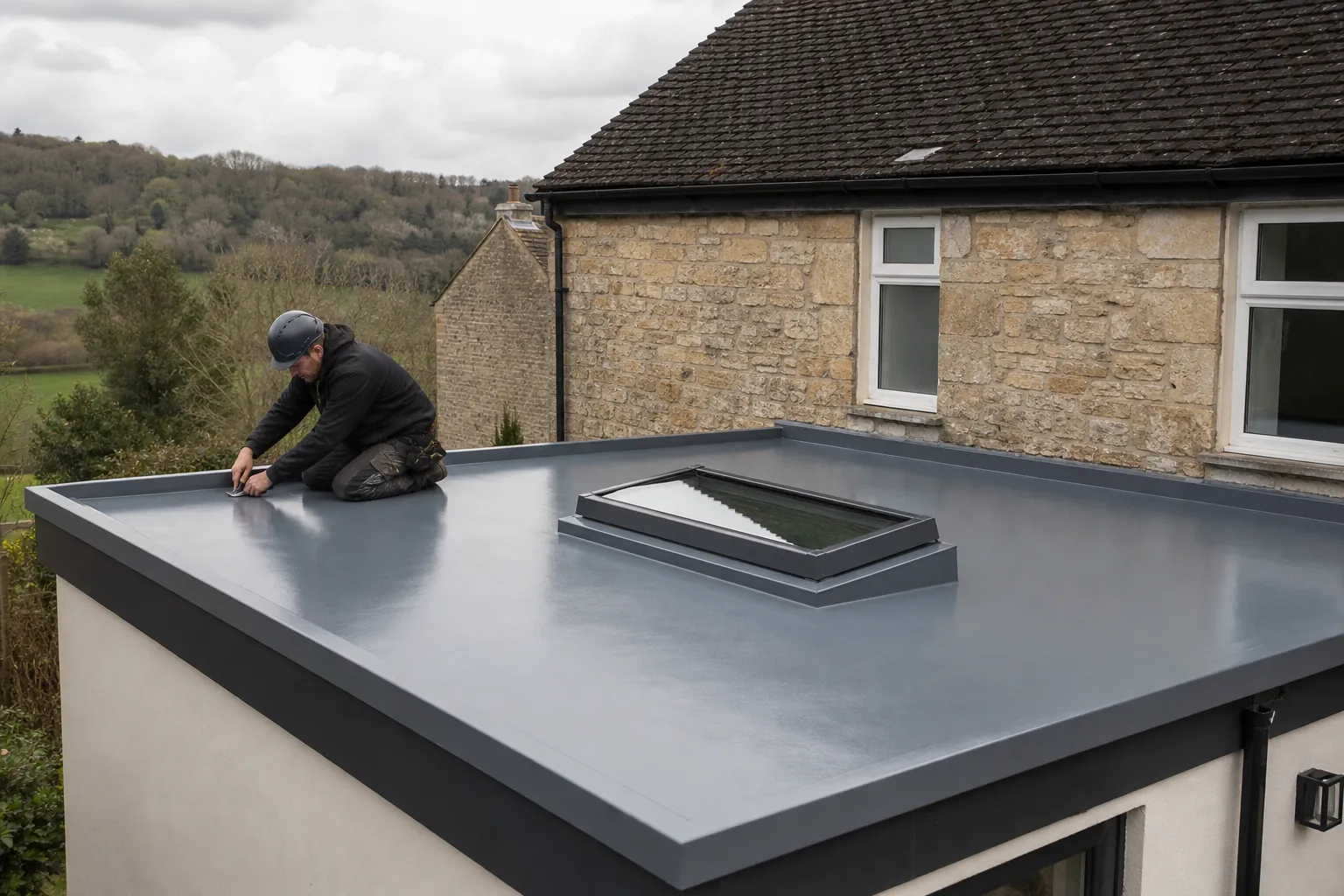
The headline range for a whole flat roof
MyBuilder's flat roof cost guide, updated on 21 August 2026, says replacing a flat roof typically costs between £2,800 and £7,500. It gives an average of £75 per m², although elsewhere on the same page the range is stated as £45 to £100 per square metre. MyBuilder's new roof guide, updated the same day, gives £2,500 to £6,000 for a flat roof of 50 to 80 m² on a semi.
Checkatrade's roof replacement guide, table dated October 2026, lands in the same place. It shows flat roof replacement at £2,800 to £7,500, or £45 to £120 per m², all plus VAT, and its worked example assumes a 32 m² flat roof. When two independent guides give the same total range, the range is probably a fair map of the market, even though neither tells you where your roof will fall in it.
Why is the range so wide?
Because the lowest figure is a small, simple roof on a sound deck with easy access, and the dearest is a big roof with new decking, thick insulation and a scaffold. The next section breaks down by material, and the later ones by what changes within a material.
Should I judge a quote by the per-m² number alone?
It is a useful sense-check, but only if the roof is measured the same way. Ask how many square metres the quote assumes and what the price covers.
Cost per m² by covering
MyBuilder's flat roof guide gives per-m² figures for each covering. They are typical UK figures from one published guide, dated 21 August 2026, and not a price list.
| Covering | MyBuilder range per m² | Typical life (source) |
|---|---|---|
| Bitumen felt | £70 to £100 | 10 to 20 years (Less) |
| EPDM rubber | £90 to £130 | 20 to 30 years or more (GreenSpec, Less) |
| GRP fibreglass | £95 to £150 | 25 to 40 years (Less) |
| PVC single-ply | £95 to £140 | 20 to 30 years or more (GreenSpec, single-ply) |
| Lead | £150 to £200 and above | 50 to 100 years (Less) |
MyBuilder also says a flat roof typically lasts 15 to 30 years, which sits across the felt, rubber and fibreglass figures. A longer lifespan costs more up front, so a fair comparison divides price by years, provided the roof is built and looked after properly.
Why is lead so much dearer?
It is a heavier, slower material to work, and it is chosen for specific jobs such as bay roofs and heritage buildings. Our lead flat roofs guide explains where it earns the price.
Is there a cheaper option that still works?
Felt is the usual answer on price, and a good felt job can run to 20 years, while a poor one can fail in under 10 according to Less. Layer count and workmanship matter more than the label; see how many layers of felt a flat roof should have.
What a garage or a small extension costs
Small roofs have a different arithmetic, because a fixed cost such as a skip, a day's travel and setting up access spreads across fewer square metres. MyBuilder's garage roof guide, updated 21 August 2026, gives £700 to £1,000 for a single flat garage roof and £900 to £1,400 for a double. Per m² it quotes £75 for felt, £125 for GRP and £70 to £100 for EPDM. Checkatrade suggests around £1,000 to £2,000 for re-felting a garage, averaging £1,500.
For a typical kitchen extension, the semi-detached figures from MyBuilder's new roof guide are the better guide: £2,500 to £6,000 for a 50 to 80 m² flat roof. A single-storey side return or rear extension is usually much smaller than that, so fixed costs weigh heavily and the per-m² figure alone can mislead.
Does a very small roof cost proportionally more?
Usually, yes. The skip, the access and the time to set up do not shrink with the roof. Our repair or replace guide can help you decide if a patch would be better spend on a tiny roof.

How the deck changes the price
The deck is the structural board that carries the waterproof layer, usually plywood or oriented strand board over timber joists. It cannot be seen from the ground, and it is the single biggest source of variation between a quote and the final bill on a typical strip-and-replace. If the old covering has leaked for years, the boards beneath may be soft or stained and have to be replaced. If they are dry and sound, the new covering can go on the existing deck.
A surveyor or roofer who has lifted a corner of the old felt can tell you which case you are in. We take photographs of the deck during the survey where we can reach it, and the written quote follows. If the deck is in poorer shape than the survey could reveal, you see photographs and agree before anything extra is done.
Can a spongy roof be fixed with a new covering over the top?
No. A soft deck is wet or rotten, and covering it just traps the problem. Our answer on why a flat roof feels spongy explains the signs.
Does the structure ever need work?
Occasionally. Joists that have rotted at the ends, a sagging span or a deck with no fall at all can mean new timbers, and that changes the price a good deal. It is also the point where the fall question comes in: see the guide to flat roof drainage for how falls are built in.
Insulation: the part many people forget to price
A new flat roof is the best chance you will get to insulate it properly, and for many replacements the regulations expect it. Approved Document L counts a new waterproof layer as renovation of a thermal element, and past its thresholds the roof should reach a U-value of 0.16 W/(m²K). Our guide to flat roofs and Building Regulations sets out the thresholds.
Insulation adds material and labour. It also changes the height of the finished roof, which can affect upstands, door thresholds and the flashing at the wall. The usual route puts the insulation above the deck, and the warm and cold roof guide explains why. What it adds depends on the thickness the U-value requires and the product chosen, so the survey settles it and the written quote carries the result.
Can I skip insulation to save money?
Not if the job falls within the thermal upgrade rule, and not wisely if it does not. A roof that is renewed without insulation is hard to improve later without stripping it again. Ask every contractor how their price handles this.
Access, scaffolding and what is taken away
Working at height needs safe access, and a flat roof over a single-storey extension sometimes needs less scaffolding than a pitched house roof, though not always. MyBuilder's scaffolding guide, updated 21 August 2026, gives about £850 to £1,200 for the scaffold on a standard two-storey house. Checkatrade, in its roof replacement guide, gives £700 to £1,300 for scaffold on a replacement. A flat roof on a single storey may need a smaller structure or a simple tower, which is why it is worth asking.
Waste is the other part. MyBuilder's new roof guide puts disposal at £100 to £1,000, depending on how much material there is and whether the old covering and deck are heavy. A one-layer felt roof on a small garage sits near the lower end. A thick built-up roof with a concrete screed sits near the upper end. Asbestos cement sheeting is its own category with its own rules and costs.
Does a tight site cost more?
It can. A flat roof behind a terrace with no side passage means materials carried through the house or lifted by hand, and that adds time. We note the route and the access when we survey, and the quote reflects it.
Comparing two totals means asking if each covers VAT and scaffolding. Many published prices leave VAT out.
Cost across the years, not just on day one
The lowest price per square metre does not always give the lowest cost over the years. Using the ranges above, felt at £70 to £100 per m² and 10 to 20 years of life against GRP at £95 to £150 per m² and 25 to 40 years gives a close fight on cost per year, and the real answer depends on how the details are built. A felt roof with three layers and well-formed upstands outlasts a thin one with the same price per square metre.
Repair costs also count. Checkatrade's repair guide, updated October 2026, gives per-m² repair figures of £100 to £140 for bitumen flat roofs, £120 to £170 for EPDM and £130 to £180 for GRP, all excluding VAT and access equipment. Repairs that keep recurring on the same patch are a sign that the roof is ending its life, and it is on that point that the repair or replace guide is most use.
How do I know the quote is fair?
Look at the plan more than the number. A fair quote says what the old roof is made of, what the new one will be, how the falls and upstands are formed, what happens to the waste and what the guarantee is. A written guarantee of ten years covers our workmanship, and the price we give is good and fair for the work described.
For repairs to a roof already leaking, the sequence is make it safe first, then decide on repair or replacement from the survey, with photographs. That is how we keep the job to the smallest scope that properly fixes the fault.