
A damp patch on a ceiling puts most people in the same position: they want the lowest sensible outlay, and they are wary of paying for a repair that only buys a few months. Both instincts are fair. A small split in a sound roof is a quick job, and a new roof laid over a rotten deck is wasted money.
What separates the two cases is rarely the stain itself. It is the age of the covering, the state of the boards and insulation beneath it, how widespread the damage is and what the repairs to date have cost. Those four things decide whether a patch is good value or just a delay. This guide takes them one at a time, with the typical prices published by national cost guides, so you can see the shape of the decision before anyone visits. For the full picture of what we do on these roofs, see our flat roofing page.
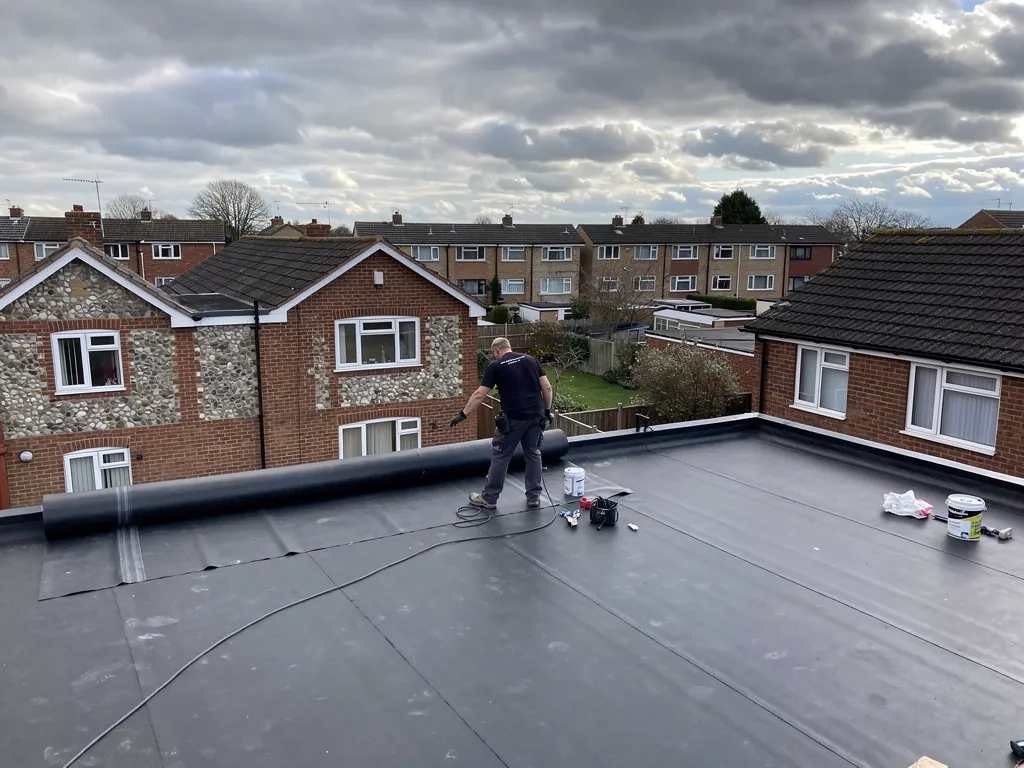
Age is a clue, not a verdict
MyBuilder's flat roof guide, updated on 21/08/2026, says a flat roof typically lasts 15 to 30 years. By material, Less gives torch-on felt 10 to 20 years, GRP 25 to 40 years, and EPDM a longer span still, with GreenSpec quoting 20 to 30 years. These are typical ranges and never promises, and they spread widely because workmanship, drainage and upkeep vary so much.
So a felt roof in its late teens is entering the zone where failure is likely, while a GRP roof of the same age is probably mid-life. A roof within or beyond its typical span does not need replacing on that basis alone. Plenty of older roofs are sound because they were laid well and kept clear. But age raises the odds that the covering has hardened, cracked or lost its protective surface, and it sharpens every other question in this guide.
What the age of a roof does tell you is how to read its history. A fault on a roof ten years old is probably a defect in one detail. A fault on a roof thirty years old is more likely a sign of wear across the whole surface.
Do I know what my roof is made of?
Often not, because the previous owner did the extension. Black and bitumen-looking with a gritty finish usually means felt. A smooth, matt rubber sheet is EPDM. A hard, glossy, fibreglass-looking skin is GRP. Send us a photograph and we can usually tell, and our survey confirms it.
The deck decides more than the covering
Under the visible covering sit the deck, usually plywood or OSB boards on older roofs and timber boards on very old ones, and often a layer of insulation. If those are dry and sound, a repair or a re-covering has something solid to work on. If they are wet or rotten, nothing laid on top will last.
Wet decks give themselves away. The roof feels spongy underfoot, boards flex in places, ceilings below show brown rings that keep returning, or a timber smell hangs in the room below. On an old felt roof you may see a hollow, bouncing blister that spreads when pressed. Water that has been getting in for a year or two will have soaked the deck. Plywood delaminates when wet, and chipboard swells and loses strength quickly.
This is where a repair stops making sense. A patch on the covering does not dry the boards beneath, and trapped moisture carries on rotting them. The deck then has to be replaced, which is almost always the moment to renew the whole covering as well, because the deck cannot be reached without lifting it.
A wet or rotten deck is the single most common reason a repair turns into a replacement. We lift a small test area at the survey where we need to, rather than guess from the top.
How far the failure has spread
Look at the pattern of damage rather than just the leak. Localised faults suit repair: one split along a seam, a lifted corner, a cracked upstand, a failed outlet collar. These are single points where something has given way and the surrounding roof is healthy.
Widespread faults point the other way: blisters across the roof, a surface that crazes when flexed, felt that has gone brittle and cracks on a fold, several patches already visible, a covering that has dried out and shrunk back from the edges. When failure is general, each repair leaves the next weak spot a few metres along, and you end up commissioning a series of small jobs that add up to the cost of a new roof without its life.
What does a patch repair realistically buy?
On a sound roof, a well-made repair can run for years. On a tired one it may buy a season or two, and the outcome depends on whether the underlying cause, such as ponding, has been dealt with. Our guide on flat roof ponding explains why water standing on a roof is often the root of the next failure, and the page on flat roof minimum fall covers why a roof laid too level cannot be cured with a covering alone.
It also matters whether the leak is simply where the water shows up. A stain in a bedroom may be coming from a failed upstand metres away. We trace the route before recommending anything.
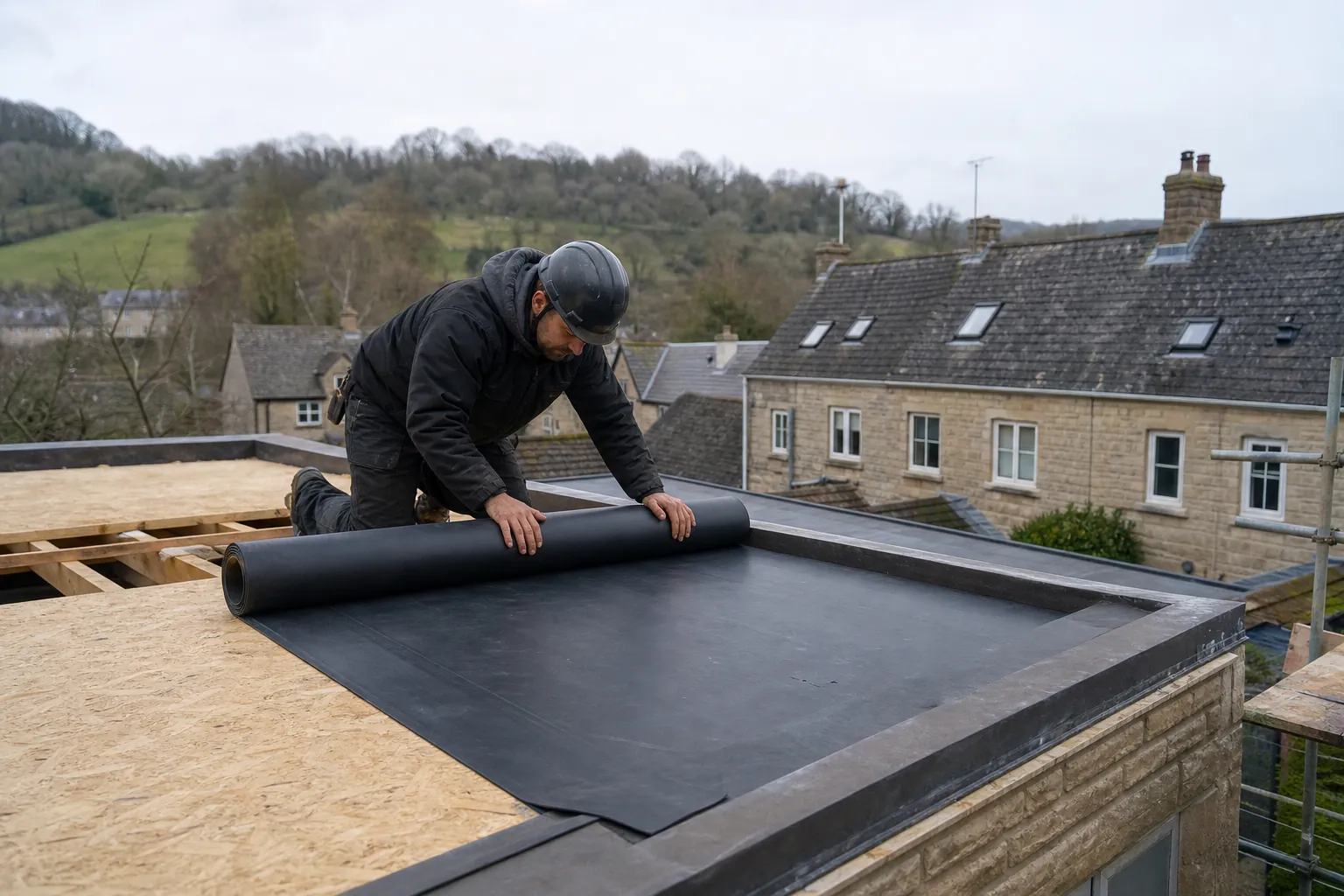
Cost now against cost over time
Typical national figures help frame the choice. MyBuilder's roof repair guide, updated on 21/08/2026, puts minor repairs at £100 to £300 and moderate repairs at £500 to £1,000, with major repairs at £2,500 or more. For a full replacement, MyBuilder gives £2,500 to £6,000 for a semi-detached house with a flat roof, and Checkatrade's October 2026 guide gives £2,800 to £7,500, or £45 to £120 per m², with its figures shown plus VAT. Roof size, access and what lies beneath the covering change all of these.
The arithmetic worth doing is not repair against replacement at today's price. It is the total of repairs over the next few years against the cost of a replacement that then runs for a decade or two. If a roof is likely to need a second and third repair, the cumulative cost can pass the price of a new roof, and the new roof also removes the risk of damp reaching the ceilings and walls below.
| Situation | Usual leaning |
|---|---|
| One split or lifted corner on a dry, sound roof | Repair |
| Blister or open seam, deck firm, covering mid-life | Repair |
| Repeated leaks in different places | Replace |
| Spongy deck or wet insulation | Replace, with new deck |
| Covering cracked and brittle across the roof | Replace |
Whatever the answer, we put the verdict on paper after the survey: which of the two your roof needs, and why. When you set quotes side by side, confirm that VAT and scaffolding are in each total, as both can move it a good deal. Our own flat roof cost page goes into what drives the price.
Which covering, and what will it have to meet?
If the answer is replacement, the next question is what goes on. The existing material is not always the best choice: a roof that failed early because of its complexity might do better in a different system. Our guide to flat roof materials compares felt, EPDM, GRP, liquid, single-ply and lead on life, cost and fit.
Replacement also brings regulations into play. In Approved Document L, a new waterproof membrane on a flat roof is listed as renovation of a thermal element. If more than 50% of the surface is renovated, the entire element should reach the Table 4.3 U-value of 0.16 W/(m²·K) set for roofs. Put simply, the old insulation, if there is any, is judged against today's standard, and a thin or wet layer usually gets replaced. A roof that is being re-covered may therefore need more insulation than it has now. That is why we ask whether the roof is warm or cold, covered on our page on warm and cold flat roofs, and why you may need a building control application. Where the job needs notifying, we walk you through consent and deal with the Building Regulations notification ourselves.
Can a new layer go over the old one?
Occasionally, if the old covering is dry, firmly stuck to a sound deck and the extra weight is acceptable. It is faster and avoids a skip of old material, but it hides what is underneath, and it is not suitable where the deck is wet. We cover when it works on the overlay flat roof page.
What we check on the survey
A decision this size should rest on evidence, not instinct. When we survey a flat roof we start from outside: the covering, seams, trims, upstands, outlets, rooflights and any areas holding water. Then from inside where we can: ceilings, the loft or void beneath, the underside of the deck, and timbers around the edges.
Pictures taken on the visit go in with the quote, which means you can see the roof as we found it. Where a repair will do, the report says that and spells out what the repair will and will not achieve. Where the roof needs replacing, it says that instead and gives the reasons. We aim to recommend the smallest job that cures the fault, which sometimes means a repair that costs a few hundred pounds and sometimes means the larger job. A repair is not the cheap option if it fails again, and a replacement is not the safe option if the old roof had plenty of life in it.
What should I send before the survey?
A few clear photographs from ground level and from any window that overlooks the roof, a note of when the leak shows (after heavy rain, after wind from one side, or all the time) and whatever you know about the age and the last repair. That narrows the likely causes before we arrive.
Our work carries a 10-year workmanship guarantee in writing. At the end of a job the rubbish goes with us and the garden or yard is left tidy. If you want to see the stages of a new roof first, our page on the flat roof replacement process follows the job from strip to trims.