
Roofers tend to have favourites, and each favourite has real strengths behind it. A covering that behaves perfectly on a rectangular garage may struggle on a roof with a chimney, three rooflights and a curved bay. Cost, looks, how much foot traffic the roof gets and how awkward the access is all pull the decision in different directions.
This guide compares the coverings fitted on British houses today, using the products and standards we work with here rather than imported specifications. We cover how long each tends to last, what it costs per square metre according to published guides, how it looks and where it is the wrong choice. The wider picture is on our flat roofing page, and the sections below link to a closer look at each material.
Start from the roof you have
A roofer weighs four things before naming a product. First, the shape: a simple rectangle with one outlet is easy for almost any covering, while a roof with many penetrations, curves and upstands favours a material that can be moulded or welded. Second, the deck: new boards, old boards or a concrete slab each have limits on what can be laid on top. Third, the use: a roof that is only looked at from a window can take a thinner finish than one used as a terrace. Fourth, the structure beneath: a covering that is heavier or hotter to install may not suit a fragile building.
Then comes the build-up beneath the covering, which counts for as much as the covering. Whether insulation sits above the deck or between the joists changes how the roof manages moisture, and it is covered in our guide to warm and cold flat roofs. Rules on thermal performance apply when a covering is replaced; the flat roof Building Regulations page explains when.
Does the material change how it drains?
Not by itself. Every covering depends on the fall of the deck, and water that cannot leave will shorten the life of any of them. A roof with too little fall needs the deck corrected, not a more expensive membrane.
Torch-on felt: the familiar option
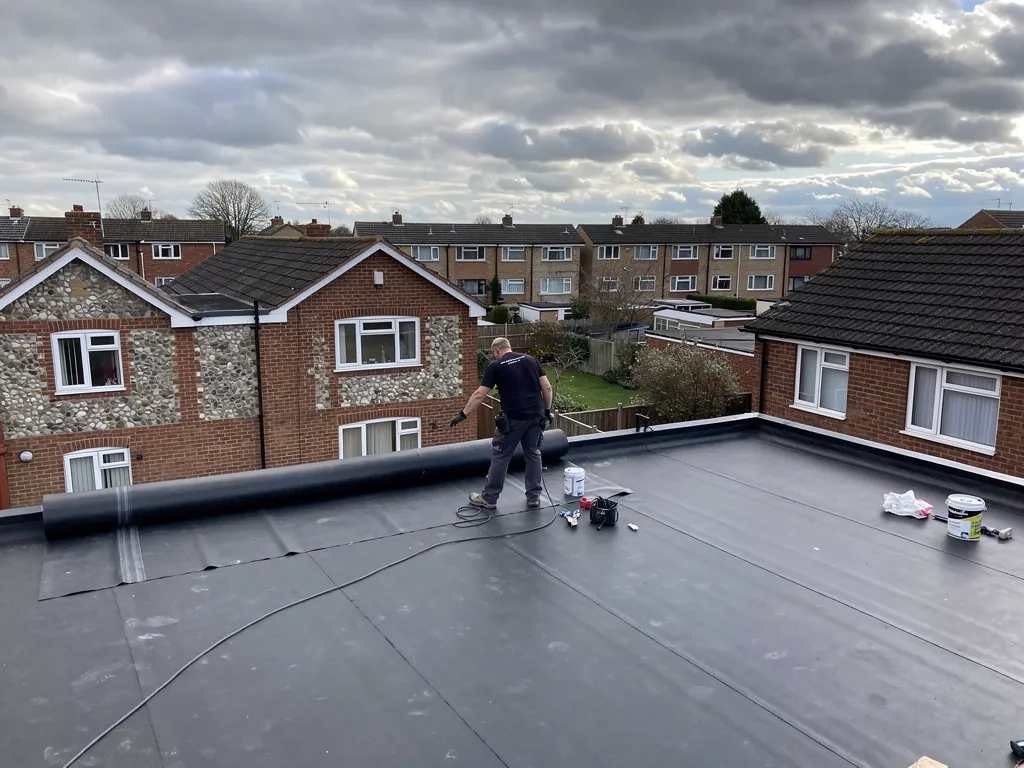
Modern felt is a polymer-modified bitumen sheet, not the tarry roofing paper of older garages. It is laid in two or three layers, fused together with a gas torch, and finished with a mineral-chip capping sheet. It is widely fitted, widely understood and cheap to repair, since a repairer can cut out a damaged area and fuse new felt in.
On life, the sources disagree. Less gives 10 to 20 years, noting that careful laying can reach 20 years while a careless job may give up before 10. CORC, a trade body, says well-maintained felt can last 30 years or more. The spread is a fair summary of the real situation: workmanship, the number of layers, the quality of the details and how the roof is maintained all count for more than the product label.
Its weak points are the seams, the upstands and the edges, all of which depend on the skill of whoever held the torch. It also needs open flame work, which is why we choose details with care on older timber roofs. MyBuilder's flat roof guide, updated on 21/08/2026, gives bitumen felt at £70 to £100 per m². Our page on torch-on felt roofing goes into the layer system.
Felt is a sensible choice on a straightforward roof where the budget is tight and the details are simple. It is a poor choice for a roof with many awkward junctions laid by someone in a hurry.
EPDM rubber: the quiet performer
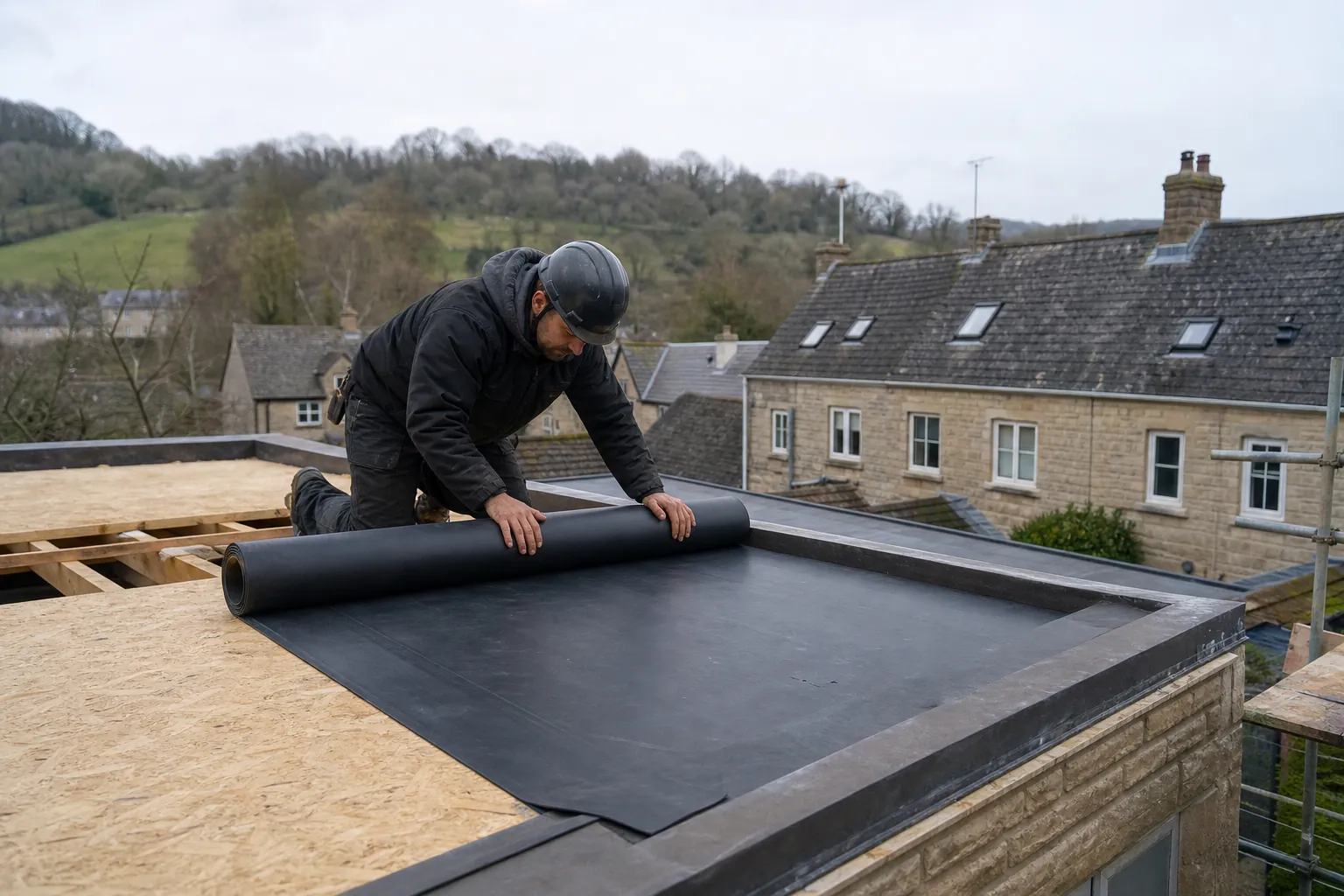
EPDM is a man-made rubber sheet. It arrives as a single sheet cut to the size of the roof, glued to the deck and sealed at the edges with purpose-made trims and tapes. Because there are few or no seams on most domestic roofs, the number of places that can fail is small, and there is no flame involved.
GreenSpec gives an expected service life of 20 to 30 years. Less quotes 30 to 50 years and says manufacturer warranties of 20 to 25 years are standard, while CORC says well-maintained EPDM can pass 50 years. Warranties come from the maker and are not lifespans, so 20 to 30 years or more is the safer reading. MyBuilder gives EPDM at £90 to £130 per m².
EPDM is black and plain, which suits most garage and extension roofs but may not suit a roof overlooked from upstairs. It is also less forgiving on busy roofs: sharp heels and sharp objects can mark it, and a puncture needs a patch. Small, complicated roofs cost more because cutting and folding around corners is slow work.
Is EPDM better than felt?
On a large, plain roof it often is, because there are fewer joints to age. On a small roof full of corners the gap narrows. Our comparison of EPDM rubber roofing and the page on EPDM against GRP set out the trade-offs.
GRP fibreglass: one skin, and walkable
GRP means glass-reinforced plastic. Resin is laid over fibreglass matting on the deck, then topped with a pigmented gel coat. The result sets hard as one continuous skin, with no seams, which makes it excellent for roofs with many corners, steps and rooflights, and it can be walked on without much fuss.
Less gives GRP a life of 25 to 40 years, and CORC says well-maintained GRP can last 25 years or more. MyBuilder puts it at £95 to £150 per m², a little above EPDM, and the gap widens on awkward shapes where the work is hand-finished.
The catch is that it is rigid. A deck that flexes, either from poor boards or a building that moves, can crack the skin, so the base must be sound and well fixed. Laying also depends on dry, mild weather, because resin will not cure properly in damp or very cold conditions, and a roof started on a doubtful day can have a weak finish. Colours are available beyond black, such as grey, which helps where the roof is seen from above. Read more on GRP fibreglass roofing.
Liquid coatings and single-ply PVC
Liquid roofing is applied by roller or brush over a prepared surface, forming a continuous waterproof skin once it cures. It is useful for roofs with plenty of detail, for sealing an existing sound covering without stripping it, and for places where heat or access makes other methods difficult. Quality varies sharply between systems, so the base surface, the primer and the number of coats all matter. We cover the method on our page on liquid flat roofs.
Single-ply PVC is a factory-made sheet, usually reinforced with a polyester scrim, whose seams are fused with a hot-air gun into one watertight membrane. It is common on commercial buildings and increasingly used on homes. MyBuilder gives PVC single-ply at £95 to £140 per m². It copes well with complicated shapes because the pieces are welded, and it comes in light grey and other shades. Its welds need a trained installer, and a poorly welded seam is a point of failure. Our page on PVC single-ply for homes explains where it fits.
Can liquid be put over an existing roof?
Sometimes. The old covering must be sound, dry and firmly stuck down, and the deck must be free of damp. A wet or blistered base will bring the new coating up with it. The survey tells us which side of that line a roof is on.
Lead and the metals
Lead is the traditional flat roof covering for churches, bay windows and listed houses, and it is still the right answer in some places. Less gives lead flat roofs a life of 50 to 100 years, and MyJobQuote says lead flashings can last for more than 80 years when properly installed. MyBuilder gives lead at £150 to £200 or more per m², roughly double most alternatives.
The price buys longevity and appearance. Lead weathers to a soft grey, is easily shaped around odd details and does not need replacing in a lifetime, if it is laid in suitable lengths on a sound deck so it can move with temperature. Lead sheet codes run from 3 to 8, with heavier codes for more demanding uses, and flat roofs normally need a heavier code than flashings. Lead has limits too. It is heavy, it is a target for theft in some places, and it is overkill on a plain shed roof.
On a listed or conservation-area building, a change of material can need consent, and the council may ask for the same material again. Before swapping coverings, ask Swindon Borough Council's planning team, and read our guide to flat roofs in conservation areas for what to ask.
Why is lead so much dearer?
Material cost is part of it, but so is the labour: lead is cut, dressed and welted by hand, and the details take skill and time.
Side by side, and how to choose
This table brings the published figures together. Prices are typical UK ranges from MyBuilder's flat roof cost guide, updated on 21/08/2026, and lives are typical ranges from the sources named above, not promises.
| Covering | Cost for each m² | Typical life | Best suited to |
|---|---|---|---|
| Torch-on felt | £70 to £100 | 10 to 20 years (Less) | Plain roofs, tight budgets |
| EPDM | £90 to £130 | 20 to 30 years or more | Large roofs with few details |
| GRP | £95 to £150 | 25 to 40 years (Less) | Awkward shapes, walk-on |
| PVC single-ply | £95 to £140 | Depends on installer and product | Complex plan shapes |
| Lead | £150 to £200+ | 50 to 100 years (Less) | Period and listed buildings |
Our rule of thumb is to match the covering to the roof you actually have. A plain garage with an outlet at one corner will do well with EPDM or good felt. A kitchen extension with three rooflights and a parapet wall often justifies GRP. A listed bay may need lead whatever the price. Ask any roofer to name the product, the layers and the warranty, and check VAT and scaffolding are in the price. Our survey ends in a written quote, backed by pictures taken on your own roof, and the job itself carries a 10-year workmanship guarantee, in writing. See also flat roof cost and the guide to an overlay flat roof if a new layer over the old is on the table.