
Torch-on felt is called that because the sheets are fused to the roof by heating their underside with a gas torch until the bitumen softens and flows. It is nothing like the thin, tarred roofing felt on old sheds. A modern system uses reinforced sheets with a bitumen blend that has been modified with polymers to make it more flexible and more resistant to cold and heat, laid in at least two layers with the top sheet finished in mineral granules.
It is one of the most widely used flat roof coverings in Britain, on garages, house extensions, porches and commercial buildings. It has a mixed reputation because quality varies so much between systems and between installers. This guide explains what is in a good build-up, how long it lasts, and how the flame is used without putting the building at risk. For other coverings, see GRP fibreglass roofing.

What makes modern felt different from the felt of the past
Old built-up roofing felt was a layer of fibre or fabric soaked in oxidised bitumen. It was cheap, stiff when cold and brittle with age, and it cracked at the first movement. Today's high-performance sheets have a reinforcing core of polyester or glass fibre, coated both sides with bitumen blended with plastic or rubber-type polymers. The polymers let the sheet stretch without tearing, and they stay flexible at low temperatures.
The sheet arrives in rolls, and a mineral-surfaced cap sheet carries the colour and the weathering layer. The mineral granules shield the bitumen from sunlight and give the roof its familiar speckled grey, green or red finish. Underneath, a smooth base layer provides the second thickness of waterproofing, and a third layer is added where the roof is walked on.
Is all felt the same?
No. Sheets vary in thickness, reinforcement and polymer content, and the lowest-priced products can be little better than the old built-up felt. When someone quotes for felt, the product matters as much as the method, and a reasonable roofer will name it and show you the data sheet.
Layers, cap sheets and what sits beneath them
A felt roof is a system, and the sheets are only part of it. From the top down, a typical warm-roof build-up has the mineral cap sheet, a base or underlayer sheet, rigid insulation board, a sealed vapour barrier that stops warm, moist air reaching the insulation, and the structural deck. Where there is no insulation above the deck, the sheets sit straight on a boarded surface with the insulation between the joists, in what is called a cold roof.
In a warm roof, moisture from cooking, washing and breathing drifts upwards. Without a sealed barrier it can reach the cold underside of the felt and condense inside the insulation, which then stops working and starts to rot the deck. The barrier is lapped and sealed at every edge and pipe.
Two layers is the minimum for a good-quality system; three layers is used where the roof will take foot traffic or has a long design life. Each layer is fused to the one beneath, and the joints in the top layer are staggered against those in the layer below so they never line up. All laps are sealed by the torch, which squeezes a thin bead of bitumen from the edge when the bonding is right.
What are upstands and why do they matter?
Wherever the roof meets a wall, the sheets turn up the wall to form an upstand and finish under a flashing, normally lead and tucked into a mortar joint. Edges at the perimeter finish with a metal drip trim. These details are where most felt roofs fail, and they take more care than the flat field. Our page on flat roof trims shows the options.
How many layers does a felt roof have?
See felt roof layers for the build-up in detail. In summary: the roof deck, a vapour control layer where insulation is above the deck, insulation, an underlayer and the cap sheet.
Laying with a flame: the fire-safety side
The reputation of torch-on felt has been shaped by the risk of fire. A gas torch applied near a roof edge or an unprotected timber can ignite concealed materials, and the damage can appear hours after the roofer has left. Careful roofers treat the flame as the most hazardous part of the job and plan around it.
Good practice starts with the area. Combustible materials within reach of the flame, such as timber fascias, soffits, felt on the neighbouring roof, insulation and cavities, are protected or avoided. The torch is not used to bond directly onto timber or into a gap in the wall. Fire extinguishers are on the roof, not at the foot of the ladder, and the roofer stays on site watching the finished work for a period after the last flame, because smouldering can start slowly.
Are there ways to avoid the flame?
Yes. Some manufacturers make self-adhesive or cold-applied felt systems that avoid a naked flame. They can be a better choice next to a thatched roof, a timber-clad wall, or any detail where fire risk is hard to control. They need a clean, dry, primed surface and are often slower to lay, and the seams are less forgiving. Hot-air welding is another route on some systems.
If someone arrives to torch-on felt beside an unprotected eaves or soffit and shows no fire precautions, stop the job. A good roofer will explain how they are keeping the building safe before they light anything.
We work out the method for your roof on the survey, noting where a flame cannot go safely, so the written quote reflects the system that suits the building.
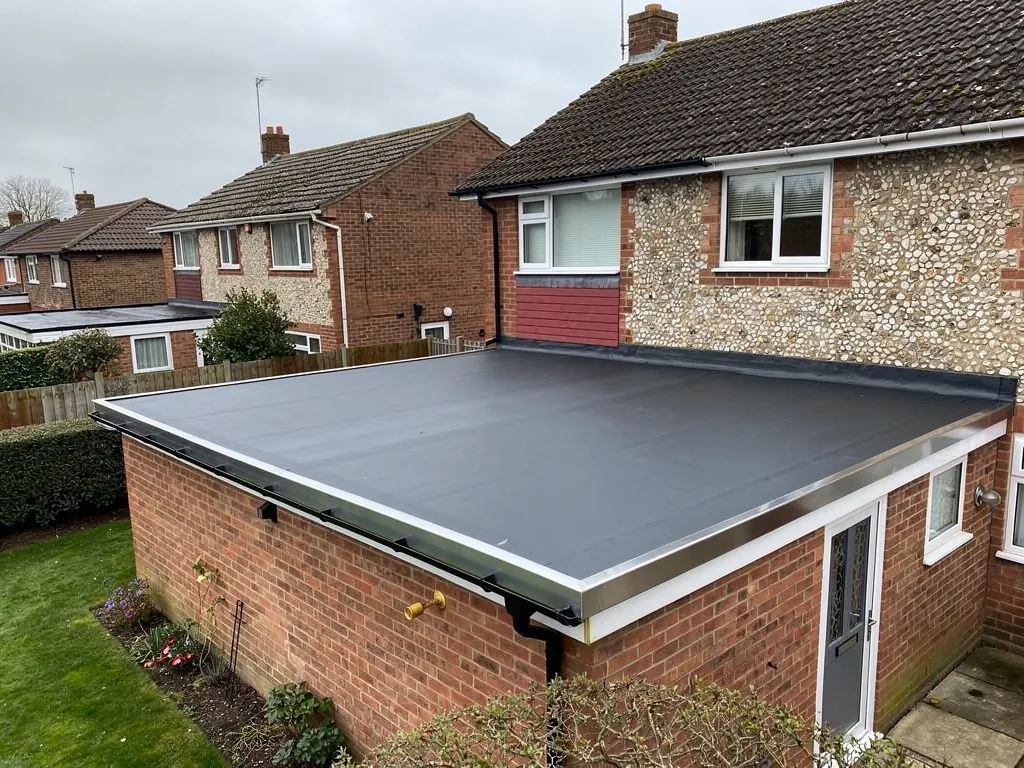
How long felt lasts and what it costs
Lifespans quoted for felt vary, and the gap between them says a lot. Less gives 10 to 20 years for torch-on felt and ties the top of that range to the quality of the installation. CORC gives 30 years or more for torch-on felt if well maintained. MyBuilder's flat roof guide puts the general range for a flat roof at 15 to 30 years. Treat these as ranges: a roof with good falls, a sound deck, quality sheets and careful detailing sits higher, one with ponding and neglected upstands lower.
On cost, MyBuilder's flat roof guide (updated 21/08/2026) gives £70 to £100 per m² for bitumen felt, within a general range of £45 to £100 per square metre. For a garage, its garage roof guide quotes felt at about £75 per m², while Checkatrade's roof replacement guide quotes £1,000 to £2,000 to re-felt one, averaging £1,500. All of these are typical national ranges, not a price for your roof. After the survey you receive one written total.
What shortens a felt roof's life?
Ponding water, which sits on the surface and works into every flaw; blocked outlets; foot traffic on a surface that was not designed for it; and moss or debris that holds moisture against the cap sheet. See flat roof maintenance for the checks that keep a felt roof in good order.
Can a damaged felt roof be repaired?
Often, yes: blisters, splits and lifted laps can be cut out and patched with new felt, provided the layers underneath are sound. A roof with widespread failure, soft decking or trapped water will keep reopening, and replacement is the more honest answer.
When felt is the right choice, and when to look at something else
Felt suits a wide range of flat roofs. It is well proven, it is repairable, and it is supplied in a wide choice of grades, so it fits both modest and demanding jobs. Upstands, rooflights and pipe penetrations all have standard details, so a competent roofer can seal each one to a known pattern, and the repair history of the system is long enough that most faults are well understood. On larger roofs it can be laid quickly in rolls, with fewer joints per square metre than a small-format covering. It is a solid choice for a garage or house extension when the deck is in good order and the roof drains well, and it copes with the odd awkward shape such as a roof that steps down round a bay or runs into two walls.
It is less attractive where a flame cannot be used safely, or where the work is on a small, intricate roof in which a continuous finish is easier to keep watertight. A balcony or dormer cheek may suit a one-piece laminate better, as covered in our guide to GRP. Cold-weather laying is possible, but sheets need to be warmed before they are unrolled, and our article on flat roofs in winter explains what changes.
What if the building is in a conservation area?
Matching re-covers seldom need planning consent, though a listed building needs its own consent and a conservation area adds care over anything visible from the street. Read flat roofs in conservation areas before you commit.
Does replacing the covering trigger the insulation rules?
It can. Under Approved Document L (2021), fitting a fresh waterproof layer to a flat roof is treated as renovating a thermal element. When over 50% of the surface is renovated, the element should reach the 0.16 W/(m²·K) figure in Table 4.3. Building control confirms what applies to your roof. See our replacement process page for how we handle it.
Where a notification is needed we make it, and the consents are explained before work starts. When the roof is finished the debris goes with us. A 10-year workmanship guarantee comes in writing.