
With no pitch to hurry water off, a flat roof tolerates neglect far less than a tiled one. A blocked outlet that would be a minor annoyance on a pitched roof can leave a garage or kitchen extension holding water for weeks. The covering itself, whether felt, EPDM rubber or fibreglass, is usually fine for years. It is the small details around it that let go first.
That is why a short, regular look does more good than an occasional big repair. This guide covers a sensible schedule, what to check on each type of covering, what you can safely do yourself from the ground or a window, and the signs that mean it is time for a roofer. If you are weighing up a bigger job, the main flat roofing page and our guide on flat roof repair or replace picks up where this one ends.
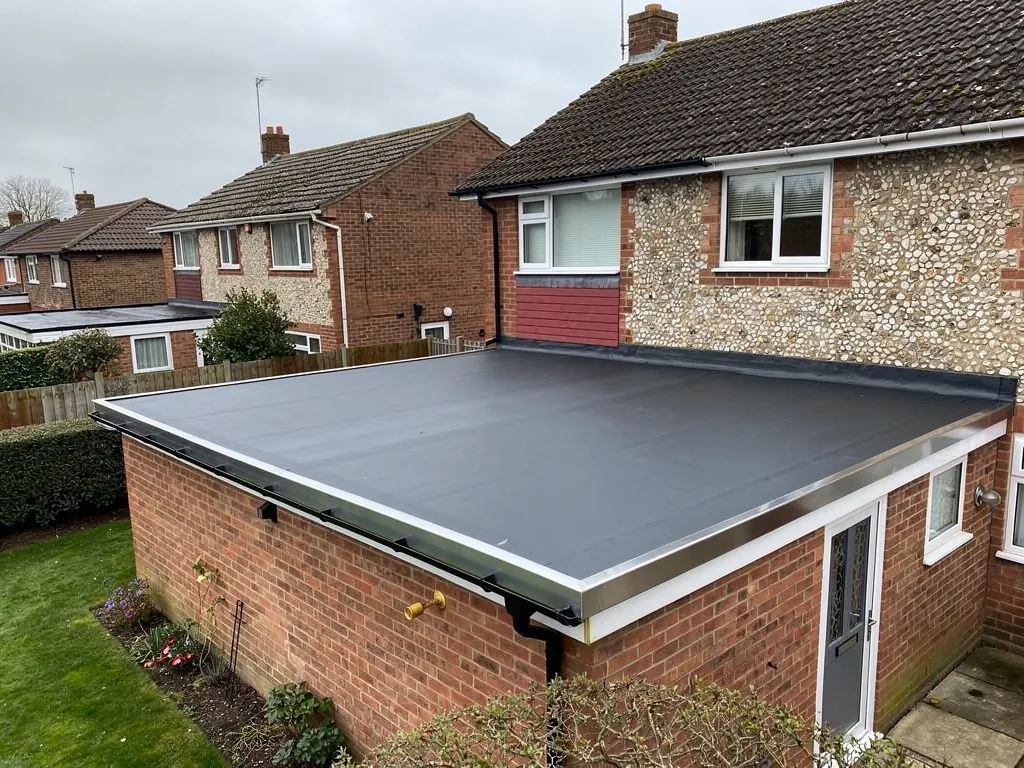
A realistic maintenance calendar
Nobody needs to be on a flat roof every month. A rhythm that works for most homes is a check in spring, once the winter weather has done its worst, and another in autumn after the leaves have come down. Add a look after any named storm or spell of heavy snow, and after anyone has been on the roof for a satellite dish, a solar panel survey or a chimney job.
The spring check is about damage: splits, lifted edges, standing water that has lingered since the last rain. The autumn check is about preparation: clearing debris from the outlets and gutters before the wet months so the roof can shed water when it matters most. Where a large tree overhangs the roof, expect leaf fall to clog an outlet within a week or two, and look more often through October and November.
What does a check actually involve?
Mostly looking. From an upstairs window, a ladder at the eaves or a neighbour's garden, you can see whether water is sitting, whether the edge trim has lifted and whether the outlet is clear. Take photographs each time. A phone picture from the same spot twice a year shows slow changes, such as a blister growing or a seam creeping, that memory never will.
Outlets, gutters and the places water leaves
The outlet is the opening where water leaves the roof, either through a spout into a gutter or into a hopper and downpipe. If it blocks, water backs up across the roof and finds every weakness in the covering. Check it first and check it most often.
Clear leaves, moss and the grit that washes off the covering by hand, wearing gloves, and never push debris down the pipe where it can lodge lower down. Pour a bucket of water across the roof towards the outlet afterwards and watch where it goes. If it drains within a few minutes, all is well. If it lingers or runs the wrong way, the fall has moved, and that deserves a closer look from a roofer.
Gutters matter as much as the roof itself. A gutter that has sagged at one bracket holds water and overflows back against the fascia, soaking the timbers that carry the roof edge. Makers of guttering ask for a slight fall to the outlet, somewhere between 1:600 and 1:350 depending on the system, with brackets close enough that a full run does not bow. Look for stains running down the wall below a joint, which usually means a failed seal.
Should I worry about a little standing water?
Some dampness that clears by the next day is normal on a flat roof. Water still lying there after two or three dry days is ponding, and over a few winters it speeds up wear on the covering, grows algae and adds weight. Our guide to flat roof drainage explains what causes it and what can be done.
Edges, trims and upstands
The perimeter of a flat roof takes more punishment than the middle. Wind lifts at the edge first, sun and frost work on the metal or plastic trim, and the junction with the wall is where two different building elements move at different rates.
An upstand is the short vertical section of covering that turns up the wall at the back of the roof, or up the side of a rooflight or a parapet. Look at it for splits along the bottom fold, for gaps at the top where it is tucked under a flashing, and for mortar that has fallen out of the joint above. The flashing, usually a strip of lead, covers that top edge and stops water running down behind the covering. If the lead has lifted or the sealant beneath it has shrunk, rain gets in at exactly the point where nobody is looking.
At the front edge, the trim, sometimes called a drip or a fascia strip, guides water into the gutter. Check that it is still firmly fixed, that the joints between lengths have not opened, and that the covering has not slipped back from the lip. A gap of a few millimetres lets water run behind the trim and onto the timber.
Where do the first splits usually appear?
Often at internal and external corners, where the covering was folded and the material was stretched. On felt, a crack along a fold line is the usual start. On EPDM it is a lifting corner. On GRP it is a hairline in the resin where the roof meets the wall. Our page on flat roof trims shows how these edges are put together.
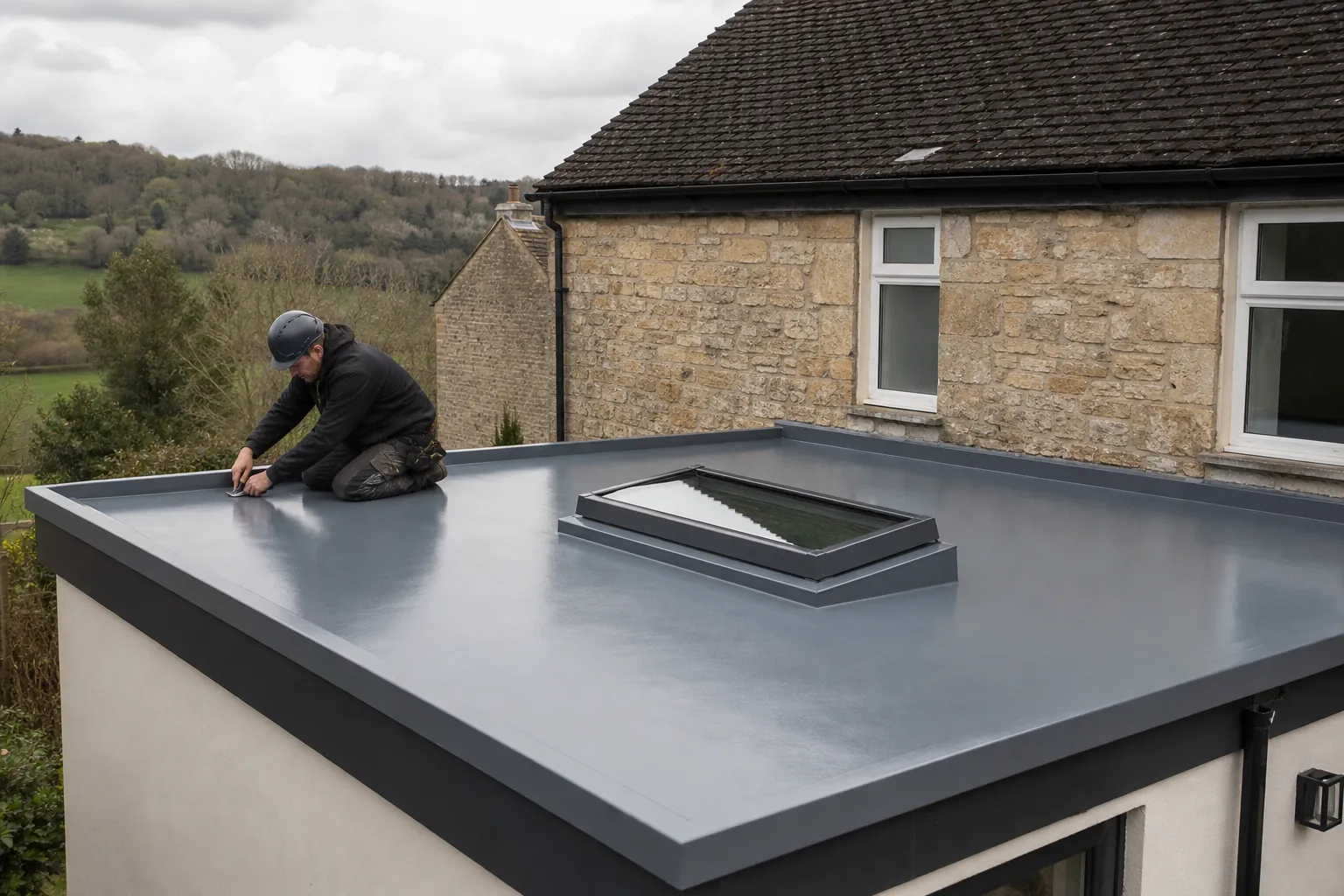
Felt, EPDM and GRP: what each one needs
The check changes a little with the material underfoot.
What should I look for on torch-on felt?
Blisters, splits and bare patches where the mineral chips have washed away. A small blister that is not cracked can wait. One that has split lets water into the layers beneath, and the repair becomes more involved the longer it is left. Look also at the seams between sheets and at the capping sheet near the walls. A good felt roof is often quoted at 10 to 20 years by Less, and one laid poorly may fail in under 10, so the age of the roof and who laid it both matter. Our guide to torch-on felt roofing covers the layers in detail.
And EPDM and GRP?
EPDM is a single sheet of synthetic rubber, usually glued down. It tends to need very little attention: keep it clear of debris, check the glued edges and the factory or site-made seams, and look for any corner that has lifted. GreenSpec gives an expected life of 20 to 30 years, and other sources quote more. GRP is glass-reinforced plastic, a resin laid over fibreglass and finished with a topcoat. Check the topcoat for crazing or fine cracks, and the joints where the roof meets walls and trims. Less puts GRP at 25 to 40 years. Read each figure as a usual span, never a guarantee, because the deck underneath matters as much as the covering above it.
Never use a pressure washer on a felt or GRP roof. It forces water under laps and strips surface protection that cannot be put back.
Moss, algae and what can be left alone
A green film or a little moss on a shaded flat roof looks worse than it is. Algae on its own does little harm. Moss is different, because it holds moisture against the covering, lifts edges as it grows and clogs outlets when it breaks off. On felt, a thick mat can also hide a defect you would otherwise spot.
Soft brushing with a stiff broom, working towards the outlet, usually shifts light growth. For anything heavier, a roofer can scrape and treat the surface. MyBuilder's roof cleaning guide, updated on 21/08/2026, gives a typical range of £300 to £600 for flat roof cleaning, and warns that pressure washing can damage delicate coverings. Size and access move the price, so the written quote after a survey is what settles it for your roof.
Is it safe to walk on my flat roof to clear it?
Sometimes, but not always. Felt softens in hot weather and splits under a heel. EPDM and GRP take light foot traffic better, though not boots with stones in the tread. If you do go up, use a ladder that is tied or footed, never lean over an unprotected edge, and stay off in wet or icy conditions. If a roof has a fragile rooflight or a sagging deck, stay off it altogether. A tree-free garage roof reached by a stable ladder is one thing; a first-floor roof over a kitchen is another, and a roofer who works at height every day is the safer choice.
Do not stack paving slabs, planters or bags of rubbish on a felt or EPDM roof as a storage space. The point loads dent the deck and cause ponding in places you cannot easily see.
Signs that need a roofer, not a brush
Some findings are beyond a tidy-up. Call a roofer if you notice any of the following.
- A soft or spongy feel underfoot, which suggests wet insulation or a rotted deck below.
- Water marks on a ceiling beneath the roof, particularly if they grow after rain.
- A split, tear or open seam anywhere in the covering.
- An edge trim that has come loose or lead lifting off the brickwork.
- Standing water that is still there days after the rain has stopped.
- Blisters on felt that are large, cracked or growing.
A leak is not always where the stain is. Water runs along the deck or the underside of the boards before it drops, so the fault may be well away from the mark. We trace it from the roof rather than patching the ceiling. Our guide to the warning signs of a flat roof leak goes through what each symptom suggests.
When does a repair stop being worth it?
When the same area has been mended more than once, when the deck beneath is damp, or when the covering is near the end of its typical life. We lean towards the smallest job that cures the problem, so a local split on a sound roof gets a repair and a roof that is failing all over gets a frank talk about replacing it. If it comes to that, the flat roof replacement process shows what the work involves, and flat roof insurance explains how cover treats wear and tear. Our own work carries a 10-year workmanship guarantee, in writing, and you see photographs of your roof with the quote.