
Owners of industrial units, offices, shops and farm buildings are often told that one material is simply better than the rest. Rarely true. A system that suits a large, flat warehouse with few penetrations can be a poor match for a small roof crowded with plant, and a metal roof that is ideal on a steel portal frame may make no sense on a brick-built shop with a parapet.
What follows compares the four families used on commercial roofs in this country: single-ply membranes, built-up and bituminous felt, profiled and standing-seam metal, and liquid-applied systems. For each we set out how it is built, the typical life reported in published guides, and the situations where it earns its place. Prices for a replacement are set by the survey, but the commercial roof cost guide explains what drives them.
Start with the building, not the product
Before comparing materials, a roofer needs to know four things about the building: what the deck is made of, what falls it has, what passes through it, and who walks on it. A concrete deck, a timber deck, a profiled steel deck and an old asbestos cement sheet roof each limit what can be laid on top.
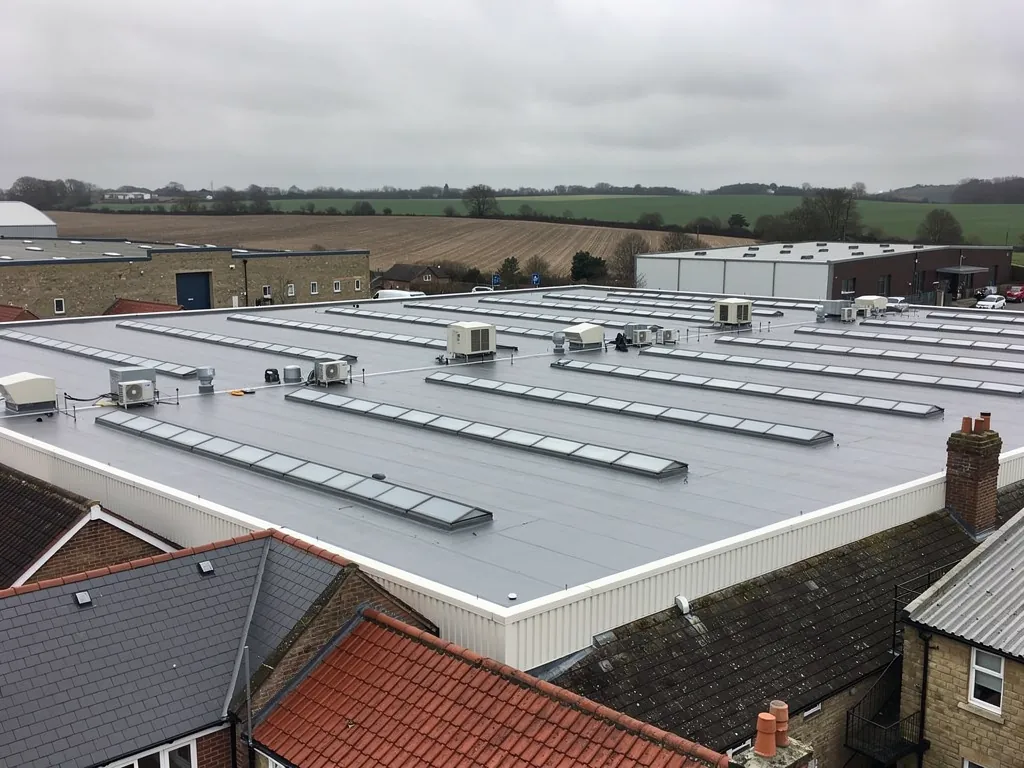
The shape matters as much. A broad, near-flat roof with a handful of rooflights suits a single sheet of membrane. A roof with dozens of pipes, brackets and plant bases gives a membrane many places to be cut and sealed, and a liquid system, which flows round awkward shapes, may cope better. A steep-sided building on a steel frame points towards metal.
What does foot traffic change?
Roofs that are visited often, for plant maintenance or window cleaning, need a covering that survives boots and dropped tools, or a protected walkway laid on top. A roof that is hardly ever visited can use a lighter system. If you know that engineers will be up there each month, say so at survey, because it changes the recommendation.
Finally, think about the next owner or tenant. Our guide to commercial roof design goes through the decisions that follow from these answers, such as drainage, access and loading.
Single-ply membranes: PVC, TPO and EPDM
A single-ply system is a factory-made sheet of synthetic membrane, laid over insulation and joined at the edges. Three materials dominate: PVC, TPO (a thermoplastic polyolefin) and EPDM, a synthetic rubber. PVC and TPO sheets are joined along their edges with a hot-air welder, which turns two sheets into one continuous skin. EPDM is usually glued down with adhesive and tape, or supplied in very large sheets that cut down on seams.
Fixing is by one of three methods. Mechanical fastening uses screws and plates through the insulation into the deck. Adhesive holds the membrane down over the full area. Ballast, in the form of paving or stone, holds it down by weight where the structure can carry the extra load.
GreenSpec gives an expected service life for EPDM of 20 to 30 years, and Less reports a range of 30 to 50 years, with manufacturer warranties often of 20 to 25 years. Those sources differ for a reason: workmanship, exposure and maintenance all move the figure. A warranty is a manufacturer's commitment on the product, not a prediction of how long the roof will actually last.
When does single-ply suit best?
It performs well on large, low-pitched roofs, on lightweight steel decks, and where a quick programme matters, because the sheets are fast to lay. It needs a sound, clean substrate and careful detailing at upstands and penetrations. Our separate guide to single-ply roofing for commercial buildings goes through each material in more depth.
Built-up and bituminous felt
Built-up roofing is made on site from several layers of bitumen-based sheet, stuck together to form a waterproof skin. A modern system typically has a base layer, a reinforced cap sheet and sometimes a layer between them, with the layers either torch-welded, laid in hot bitumen or fixed with cold adhesive. Having multiple layers means a small flaw in one is covered by the next.
Felt remains common because it is familiar, repairable and well suited to complicated roof shapes. Laps and details can be built up by hand, and local damage is mended by cutting out and patching. Against that, the traditional torch-on method involves a naked flame on the roof, so many owners now ask for systems that avoid it, and it should be a considered decision on any building with a combustible deck or contents.
Less puts torch-on felt at 10 to 20 years and notes that a good job can last 20 years while a poor one might fail in under 10. CORC, the trade body, reports felt lasting 30 years or more when well maintained. The spread says as much about installation quality and upkeep as it does about the material.
Is felt still worth specifying?
Yes, for roofs where the shape is complex, where repairs are likely to be local, and where a lower-cost, repairable system suits the lease or ownership timeline. It is a poor choice where the roof ponds, because standing water shortens its life, and the falls need putting right first.

Metal roofing: profiled sheet, composite and standing seam
Metal is the default for steel-framed industrial and agricultural buildings. Profiled steel or aluminium sheets span between purlins, and the profile gives them stiffness. Single-skin sheets with a separate lining and insulation form a built-up metal roof, while factory-insulated composite panels combine both in one unit. Standing-seam systems use long, interlocked panels whose raised joints hide the fixings, which removes the screw holes that tend to leak on exposed-fix sheets.
Zinc, copper and aluminium are also used as architectural coverings on shops, offices and public buildings. VMZINC states that a correctly designed and installed zinc roof can exceed 100 years, and notes that in some conditions the expected life could drop to 60. HomeBuilding quotes a contractor at 60 to 100 years. Those are the best-case figures for a premium material and not typical for plain painted steel.
Where does metal cause trouble?
At laps, at the fixings and at cut edges. Corrosion usually begins where the coating has been cut or scratched, and noise in rain can be a complaint in occupied buildings. Both have their own guides: see our pages on cut edge corrosion and the dedicated guide to metal roof sheeting.
Metal is light, which helps on older frames that could not carry a heavy replacement. It also expands and contracts with temperature, so a good design allows for movement at every long run and joint. For an old industrial roof, over-cladding the existing sheets can sometimes avoid a full strip, although the condition of the old sheets decides whether that is possible.
Liquid-applied systems and coatings
A liquid system is applied wet and cures in place into a joint-free membrane. The materials include polyurethane, acrylic, polyester and bitumen-based products, often reinforced with a fleece set into the first coat. Because there are no sheet seams, the coating is a good fit for roofs with awkward details, such as many small penetrations, tight corners and irregular outlines, where cutting and welding a sheet would leave many weak points.
Liquid systems can serve in two ways. On a roof with a sound structure and covering that has simply aged, a coating can extend its life and delay a full replacement. On a roof that needs replacing, a full liquid system can form the new waterproofing over a prepared deck. They are not a way of covering a failed roof. If the insulation beneath is wet or the deck is damaged, a coating applied over it hides the damage and the problem returns.
What does surface preparation involve?
The surface must be clean, dry and sound, and primed where the product requires it. Cure time depends on weather, so the work is planned around forecasts, and a coating applied in damp or cold conditions can fail to bond. The condition of the existing covering is therefore tested before a liquid system is recommended.
A coating is a maintenance and life-extension tool first. Check how it behaves where water ponds and at the laps, because those are the places where thin applications wear out first.
Our guide to commercial roof coatings sets out the limits of the approach.
Typical lifespans and costs side by side
Published figures give a rough guide, and they come from third parties, not from us. They vary widely, and they describe national averages for common flat-roof materials, not a commercial roof of any specific size. For large roofs the rate per square metre often drops because of economies of scale, while small or awkward roofs cost more per square metre. The written quote after the survey is the figure that counts.
| System | Typical life reported | Replacement per m² (MyBuilder) |
|---|---|---|
| Bitumen felt | 10 to 20 years (Less) | £70 to £100 |
| EPDM | 20 to 30 years (GreenSpec) | £90 to £130 |
| PVC single-ply | Varies by product | £95 to £140 |
| GRP | 25 to 40 years (Less) | £95 to £150 |
The cost column comes from MyBuilder's flat roof cost guide, updated 21 August 2026, and it concerns flat roofs of the kind found on homes and small buildings. MyBuilder also states a general range of 15 to 30 years for a flat roof, which fits within the figures above.
Why is cost per square metre misleading?
Because the membrane is a minor share of what the job involves. Access, scaffolding or edge protection, insulation, removal of the old layers, drainage changes and the shape of the roof can outweigh the cost of the membrane itself. Our guide to the longest-lasting commercial roof looks at how lifespan and total cost balance out over time.
Landlords, leases and picking the right system
On let property, the choice of system often depends on who pays and for how long. A landlord keeping a building for the long term may accept a higher outlay for a system with a longer expected life and a manufacturer warranty. A tenant with a short remaining lease, or a landlord planning redevelopment, may reasonably prefer a repairable system with a lower initial cost. The lease decides who is responsible for what, and a surveyor or solicitor should read it; our guide to landlord roof repair responsibility covers the practical side.
What should a quote say?
It should name the system and its manufacturer, describe the deck preparation and insulation, state the number of layers or the coating thickness, and say how upstands, outlets and penetrations will be detailed. If the specification changes the weight on the roof or its fire performance, building control may need to be involved, and a notifiable job needs a Building Regulations notification, which we prepare after talking you through the consent position.
How do I compare two different systems fairly?
Compare what each includes: whether the price takes in VAT and scaffolding, whether old insulation is replaced, how long the guarantee runs and what it covers. A workmanship guarantee and a manufacturer's product warranty are different documents. Ours is a written 10-year workmanship guarantee.
The first step is a survey, as with all our commercial roofing. We photograph your own roof, measure it and send a written quote. If a repair, a coating or a partial renewal cures the fault, that is what we recommend over a full re-cover. Tidying up is part of the job: rubbish goes with us and the yard is handed back clear.