
A single-ply membrane is exactly what the name says: one layer of flexible waterproof sheet, laid over insulation on a deck, and joined at the edges to form a continuous surface. It replaced much of the old built-up felt market on commercial flat and low-pitch roofs because the sheets are light, come in large widths with few joints, and can be recovered or repaired without hot works.
The three materials most often specified are PVC (polyvinyl chloride), TPO (thermoplastic polyolefin) and EPDM (ethylene propylene diene monomer, a synthetic rubber). They look similar from the ground and differ in how they are joined, how they age and what they tolerate. This guide takes them in turn, then covers fixing methods, details, repair and what a survey must check before one is chosen. For the wider comparison with other roof types, see our guide to commercial roof systems, and for everything else we do on industrial and shop roofs, visit our commercial roofing page.
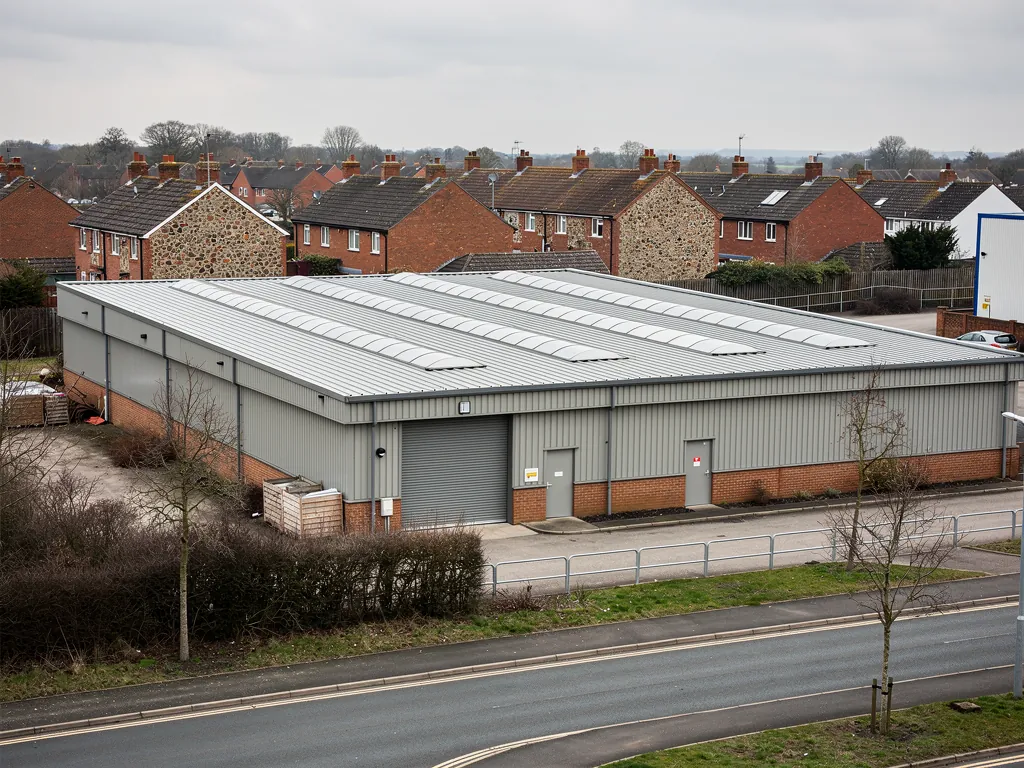
What the three membranes are made of
PVC membranes are thermoplastic sheets, usually reinforced with a polyester or glass scrim. They are flexible, available in a range of colours, and joined by hot air welding, in which the overlapping edges are softened and pressed together to form a seam that becomes part of the sheet. Plasticisers make the sheet flexible, and over a long period they can migrate out, so quality of formulation matters.
TPO is also a thermoplastic and also welded with hot air. It is a blend of polypropylene and rubber, generally formulated without plasticisers, and is often chosen where a reflective white surface and a welded seam are wanted without PVC. Formulations vary between manufacturers more than people expect, so the data sheet and the manufacturer's track record carry weight.
EPDM is a vulcanised rubber. It is supplied in very large sheets, so large roofs may have few seams at all. Joints are made with adhesive or jointing tape rather than heat, and the material stays flexible in cold weather. It is the oldest of the three in widespread UK use and has a documented track record. GreenSpec quotes an expected service life of 20 to 30 years for EPDM, and other published sources give higher figures when the substrate stays sound.
Is a membrane the same as a coating?
No. A membrane is a manufactured sheet laid on site. A coating is a liquid applied to an existing surface. They suit different situations, as our guide to commercial roof coatings explains.
How the sheet is held down
Membranes are not simply rolled out and walked away from. Wind pulls on a flat roof, and the fixing method is a design decision that depends on the building, the roof's height and the edge zones.
Mechanically fixed systems hold the sheet down with fasteners and plates along the laps, hidden beneath the next sheet. They are common on large roofs with a steel deck, because they are quick and do not rely on the substrate accepting adhesive. The number and spacing of fixings is calculated for the building, with a higher density in corners and edges where suction is greatest.
Fully adhered systems stick the membrane over its full area to a compatible insulation or deck. They suit roofs that cannot take fasteners through a membrane or are likely to flutter in high winds. The adhesive must be applied within temperature and humidity limits, so the weather decides the programme.
Ballasted systems are held by a layer of stone or paving loose-laid on top. They need a structure strong enough for the extra weight, which should be confirmed before the choice is made, and ballast makes later leak-tracing slower because the stone must be shifted.
Seams, upstands and the details that fail
Almost every leak in a single-ply roof is at a joint or detail, not in the middle of a sheet. The membrane itself is a tough, continuous material. The weak points are where it is joined to itself, to a wall, to a rooflight kerb or to an outlet.
Welded seams on PVC and TPO are tested on site with a probe, run along the weld to find any gaps. Good welds are measured by the width and continuity of the seam, and by the clean bead of melted material along its edge. EPDM seams depend on clean, dry surfaces and primed, pressed joints. Dirt, moisture or a missed corner in the adhesive is the usual cause of an open lap.
Upstands are the vertical returns where the membrane meets a wall or kerb. They are normally finished with a flashing or termination bar fixed along the top edge and sealed. If that bar is left unsealed, or the wall behind it crumbles, water runs behind the membrane and appears inside far from the source.
What about pipes and outlets?
Penetrations are fitted with prefabricated collars or welded patches rather than loose sealant. Outlets should be set low enough for water to drain freely, with a clear gap around them, and a leaf guard so that debris cannot enter. We check each of them at survey, and photograph the ones that need attention.
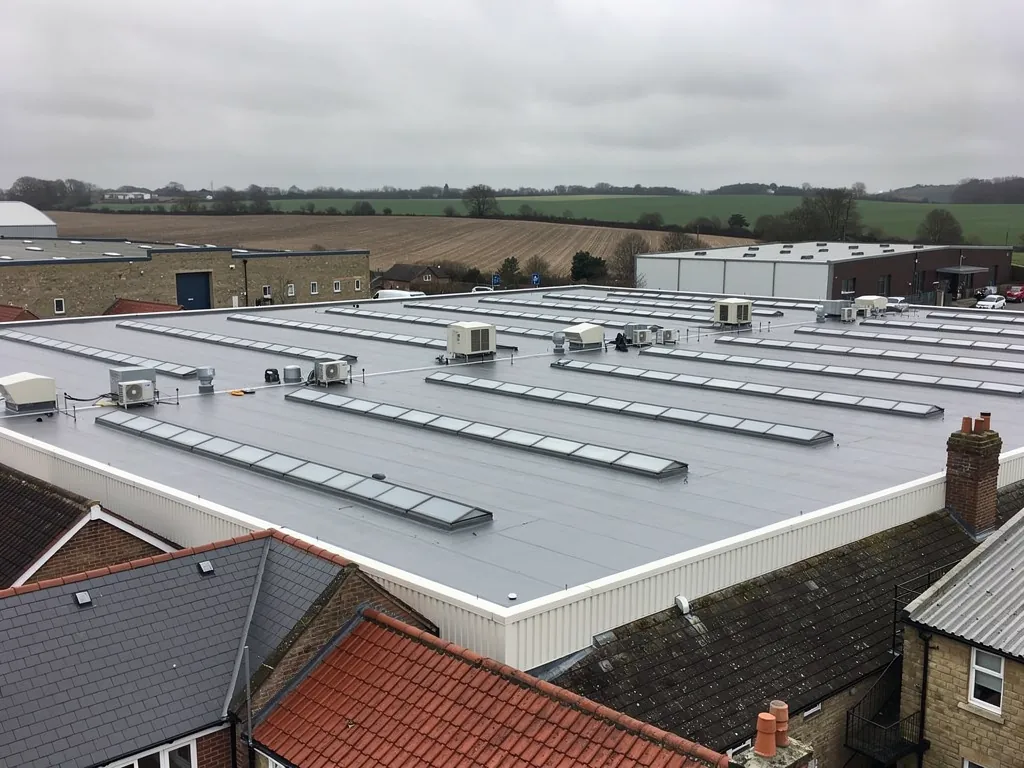
Choosing between PVC, TPO and EPDM
There is no universal winner. The choice follows the roof, what goes on beneath it, and the manufacturer's system we can install and support.
| Question | PVC | TPO | EPDM |
|---|---|---|---|
| How are seams made? | Hot air welded | Hot air welded | Adhesive or tape |
| Typical sheet width | Medium | Medium | Very wide, few seams |
| Good where | Plant roofs, many penetrations | Large clear roofs wanting a reflective finish | Simple roofs, or where hot air is unsuitable |
| Watch for | Chemical contact, such as oils and solvents | Formulation varies by maker | Seam preparation in cold or damp weather |
Some sites rule options out. A roof beneath kitchen extract, fat or oil deposits needs a membrane that resists those chemicals. A roof with heavy foot traffic from plant maintenance needs a protected walkway system or a tougher sheet. A building with a strict programme and wet weather may favour a welded system, because heat welding is less sensitive to damp than gluing.
Does colour matter?
It can. A light, reflective membrane reduces heat gain through the roof in summer, though the effect on a well-insulated building is modest. A dark one runs hotter and can age more quickly at the surface. Planning conditions occasionally dictate colour as well; see our answer on planning for commercial roofs.
What a single-ply roof needs underneath
A membrane is only the top layer. Beneath it sit insulation, a vapour control layer where required, and the deck. Each affects whether the roof performs.
The deck must be firm, dry, clean and sound. Steel decks that have rusted through, plywood that has delaminated, and concrete that holds moisture will all cause problems. Insulation boards are chosen for compressive strength and thermal performance, and are fixed to the deck before the membrane goes on. On a warm roof, which is the usual arrangement for membranes, the insulation sits beneath the waterproofing, keeping the structure warm and dry.
Falls need attention. For falls, the recommended finished minimum is 1:80 under BS 6229, with 1:40 as the design figure to allow for tolerances. A membrane is more forgiving of a shallow fall than felt, but standing water still shortens the life of seams, and ponding makes algae and dirt build up where the sheet is held wet. If a deck has dipped, tapered insulation can restore the fall during a recover.
Fire performance and thermal standards are tested for the whole build-up, not the membrane alone. Building control may need to approve a replacement, and commercial buildings are judged against their own volume of Approved Document L rather than the housing one. Where a notification is required, we file the paperwork ourselves, and you are told what was required and why.
Recovering an old roof and repairing a damaged one
One attraction of single-ply is that it can often go over an old covering rather than replace it. A recover leaves the existing roof in place as part of the build-up, with a separating layer between old and new. It saves stripping, waste and disruption, but only when the old roof is dry, firm and not carrying wet insulation. A survey that includes moisture checks decides it. A recover on a wet roof traps water against the deck and the problem returns hidden.
On metal roofs, a different logic applies. Profiled sheets with a low pitch are sometimes fitted with a support layer and a membrane to avoid leaks at the laps, which is a distinct approach from over-cladding with new sheets; our guide to metal roof sheeting compares the options.
Repairs to membranes are generally simple when the fault is clear. A puncture is cleaned and covered with a patch of compatible material, welded or glued depending on the membrane. A failed seam is reopened, cleaned and rejoined. Damaged flashings are cut out and replaced. What cannot be done is to mix products carelessly: a patch from the wrong family will not bond, and the repair fails within months.
Always find out which membrane is on your roof before anyone repairs it. Compatibility decides whether a patch holds.
Landlords managing several units find this particularly useful. Our guide to landlord roof repairs deals with the practical side of arranging it.
Questions to settle before you order
Before committing to single-ply, settle the following with your contractor.
- Which membrane, from which manufacturer, and which fixing method has been designed for your building?
- What does the manufacturer expect in terms of inspection and maintenance to keep a warranty valid?
- How will foot traffic to plant be protected?
- What are the existing rooflights, outlets and penetrations, and how will each be detailed?
- Is there asbestos in the existing roof or its surroundings? See our answer on asbestos on commercial roofs.
A manufacturer warranty is not a lifespan, and it is not our workmanship guarantee. The first is the maker's promise about the product under stated conditions. Ours is a 10-year workmanship guarantee, in writing.
The survey comes first, with pictures taken across your own roof, and a single written total follows. If a repair or a different system would suit you better than a full recover, we put that in front of you instead. When you set quotes side by side, look for VAT and scaffolding in every one.
It is also worth asking what happens at handover. A tidy job ends with a record: the membrane type and batch, the fixing pattern, photographs of each detail before it was covered, and a note of any area where the deck or the insulation was repaired. That file is what the next owner or the next contractor will want, and it makes a manufacturer warranty claim easier to support.