
Anyone searching for a commercial roof price is usually hoping for a number. The reality is that a commercial roof total is built from several things at once: the area, the type of building, the existing covering and what has to come off, the insulation, the access, and the system that goes back on. Two units of the same floor area can differ by a large margin once those are known.
That does not mean there is nothing to say. Published cost guides give typical rates per square metre for common flat roof coverings, and separate figures for scaffolding and asbestos sheet removal, which are often the two biggest swing items on an industrial roof. This guide sets those out with their sources and dates, then explains the drivers that sit on top. The page covers the money side of the work described in our commercial roofing service, and the written quote that follows a survey is what fixes the final total.
Published rates for flat roof coverings
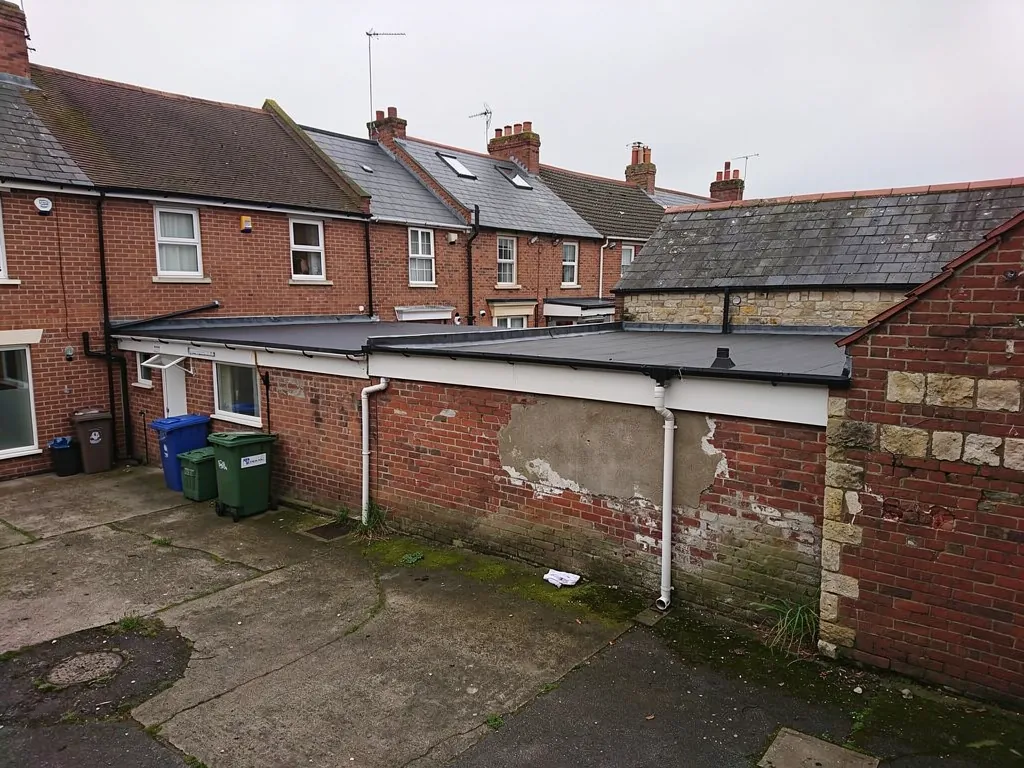
The most useful published figures are rates per square metre for the common flat roof coverings. MyBuilder, in a price guide updated on 21/08/2026, lists these typical ranges when a flat roof covering is renewed. The pounds are national averages, not a Skyline price, and they apply to the covering and its fitting for a typical flat roof.
| Covering | Typical range per m² |
|---|---|
| Bitumen felt | £70 to £100 |
| EPDM rubber membrane | £90 to £130 |
| GRP fibreglass | £95 to £150 |
| PVC single-ply | £95 to £140 |
| Lead | £150 to £200 and above |
Checkatrade, with a table last updated in October 2026, puts flat roof replacement at £45 to £120 per m² before VAT, based on a 32 m² roof. The two guides differ because they sample different jobs and different assumptions, which is itself a useful reminder of how wide the range is.
Do these rates apply to a large industrial roof?
Only as a rough guide. They describe flat roofs of the sort found on extensions and small buildings. Profiled metal, fibre cement and composite panel roofs on large units are priced on survey, because the system, fixings, laps and access differ. Our guide to commercial roof systems sets out how those roofs are made up.
How area turns a rate into a budget
A per-metre rate is only as good as the area it is multiplied by, and getting the area right is less simple than it sounds. A roof plan gives the footprint of the building, but the surface to be covered is larger once you add upstands, parapet linings, rooflight kerbs, laps and the pitch of any sloping sections. Allow for those and the working area for a replacement can be noticeably more than the floor area under it. Measuring on site, rather than from a plan or a satellite image, avoids a quote that is wrong by the first morning of the job. A roof with many rooflights or plant platforms also has more detail work per square metre than a clear span, and detail work is slower.
Arithmetic shows how fast the totals grow. A 200 m² roof at £90 to £130 per m² comes to £18,000 to £26,000 on the MyBuilder EPDM range, before extras. A roof twice that size is twice that figure. The multiplication is illustration, not a quotation: a real price also reflects the items in the next sections.
Does a larger roof get cheaper per square metre?
It can, because set-up, scaffold, skips and site management are spread across more area, and materials may be ordered in volume. It can also get dearer: a long-span roof may need a crane, a bigger crew, or sequencing to keep part of the building in use. Which effect wins depends on the unit, and neither is a safe assumption.
Scaffolding, edge protection and access
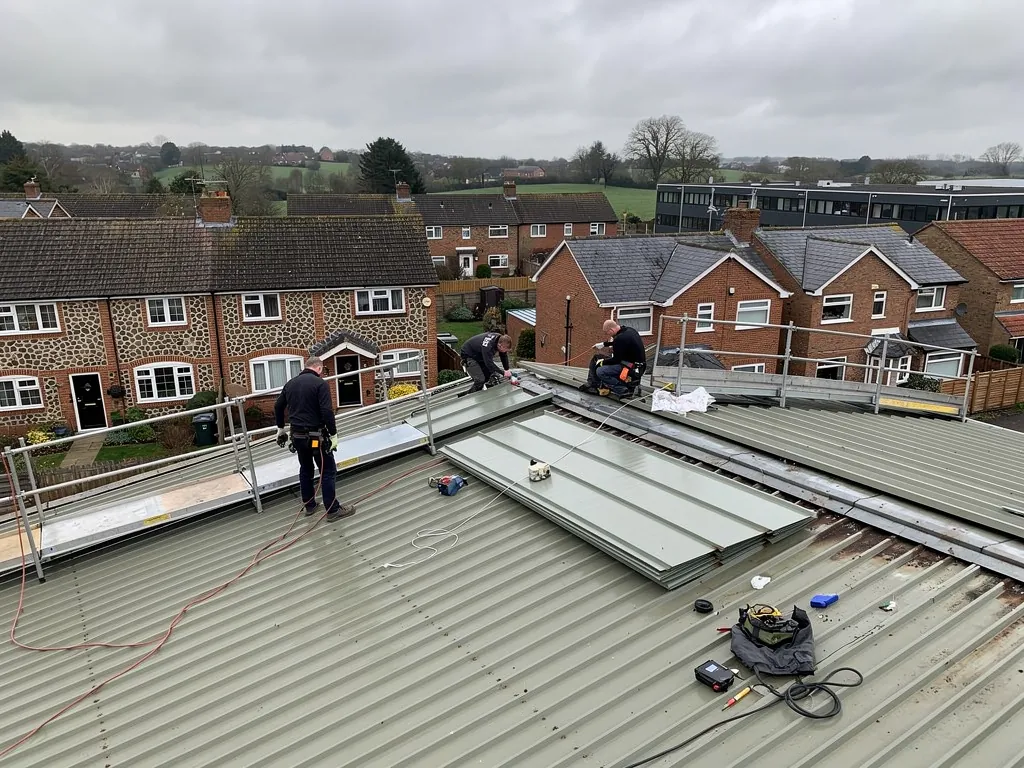
Access is often the line that surprises people. A low-eaves industrial unit may be reached with mobile towers and edge protection. A taller building, a roof over a loading bay or one above a public pavement can need full scaffold, hoists and a scaffold licence.
MyBuilder gives around £850 to £1,200 for a standard two-storey house scaffold, with a scaffold licence at £50 to £200. Checkatrade, updated in February 2026, puts scaffolding at around £875 per month for a semi-detached house. Those are domestic figures and a commercial perimeter is longer, higher and held for longer, so the cost can be considerably more. Edge protection along a long eaves line is a substantial item in its own right.
Is access ever cheaper?
Sometimes. Where a unit has a flat roof reached from a lower roof or a mezzanine, or where equipment can be lifted onto the surface by a loading-bay hoist, the cost falls. Working from a mobile elevated platform may also avoid scaffold on a straight run of eaves. The survey records which options are available, because the right answer depends on the ground around the building as well as the building itself.
Whatever the quotation, check that VAT and scaffolding are covered, and whether the scaffold is hired for the full duration. Checkatrade's published cost tables are stated before VAT, so the final bill on a commercial job needs to be checked for it.
Stripping, disposal and asbestos sheets
What comes off matters as much as what goes on. Stripping an old covering means labour, skips and disposal, and a roof with several layers, wet insulation or a failed deck costs more to clear. MyBuilder's roof replacement guide gives disposal at £100 to £1,000 for a domestic roof, which is a reminder of how much variation there is even before a commercial building is involved.
Asbestos cement sheets are the largest single swing on many older industrial and agricultural roofs. HSE says that if a building was built or refurbished before 2000, you should assume asbestos is present. MyBuilder puts asbestos sheet removal at around £2,000 on average, with rates beginning at £50 per m², with a single garage roof between £350 and £1,295 and a double garage between £650 and £1,800. A large industrial roof will be a different order of magnitude. Where it is carefully removed, weathered asbestos cement is non-licensed work under HSE guidance, but the method, the notification where the sheets are broken, the waste route and the paperwork all have to be right.
Why does a survey need to check for asbestos?
Because the answer changes the method, the programme and the price. A roof that turns out to be asbestos cement becomes a separate project from one on steel or fibre cement, and finding out part-way through is expensive. Our guide to asbestos commercial roofs covers the process in more detail.
Replace, overclad or repair: the three price levels
Three approaches sit at very different cost levels, and a competent survey should say which one your roof calls for. A repair deals with local faults and costs the least; it makes sense where the covering is broadly sound and the leaks are confined to laps, flashings or a few sheets. An overcladding fits a new insulated sheet over the old, avoiding stripping and often avoiding asbestos removal; it costs more than a repair and less than a full strip. A full replacement strips the covering, deals with the layers and deck beneath, and gives the building a new roof. It costs the most and settles the question for the longest.
Our guide to roof overcladding explains the middle route, including the weight it adds and when the existing structure can carry it.
When is replacing the cheaper choice over time?
When repairs are recurring. A roof that has needed work every winter for several years may cost more in patches, lost stock and disruption than a new covering would. Flat roofs generally last 15 to 30 years according to MyBuilder, with EPDM often 20 to 30 years or more, though sources vary. A roof near the top of its span rarely repays another round of repairs.
If a repair is all the fault needs, a repair is what we will advise.
Insulation, Part L and the thermal upgrade
A commercial roof replacement is also an energy decision, and the insulation brings its own cost. The Planning Portal says repairs or re-covering normally go ahead without a building control application provided that less than 25 per cent of the total building envelope and less than 50 per cent of the roof is affected. Above those limits, approval applies and further work such as improving the insulation may follow.
For dwellings, Approved Document L treats a new flat-roof waterproof membrane as work on a thermal element, which can mean upgrading the insulation of the whole element. Commercial buildings have their own approved document, so ask your building control body which standard applies to yours. The cost of the extra thickness, any change to upstands, and the knock-on effects on doors, rooflights and parapets all feed into the total.
Who decides whether the work is notifiable?
That is a matter for the building control body, which is either the council or a registered building control approver. On our side, we explain consent to you and deal with the Building Regulations notification where it applies, so that the question is asked early and the answer is known before the quote is finalised. If the building has not yet been designed or altered, the roof design guide, commercial roof design, goes through the regulatory side in full.
What else moves the total
Several smaller items add up. Rooflights, smoke vents and hatches need new kerbs or replacement units. Outlets, gutters and rainwater pipes may need renewing or resizing. Roof edges need trims, copings or parapet linings. Lightning protection, solar fixings and plant on the roof have to be disconnected and refitted by the right trades. Walkways and edge protection for future maintenance are often added at the same time.
Working conditions matter too. A roof over an occupied unit may need work in sections, with temporary protection, so that production or trading continues. Our guide to commercial roof layers explains what is underneath when the covering comes off, and why decks sometimes need repair once exposed.
A fair comparison needs the same scope in every quote: the same area, the same system and insulation, the same access, and a clear statement on VAT and scaffold. Differences in price often trace back to a difference in what is being offered.
What do we need to give you a total?
A survey of the roof, with photographs, followed by a written quote. We need the address, building use, approximate area and any earlier roof reports or asbestos surveys. Prices from our contractors are given as one total, and the work carries a 10-year workmanship guarantee in writing. Call 01793 626096, send a WhatsApp message or fill in the enquiry form.