
Ask which roofing material is best and the honest reply is another question: best for what? A pitched roof on a Victorian terrace, a low-slope extension and a stone cottage on the downs each want something different. Weight decides what the rafters can carry. Pitch decides what will shed water. Planning and conservation rules decide what you are allowed to use. After that comes budget, then how long you want the covering to last.
Below we set the main coverings side by side, using lifespans, pitches and prices from named third-party sources and manufacturers. Read every lifespan as a rough band and not a promise, since workmanship, exposure and upkeep push it either way. Prices here are national guide figures, covered in more depth in our roofing costs guide. Each material also has its own hub where we go much deeper on one covering.
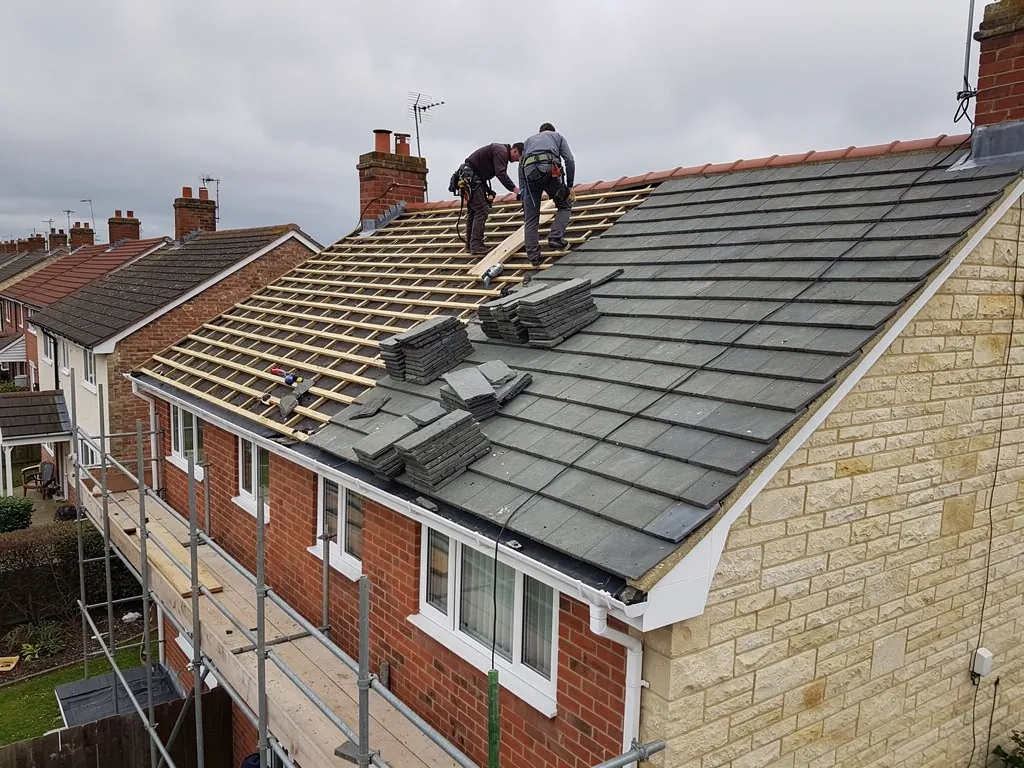
Choosing by pitch, weight and the building
Three tests narrow the field before you think about looks. The first is pitch, the angle of the roof slope. Every covering has a lowest slope it can safely sit at, because below that the rain gets pushed up between the laps, and the product sets that limit rather than anyone's taste. The second is weight. A heavier covering loads the rafters and walls harder, and the Planning Portal draws the line at 15 per cent or more for a heavier new covering, which needs Building Regulations approval, while Approved Document A words it as an increase above 15 per cent. Our guide to roof work and Building Regulations explains how each test is applied.
The third test is the building itself. A listed cottage, a house in a conservation area or a row of matching terraces limits what the council will accept, which is why materials and planning are tied together.
Which covering is lightest?
Metal and membrane coverings weigh far less than tile or stone, so they suit a low-load structure such as an extension or a porch. Natural stone is the other extreme: Cotswold District Council's guide calls a stone slate roof very heavy, at roughly 1,000 kg for every 10 square metres.
Does the covering change the cost of the rest of the job?
It can. A heavier covering may call for stronger timbers, and a thin one may need a fully supported deck, so the covering can change the cost of everything underneath it.
Concrete and clay tiles
Tiles are the covering most Swindon homeowners will know. Concrete tiles come in interlocking profiles, which are quick to lay and shed water at shallow pitches, and in plain tiles that overlap in rows. Clay tiles are fired from clay, hold their colour better and are available as flat plain tiles or curved pantiles.
| Covering | Typical life | Minimum pitch | Price guide |
|---|---|---|---|
| Concrete interlocking tile | Often 30 to 60 years | 12.5° to 25°, by profile | Repair work £90 to £120 per m² |
| Concrete plain tile | Often 30 to 60 years | 35° | Priced on survey |
| Clay plain tile | 40 to 60 years or more | 30° to 40°, by tile | Repair work £110 to £160 per m² |
| Clay pantile | 40 to 60 years or more | 15° for one common pantile | Priced on survey |
Sources: MyBuilder (21 August 2026) and Marley for lifespans and pitches; Checkatrade (October 2026) for repair rates, excluding VAT. The concrete figure comes with a caveat, as Marley states that its expected life of around 60 years is not a guarantee or warranty, while MyBuilder expects concrete tiles to need replacing at some point between 30 and 50 years.
Why do clay tiles last so long on old buildings?
A clay life of around 60 years is often quoted. The Building Conservation Directory answers that a few peg-tiled roofs have survived for many centuries, so 60 years is no reliable ceiling. Weight differs too: a Marley concrete plain tile roof is about 73.8 kg per square metre at a 100 mm gauge.
What about moss on concrete?
Colour and finish matter more than people expect. Concrete tiles come in several tones and surface textures, and a mismatched repair stands out on a roof that has weathered for decades. Clay holds its colour better, and a few reclaimed clay tiles can blend a patch into an old slope. We match what is already there where we can, and say where we cannot.
Moss sits on every covering, but it holds water against porous concrete, so tiles on a shaded slope can look tired earlier than their age suggests. Our guide to clay and concrete roof tiles goes further on the choice.
Slate: the natural stone and its manufactured cousin
Natural slate is split from rock, thin, dense and slow to wear. MyBuilder's slate roof guide, updated 21 August 2026, expects a well-installed slate roof to last 80 to 100 years or more, with Welsh slate regularly going beyond a century. Checkatrade's slate guide puts the full range at 50 to 200 years. The same MyBuilder page gives synthetic or fibre-cement slate 30 to 50 years. Fibre-cement slate is a made product, pressed to resemble the natural stone, with a shorter life to match its lower price.
Slate also changes how a roof is built underneath. It needs sound battens set to the right gauge, and the nails or hooks that hold each slate have to outlast the stone, which is why a roof can fail long before the slate itself has worn. When a slate roof is leaking, the cause is more often a rusted fixing than a worn-out slate.
Pitch matters here. Cupa Pizarras, a slate manufacturer, explains that BS 5534 allows natural slate down to 20 degrees for a 500 mm slate with a 115 mm headlap, and that hooks are not for pitches under 25 degrees. Headlap is how far each slate overlaps the slate two courses below it.
How much does slate cost?
MyBuilder gives £100 to £180 per square metre installed, with Welsh at £140 to £180, Spanish at £100 to £130 and reclaimed at £110 to £150. Checkatrade shows Spanish slate repairs at £150 to £220 per square metre, excluding VAT.
Is natural slate right for a Victorian terrace?
On a terrace of that age it is often the like-for-like answer. The Swindon railway cottages were described in the council's appraisal as having heavy-looking pitched slate roofs. Our guides on natural versus fibre-cement slate and Victorian slate roofs on Swindon's terraces take the question further.
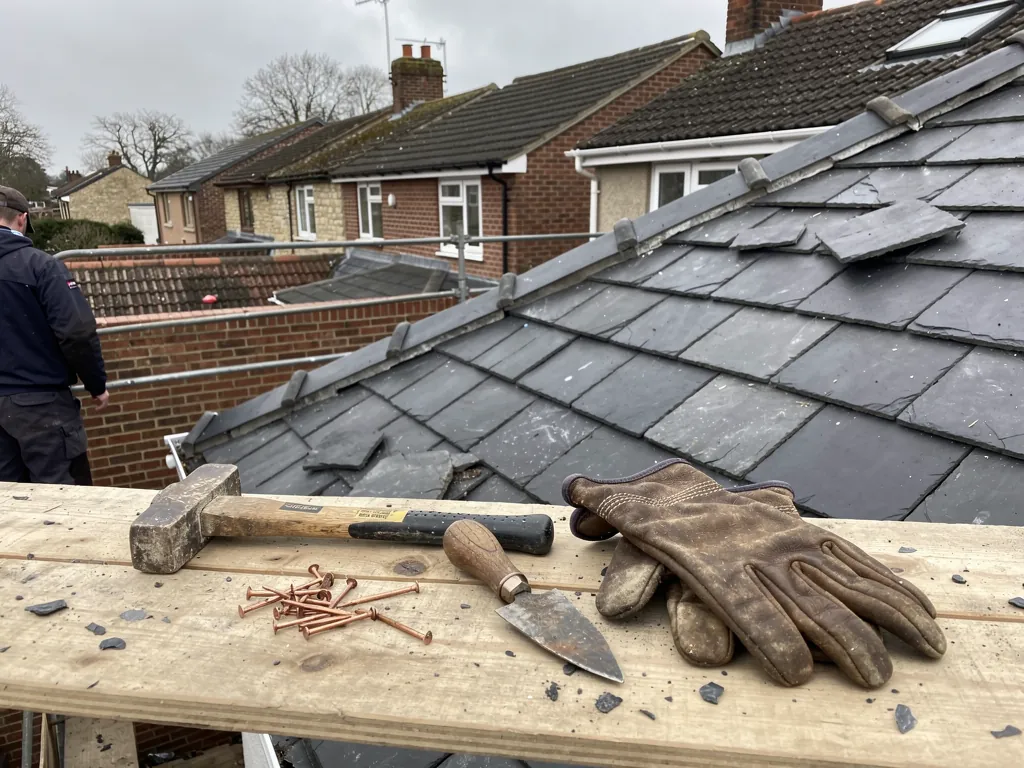
Cotswold stone and its lookalikes
Cotswold stone slate comes from oolitic limestone. Cotswold District Council's technical note says a roof kept in regular repair can easily reach 100 years, and perhaps 200 or 300. That guidance dates from April 2000, so we read it as traditional practice. The slates are laid in diminishing courses: large ones along the eaves, shrinking towards the ridge. Traditional roofs sit at a steep 47 to 55 degrees, although that is a traditional range, not a minimum.
Weight is the cost of this beauty. At about 1,000 kg per 10 square metres, a stone roof has to be carried by suitably strong timbers, and a switch to anything lighter or heavier changes what the structure sees. Checkatrade's guide puts stone slate at around £160 to £210 per square metre, though not specifically for Cotswold stone.
Can a reconstituted slate stand in?
Reconstituted slates such as Bradstone's Cotswold range are concrete made to BS EN 490, with diminishing lengths and random widths. The maker states a lowest pitch of 30 degrees and a laid weight near 84 kg per square metre. English Heritage policy, repeated by the district council, treats such substitutes as wrong for historic buildings.
Does a listed building have to keep real stone?
Listed building consent covers it, and the Cotswold District Local Plan extract in the same guide does not permit natural roofing materials on a listed house to be swapped for modern ones where that would damage its interest. Our Cotswold stone roofing hub deals with this sort of roof directly.
Flat-roof coverings: felt, EPDM, GRP, lead and zinc
Flat and low-slope roofs use sheets and membranes, not tiles. A flat roof still needs a fall so water drains off. IKO, citing BS 6229:2018, recommends a finished fall of at least 1:80, which means designing for 1:40 so tolerances do not eat the margin.
| Covering | Typical life | Price guide per m² |
|---|---|---|
| Torch-on felt | 10 to 20 years | £70 to £100 |
| EPDM rubber | 20 to 30 years or more | £90 to £130 |
| GRP fibreglass | 25 to 40 years | £95 to £150 |
| Lead sheet | 50 to 100 years | £150 to £200 or more |
| Zinc | 60 to 100 years or more | Priced on survey |
Sources: Less (March 2026) and GreenSpec for lifespans, MyBuilder (21 August 2026) for prices, and the zinc manufacturer VMZINC with a contractor quoted by HomeBuilding for zinc. Felt costs least per square metre, but sources disagree on its life: Less says a good felt job can reach 20 years, whereas a poor one could be finished inside ten.
Which flat covering suits a garage?
MyBuilder's garage roof guide gives felt around £75 per square metre, GRP £125 and EPDM £70 to £100. EPDM handles larger spans in one piece, while GRP sets into a single hard shell. Our guides to EPDM rubber roofing and GRP fibreglass roofing compare them head to head.
Matching the covering to your house
A like-for-like replacement is usually the least disruptive choice, so start by identifying what you have. Our guide to the roofs on Swindon houses helps you recognise your own. Where the old covering has failed because of the building, such as a roof too shallow for its tiles, the answer may be a different covering altogether, and that is where pitch and weight tests earn their keep.
On a 1970s estate house with concrete tiles, the sensible move is often another concrete tile or a lighter option. On a railway-era terrace, natural slate keeps the street in character. On a stone cottage near the downs, stone slate is the traditional covering, and a substitute needs the council's agreement. An extension or porch with a shallow slope suits EPDM or GRP, while a bay window or small leaded roof may call for lead.
Who should I trust to recommend a covering?
Someone who looks at your roof first. If a caller at the door insists on a particular material before seeing the roof, read our answer on doorstep roofers before agreeing to anything. At Skyline Swindon Roofing the survey comes first, the covering follows from what the photographs show and what the written quote sets out from what the roof can carry and what the street allows. Our 10-year workmanship guarantee is in writing, whichever covering you choose. Read the home page for how we work, or the cost guide linked above to see where a quote might land.
Ask for the product's own data sheet. Minimum pitch, headlap and fixing method live there, and they override any rule of thumb on this page.