
From the ground, a fibre cement slate and a natural slate can look much alike. Up close, and over thirty or forty years, they behave differently. Natural slate is a split metamorphic rock quarried in Wales, Spain and elsewhere. Fibre cement slate is a manufactured sheet, pressed from cement and reinforcing fibres, cut to the same sizes and fixed in the same way.
That difference drives the choices that matter when a roof is being replaced: how long it should last, what it costs now and later, how heavy it is on the rafters, how the colour weathers, and whether it is acceptable on an older or protected building. This guide goes through each in turn, and sets out where we would recommend one over the other. If you are repairing rather than replacing, start with slate roof repairs, or see the full slate roofing service.
What each material actually is
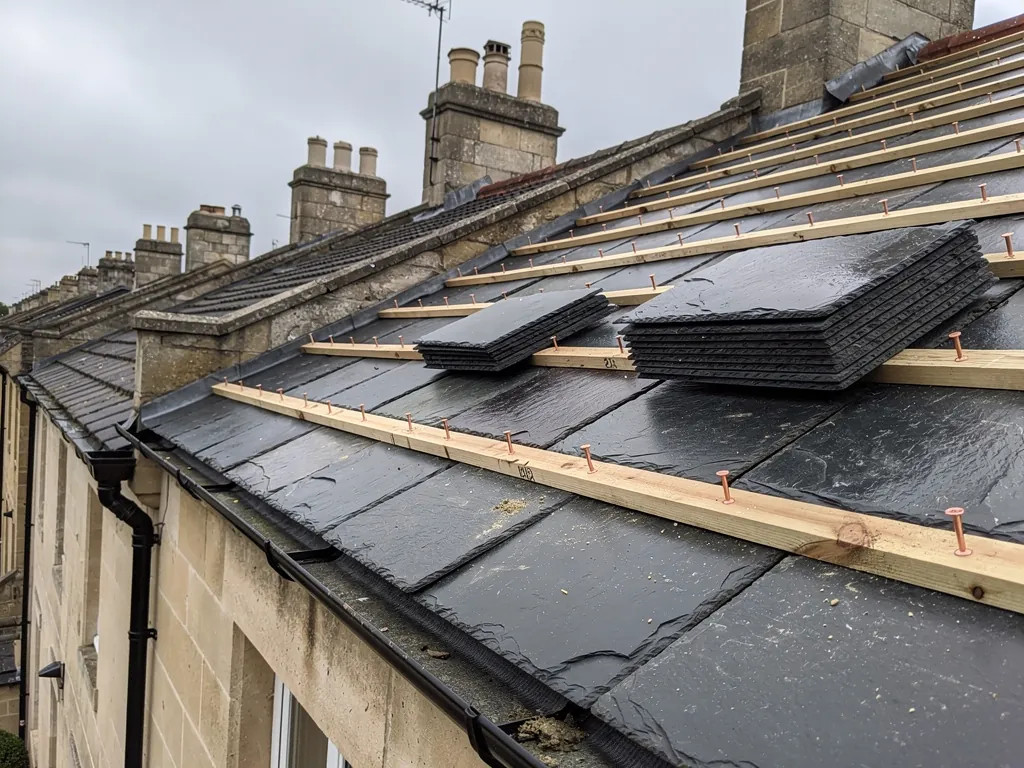
Natural slate is a fine-grained rock that splits cleanly into thin sheets along the planes it formed under pressure. Every slate is therefore a piece of the original stone, trimmed to size and holed for its fixings. The surface is slightly uneven, the edges are rarely identical and the thickness varies a little from slate to slate, which gives a roof its texture.
Fibre cement slate is made in a factory. A mix of cement, mineral fillers and reinforcing fibres is formed into thin boards, cured and cut to size. The surface is flat and the thickness consistent, and a roof of it looks very even. Modern products use fibres that are not asbestos, but a fibre cement sheet laid before 2000 may contain it. An old fibre cement roof deserves caution, because HSE tells owners to presume asbestos in anything built or refurbished before 2000.
Is fibre cement slate the same as synthetic slate?
MyBuilder uses the terms synthetic and fibre-cement slate together in its price guide. Other synthetic slates are made from recycled plastic or rubber, and they behave differently again, so make sure a quote says which product it means. When a roofer says artificial slate, ask for the make and the data sheet.
Welsh and Spanish slate are the two natural sources most often specified in this area. Our page on Welsh and Spanish slate explains how they differ.
Lifespan: decades against a century
MyBuilder's slate roof guide (updated 21 August 2026) puts a well-fitted natural slate roof at 80 to 100 years or more, while Welsh slate regularly clears a hundred years and Spanish slate sits at 75 to 100. Synthetic or fibre-cement slate is given 30 to 50 years on the same page. Checkatrade's slate cost guide stretches the natural range from 50 to 200 years, with more than a century easily reached. Those figures are typical ranges from third-party guides, not promises.
The gap is a matter of the material. Natural slate does not absorb much water, does not rot, and does not lose its strength with age; what usually brings a slate roof down is the nails or the battens, not the slate itself. Fibre cement is more porous and relies on its surface finish to shed water, which weathers over the decades.
Workmanship counts for more than the label in both cases. A natural slate roof fixed with corroding iron nails will fail early, and a fibre cement roof laid with the correct headlap and fixings can reach the upper end of its range.
Why do natural slate roofs outlast their nails?
Old slates are held on by fixings that corrode long before the stone does. That is why a century-old roof can often be stripped, the sound slates kept and the roof relaid on new battens with new fixings. Our page on slate tingles covers one of the repairs that keeps an ageing roof going.
Price today against price over the whole life
MyBuilder's slate guide, updated on 21 August 2026, gives a typical installed cost of £100 to £180 per square metre for slate. Welsh slate is £140 to £180, Spanish £100 to £130 and reclaimed £110 to £150. For stone slate, Checkatrade's guide says the average cost is around £160 to £210 per square metre. Those figures cover natural products, and a fibre cement roof usually costs less on the day.
The comparison that matters is cost per year of service. A roof that costs less now but is replaced in 40 years can cost more over a century than one that cost more now and is still sound at 100. That calculation assumes the repairs stay small and the house stays in your hands for the period, which is not true for everyone. If you plan to sell in the next few years, a lower price may suit you better.
Several factors that are unrelated to the slate itself also move the price:
- How large and complicated the roof is, with its hips, valleys and dormers.
- The access, and whether a scaffold is needed.
- The condition of the battens, boards and rafters beneath.
- The lead work at the chimneys and walls.
Our page on slate roof cost explains the picture in more detail. The written total follows the survey, and it tells you what the roof needs and what it does not.
Weight, pitch and what your rafters can take
Both materials are lighter than concrete tiles or stone slate, which is one reason they suit many roofs. Weight depends on the size, thickness and lap of the product chosen, so the figure on a data sheet matters more than the general rule. Natural slate is dense, but it is cut thin; fibre cement is lighter in the sheet but sometimes thicker.
Swapping to something lighter than before raises no structural worry. Swapping to something heavier does. Among the Planning Portal's cases needing approval is a replacement covering weighing 15 per cent or more above the old one, whereas Approved Document A treats a significant change as an increase above 15%. Your building control body has the final word, and we can supply the figures.
What pitch does each need?
According to Cupa Pizarras, a slate maker, BS 5534 gives 20 degrees as the floor for natural slate where exposure is moderate, the slate is 500 millimetres long and the headlap is 115 millimetres. Hook fixings drop out below 25 degrees. A flatter roof needs another covering. Fibre cement has its own limit, which comes from the product data sheet. Our page on the minimum pitch for slate covers the numbers.
A roof that is too flat for the chosen slate leaks in driven rain even when it looks right. That is a design fault, not a workmanship one, which is why the pitch is measured at the survey.
How they look on day one and in year thirty
On day one, new natural slate is darker and slightly textured, with a depth to the colour that comes from the stone. Welsh slate runs from blue-grey to purple and green, and Spanish slate is generally a darker grey. Fibre cement comes in a few smooth, uniform colours, and its edges are precise.
Over time the two part company. Natural slate mellows slowly. It picks up lichen in damp positions and a soft sheen from the weather, and a mixed roof of slates from different batches blends in. Fibre cement can fade, streak or grow algae and moss on a damp north-facing slope, because its surface holds moisture longer. The colour change is not uniform across a roof, so a section repaired in later years may stand out.
Can you repair a roof with a different slate?
You can, but the join shows. Matching a weathered natural slate is possible with reclaimed or carefully chosen slates, and our page on matching roof slates explains how it works. A fibre cement roof is more tied to the manufacturer's current range, and the original colour or size may no longer be made.
Moss settles on any damp slope. Cleaning only helps for a while, and a hard jet can scar a softer surface, so a gentle method is the better route. MyBuilder's cleaning guide cautions against pressure washing on delicate tiles.
If you are keeping a roof for a long time, look at a sample slate that has been outdoors, not only a clean one from a brochure.
Listed buildings, conservation areas and older houses
This is where the two part ways most clearly. English Heritage policy, as printed in Cotswold District Council's stone slate guide of April 2000, rules out resin-fibre slates, reconstituted stone and concrete tiles as replacements for a real stone slate roof and says they do not suit historic buildings. It was written about stone slates, yet the principle is a useful pointer: conservation officers tend to expect a matching natural material on an old building.
Listed buildings need listed building consent for works that affect their character, and removing a natural covering and replacing it with a modern one is a typical case that can be refused. In Swindon, the Railway Village forms part of Swindon's Railway Conservation Area. Its roofs are generally slate, according to the council's appraisal, and an Article 4 direction withdraws some permitted development rights.
Does a conservation area rule out fibre cement?
A like-for-like re-cover rarely needs planning permission, but changing to a material that alters how the roof looks might. A listing or an Article 4 direction makes the position stricter. Raise it with Swindon Borough Council's planning team, or whichever council covers your address, before you choose. Our page on slate roofs in conservation areas gives the detail.
If your house is in the Railway Village or similar protected setting, the decision is usually made for you, and natural slate is the safe route.
Which one we would recommend, and when
The material we suggest follows the building, not a liking for one product. Where a house has natural slate and a sound structure, we lean towards natural slate again, because it lasts longest, suits the building and is accepted in sensitive places. On a plain modern house outside any protected area, with a tight budget, fibre cement slate can be a sensible lower-cost choice, provided the shorter lifespan is understood from the start.
We would rather quote a modest repair that works than a replacement the roof does not need. A roof with a few dozen slipped slates may need repair, not replacement, and our page on re-slating a roof explains how we decide between the two.
When you ask for quotes, ask each firm the same questions:
- Which exact product and thickness is being quoted, and who makes it?
- What headlap, fixings and underlay are included?
- Are VAT and scaffolding inside the price?
- What happens to the old slates and batten, and who takes away the waste?
Our survey produces pictures of the actual slopes, and the written quote comes next. Workmanship is guaranteed in writing for 10 years, and nothing is left behind on site.