
Nearly every natural slate on a new or re-covered British roof comes from one of two places: the Welsh quarries or the Spanish ones. Spanish slate is the sensible default for many modern jobs because it costs less. Welsh slate has the longer reputation and is often the closer match for the older houses that Swindon grew around. Neither is a bad choice, but the right one depends on the building, the budget and what a conservation officer will accept.
This guide sets the two side by side on appearance, expected life and cost, using published national figures, then looks at the situations where we would lean one way or the other. If you are still weighing slate against a cheaper covering, start with our comparison of natural and fibre-cement slate.
Telling the two apart by eye
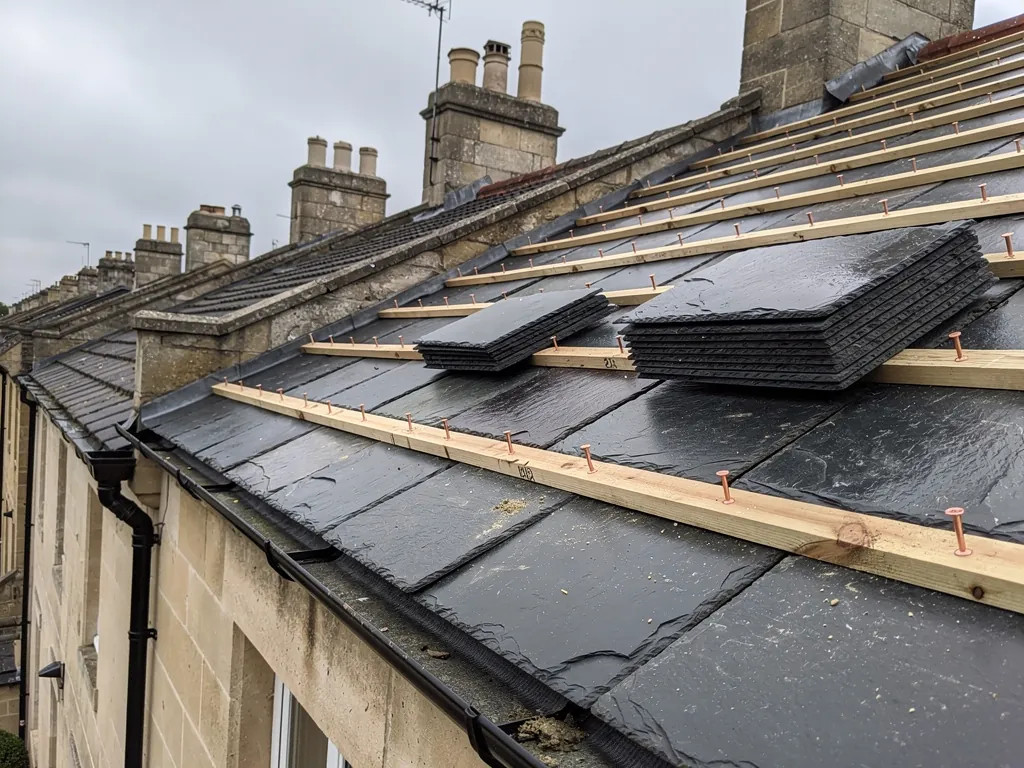
Welsh slate is typically a cooler blue-grey, and the best-known quarries also produce purples, heather tones and greens, so a Welsh roof often carries a slight variation in shade from slate to slate and shifts in tone as the light changes. The face is usually riven, meaning split along the natural grain, and has a slight texture that catches the light.
Spanish slate is generally darker and more uniform, running from charcoal to blue-black, with a flat, even finish. Across a whole slope that gives a calm, regular look, and it is the reason many people like it on a modern extension or a new house. It can look a little flat beside a century-old Welsh roof next door, and that difference becomes visible when the new roof shares a ridge or a party wall with the old one.
Does the colour change with age?
All natural slate weathers, and both types soften in tone over the first years. Natural variation within one batch is normal, so a delivery should be mixed from several pallets to avoid patches of lighter or darker slate on a slope. If you are trying to match a roof, hold a sample against the existing slate in daylight, not under a loft bulb, and look at a wet slate as well as a dry one.
How long each is expected to last
Published lifespans for slate are wide, because they depend as much on the nails, the pitch and the care it receives as on the stone. MyBuilder, whose slate roof cost guide was updated on 21/08/2026, gives slate laid properly 80 to 100 years or more, Welsh slate frequently beyond a century, and Spanish slate 75 to 100 years. Checkatrade gives a wider spread for slate generally, from 50 to 200 years, and adds that many pass 100.
Read those as typical ranges, not promises. A manufacturer's warranty on a slate is not a lifespan, and a slate roof's real limit is usually the fixings or the junction detailing, not the slate itself. We say the same thing about Victorian roofs in our guide to Victorian slate roofs: the slate often outlives the nails.
Does a shorter range mean worse slate?
Not on its own. A range of 75 to 100 years is still several lifetimes of ownership, and most owners will never test the difference. The bigger question is quality within each type. Both Welsh and Spanish quarries produce a range of grades, and bottom-grade slate of either origin is not what you want over a roof you mean to keep. Ask the supplier for the test certificate and the grade of the slate being quoted, and ask us to check it against the survey.
The slate matters, but the lifespan is decided by the nails, the underlay, the flashing and the maintenance.
What each costs, and what else moves the price
On cost, the two are some distance apart. MyBuilder's slate guide (updated 21/08/2026) gives a typical installed price of £100 to £180 per m² for slate overall, with Welsh slate at £140 to £180 per m², Spanish at £100 to £130 and reclaimed slate at £110 to £150. Those numbers are nationwide guide figures and say nothing about our own charges. Your own total arrives with the written quote once the roof has been surveyed.
On a typical semi-detached roof the difference between the two can add up to a meaningful sum, but the slate is only part of the price. Access matters: a house on a narrow terrace street may need a longer scaffold, and a chimney or dormer adds both labour and lead. Around £850 to £1,200 is MyBuilder's figure for scaffolding a standard two-storey house. Disposal of the old covering, the new battens and underlay, and any timber repairs found when the roof is stripped all follow the roof, not the slate origin.
Is the cheaper slate a false economy?
No, provided it is the right grade and the roof is fixed to a good standard. For a roof with no heritage constraint, Spanish slate gives a sound result at a lower price. A cheap slate laid badly is the false economy, and a dear slate laid badly is just a dearer failure. Before comparing totals, find out whether each quote carries VAT and scaffolding.
Where Welsh slate is the better fit
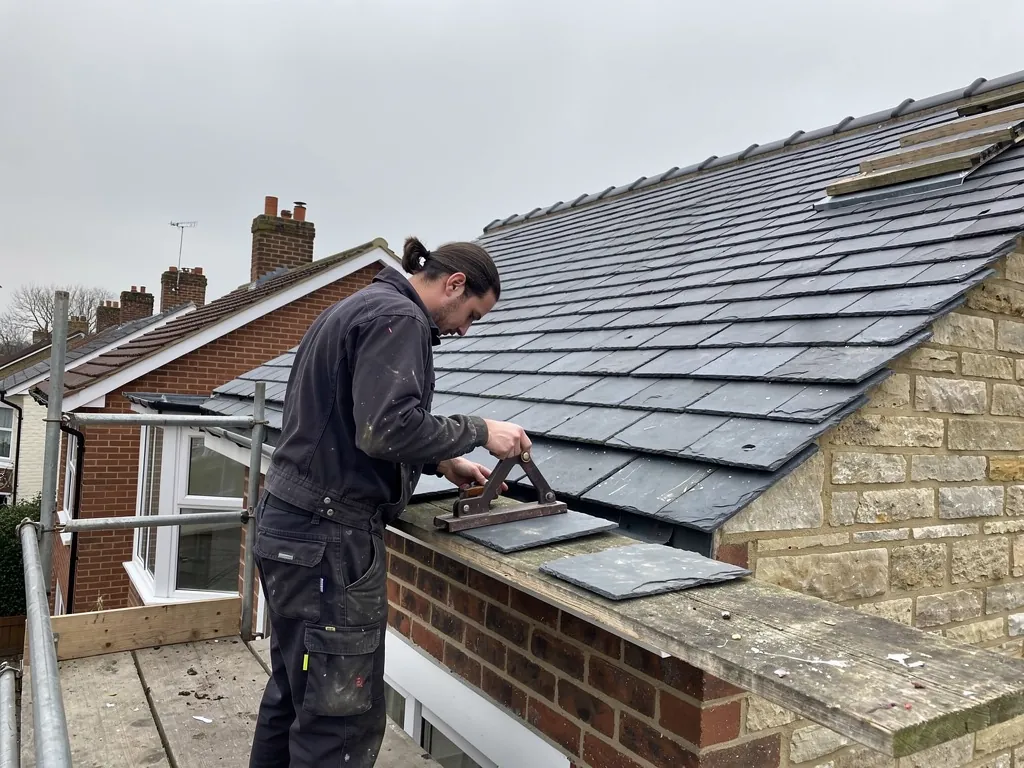
Welsh slate is usually the better answer on an older building where the roof is part of the architecture. That covers a listed cottage, an unlisted house in a conservation area, and a Victorian terrace that is meant to match its neighbours. Swindon's Railway Village is the obvious local example. The council's conservation appraisal says its roofs are generally slate, the cottages were statutorily listed in 1970, and an Article 4 direction was adopted in 1980. On a roof like that, the council can tell you which slate and what detail it will accept, and consent may be needed, so ask Swindon Borough Council's planning and conservation team before you order anything.
The same reasoning applies on a smaller scale to a repair. If a run of slates is missing on an old Welsh roof, replacements that match in size, thickness and colour will blend in. A patch of dark, flat Spanish slate in the middle of a bluer roof stands out for years.
What if the original is Welsh but money is tight?
Reclaimed Welsh slate is the usual compromise, and MyBuilder's range for reclaimed (£110 to £150 per m²) falls between the two new options. It also keeps the weathered look. Reclaimed supply and quality vary, so each batch needs to be sorted and tested, and our guide to slate roof repairs shows how we reuse sound slates already on the roof before buying any.
Where Spanish slate makes sense
Spanish slate suits a new build, an extension, a 1930s or later house without heritage constraints, or any roof where the slate is being chosen for a clean, consistent look and a sensible price. It can also suit a roof where the old covering was already a more recent substitute, such as a poor-quality slate or a tile, and the aim is a good-looking durable roof, not a restoration.
It is also a practical choice where a large area has to be covered. The saving per m² compounds across a big roof, and for a landlord or a homeowner with a long, plain slope the numbers can decide it. In those cases we make sure the cost saving is going into the right place, which means the underlay, the battens, the fixings and the leadwork rather than a reduced specification.
Can Spanish slate be used on a Victorian terrace?
It can, but we would not do it casually. On an unlisted terrace outside a conservation area, planning rarely prevents it. If the street still has a continuous run of Welsh roofs, the new colour will stand out, and the mismatch is hard to undo later. A mixed-material terrace looks like a patchwork from the road. If you are unsure, we can show you both options against photographs of your own roofline, and our guide to slate roof cost shows what moves the price.
Mixing slate types and patching an existing roof
Repairs raise a practical question: can new slate be set in among old? The answer depends on the size and thickness as well as the colour. A thicker or thinner slate does not sit on the course below in the same way, so the tails may ride up or leave a gap, and the roof develops a ripple. Matching the dimensions matters as much as matching the shade.
For a small repair of a few slates, we first look for sound slates on the same roof that can be taken from a hidden slope, a low-visibility area or a back addition, and used where the repair shows. That keeps the front elevation consistent. If a replacement is bought, it should be of the same origin, size and thickness as far as supply allows. Our guide to slipped slates covers the usual causes and the repair that follows.
For larger works, a full re-slate in a single slate type gives a uniform result. Combining Welsh and Spanish on different slopes of a single house is possible and sometimes done on a rear roof that cannot be seen from the street, but the join between them at a hip, valley or ridge needs careful detailing.
Does a different slate change the roof's weight?
It can. Slate thickness varies by quarry and grade, so a heavier slate adds load. A heavier slate matters because the Planning Portal says Building Regulations approval applies once the roof covering gains 15 per cent or more in weight. We check the structure and the weight before anything is ordered.
Choosing, and what to ask for in writing
When you compare quotes, ask each contractor to name the slate: the country, the quarry or supplier, the size, the grade and the thickness. A quote that says only natural slate leaves too much unsaid. Ask for the test certificate for the slate being supplied, and ask how the old slates will be treated, whether reused, sold or taken away, and whether a new underlay and ventilation are included.
Then bring the building into the decision. For an unlisted modern roof, price and appearance lead. For a listed house or one in the Railway Village or another conservation area, start with the council's view, because the choice of slate may be part of a consent condition. For a Victorian terrace with matching neighbours, a match will usually serve you better than the lowest-priced option.
- Slate origin, size and grade named in the written quote
- Underlay, battens and ventilation described
- VAT and scaffold either included or stated as excluded
- Lead flashings and the ridge covered by the same quote
The survey puts photographs of the actual slates in your hands, and our 10-year workmanship guarantee is in writing. Call 01793 626096, or write through WhatsApp or the enquiry form. The wider slate roofing service is described on its own page.