
Slate suits repair better than most coverings. Each slate is a separate piece, and a damaged one can usually come out and be replaced while its neighbours stay put. That is a real advantage on a Victorian terrace, where stripping a full pitch to cure one leak would be overkill. More on the range of work is on our slate roofing page.
It only works when the problem is local, though. A repair treats a symptom, and the question a roofer has to answer first is whether the symptom is isolated or the first sign of something wider. This guide takes the methods in the order we would use them, from a single replacement slate to part-reslating, and says where each stops being the right answer. Water coming in as you read this? A leaking roof is our priority, and the opening job is containing the water. A lasting repair comes after the cause has been traced.
Finding the fault before touching a slate
Slate repairs fail most often because the fault was misread. A stain on a bedroom ceiling can appear well away from the break, because water tracks along the timbers and the underlay before it finds a way down. Starting with the slate nearest the stain is a gamble.
Where does the water usually enter?
Our approach is to work upwards from the damp, looking at the sources in order: slipped or broken slates, then the lead at walls and chimneys, then valleys and the ridge, and last the gutters and roofline. The survey photographs record each of these at your address, so you can see the fault for yourself ahead of any figure being agreed.
Does the loft tell you more than the roof?
Often it does. From inside, daylight through a gap, a wet rafter or a trail of staining on the underlay gives the line of the leak. On roofs with no underlay, which is common on older Swindon terraces, rain that gets past a slate falls straight through, so the loft is the quickest way to match a gap outside to a stain below.
Our survey notes the nail condition across the whole slope as well as the broken slate. That reading tells us whether a repair will last. It is the same reasoning behind the advice in our guide to slate roof maintenance.
Replacing a broken or missing slate
The standard repair is a one-for-one swap. The old slate is out, a matching slate goes in, and it is secured so it cannot slide.
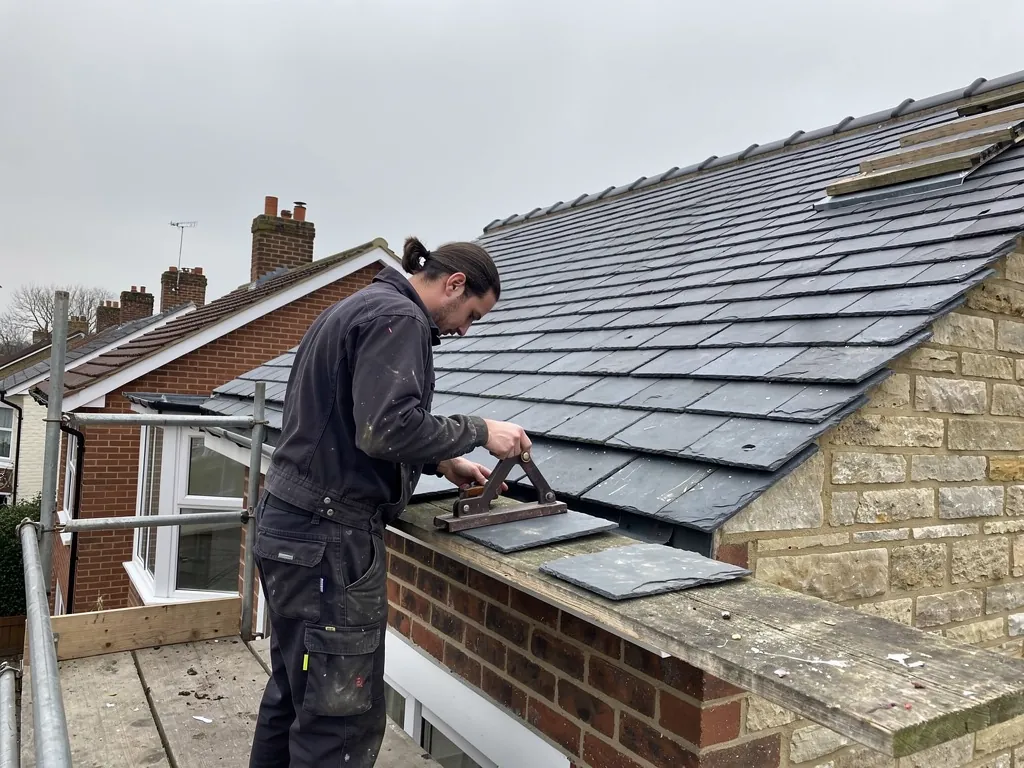
A slate is held by nails driven through holes near its top and covered by the course above. To take a broken slate out, a roofer slides a slate ripper, a long flat tool with a hooked barb at each side, up under it and cuts or pulls the nails. The ripper has to be used with care, because it can snap the slates around it if the angle is wrong. With the old slate out, the new one slides in from below and can no longer be nailed in the usual way, since the course above hides the nail position.
How is the new slate held on?
Two ways. A tingle is a strip of lead or copper nailed to the batten beneath and bent up over the tail of the new slate to keep it from sliding. A slate hook does a similar job, hooking over the batten and clipping the slate's lower edge. Cupa Pizarras advises against hooks on any pitch below 25 degrees, so a lower slope needs a tingle or a different method. Our page on slate tingles covers both.
MyBuilder puts minor roof repairs at £100 to £300, and replacing a handful of slates falls within that band.
Temporary measures: what holds until the repair
Sometimes a leak arrives before the repair can be done. A temporary fix is only worth having if it stops the damage and leaves the proper job easier, never harder.
The sensible short-term steps are simple. Catch the drip with a bucket and move belongings. Lift loft insulation away from the wet area so it can dry. If a slate is missing and the weather is bad, a roofer can fit a temporary strip or cover the gap with a sheet held down without nails through the sound slates. What does harm is a smear of bitumen or sealant across the gap, which holds water in and must be cleaned away before the real repair can start.
Should I climb up to cover the gap myself?
No. Slate is brittle and slippery when wet, and a fall from even a lean-to is serious. A bucket indoors is safer than a tarpaulin you cannot secure. If water is running in fast, call us, and the first thing we do is stop the water coming in. The drip you see may also have a second source nearby, so the temporary fix is a pause, not the answer.
Matching the slate you already have
The visible risk in any repair is a new slate that stands out. Slate weathers, and old slates are a different tone from a new one. Size and thickness vary too, so the replacement has to fit the course it goes into.
There are three sources. Reclaimed slates from a salvage yard or from a roof that was stripped are the best match for weathered colour, and the right size can be sorted from a batch. New natural slate matches the type but not the age. Fibre-cement is the easiest to find and the lowest in price but a poor visual match, and it does not behave like natural slate, so it is not a good choice on a roof that is otherwise natural. Our page on natural against fibre-cement slate explains the difference in how they age.
What if the roof has a mix of slates already?
Many old roofs have had repairs over decades, and the patchwork is part of the character. A roofer will usually place the odd replacement at the back or the less visible slope and use the best-matched pieces on the front elevation. Listed status, or a home within a conservation area, gives the Council a say, because the look of the roof is a planning matter there. If in doubt, ask Swindon Borough Council's planners before you change material.
Re-nailing and when nails are the real problem
Some repairs are not about slates at all. A slate that has slid is often a slate whose nail has rusted, and the cure is to fix the course, not just the slate.
Re-nailing is what it sounds like. Slates are lifted in turn and fixed again with new nails, usually copper or a modern corrosion-resistant type, and the roof is returned to level. The work is slow, so it earns its keep on a short run with healthy slate on either side.
How can you tell if the nails have gone?
The pattern shows it. Slates that have dropped in a line along one course, or on one slope, usually mean the nails are failing together, which is the condition known as nail sickness. Our nail sickness page covers how it develops and how we test for it. A gentle lift of each slate by hand shows how much it moves, and one that rises freely has lost its fixing.
The point where re-nailing stops being worth it is when slates are slipping widely. Once more than the odd course has gone, the labour to lift and re-fix sits close to the cost of stripping and relaying, and a new roof stays dry for longer. If the survey shows that, we put it in the written quote in those terms. What we aim for is work in proportion to the fault.
Lead, valleys and ridges in a repair
Many leaks that look like slate problems turn out to be lead. Cracked flashings, open soakers and worn valley linings let in water at the joints, and no amount of slate replacement will stop it.
A flashing repair can range from a patch to a full renewal. MyJobQuote puts a lead patch on a chimney at £150 to £250 and a full replacement at £350 to £460 without scaffold or £700 to £920 with it. Checkatrade gives Code 5 lead flashing not exceeding 150 mm at £50 to £70 per metre and stepped flashing at £80 to £120 per metre, excluding VAT. Leadworx names Code 4 as the usual weight for everyday flashings and keeps Code 3 for soakers.
Valleys are different. A lined valley with a single crack can be patched, but a valley that has fatigued along its length needs relining, and that means lifting the slates on both sides. A blocked valley, by contrast, needs only clearing. For the ridge, re-bedding runs £300 to £600 in MyBuilder's slate guide, and since BS 5534:2014 the fixing also includes mechanical clips or screws. Details are in our guide to slate valleys.
If wildlife is using a gap in the roof, such as bats in a roof space, tell us before work starts, because bats are protected and the work has to take account of them.
Part-reslating: a slope, a section or a whole roof
Between a single slate and a full re-roof sits part-reslating. It is the right answer when one area is in poor condition and the rest is sound, for example a rear slope that takes the weather or a section near a leaking valley.
The slates are stripped from the area, the battens checked and renewed where rotten, the underlay laid, and the slates reused where good, with new or reclaimed slates to fill the gaps. The edge between old and new is dressed carefully so water cannot get in at the join. It is a real job, not a patch, and it gives a clean break where the old roof can be left to carry on.
Does part-reslating affect Building Regulations?
It can. The Planning Portal sets two limits: less than 25 per cent of the total building envelope and less than 50 per cent of the roof. Work that stays under both usually needs no building control application, whereas work beyond them brings approval into play. Under Part L, renovating more than 50% of the roof surface means the whole roof is improved to the stated insulation value. If the work turns out to be notifiable, we tell you which approval applies and deal with the Building Regulations notification for you.
Compare that with a whole re-roof in our reslating guide, which describes what stripping, relaying and re-battening involve and how long to allow.
What a repair should cost, and when to stop patching
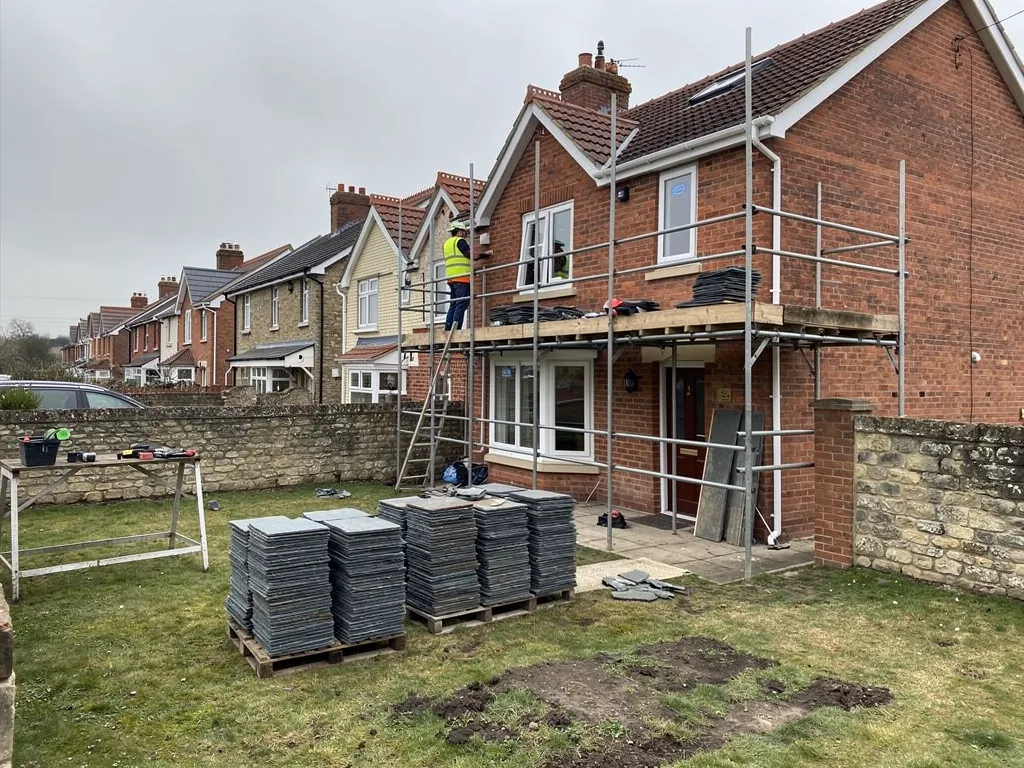
Typical UK costs give a sense of scale. MyBuilder lists minor roof repairs at £100 to £300, moderate repairs at £500 to £1,000, and major repairs £2,500 or more. Checkatrade (repair table, June 2026) lists natural Spanish slate repair at £150 to £220 per m², before VAT and access equipment. Scaffolding, where the work is high, adds MyBuilder's typical £850 to £1,200 for a two-storey house, so on a small repair the access can cost more than the slates.
That is why repairs are best grouped. If a roof needs three small jobs on one elevation, doing them in a single visit saves paying for access three times. The written quote shows one total for the job.
A useful test: if repair bills over a few years are heading towards the price of a re-roof, the repairs are no longer saving money.
The signs that it is time to stop patching are consistent: slipped slates across several courses, repeated leaks at different spots, delaminating slates that flake as they are touched, and timbers that show rot when the roof is opened. It is better to learn that from a survey than from a second repair bill.