
Slate has a reputation for being fit and forget, and the reputation is half earned. The slates themselves rarely wear out in a lifetime. What fails first is everything that holds them or sits around them: the nails, the lead at the walls and chimneys, the valley linings, the ridge and the gutters. Those are the parts that need an eye kept on them.
This guide sets out a sensible routine for a slate roof on a Swindon house, what you can safely look at yourself from the ground, what belongs to a roofer, and what each type of fault tends to cost to put right. It is written for a pitched roof covered in natural slate. If your roof is a century or more old, our page on Victorian slate roofs adds what to expect from that age of building.
A routine that fits the roof
Think of maintenance in three layers. The first is a glance from the garden or pavement. The second is a closer look at the details by someone safely up at roof level. The third is the odd bigger job, such as new lead or a re-bedded ridge, that comes round every few decades.
How often should a slate roof be looked at?
There is no published rule specific to slate, so use judgement. Walking round the house with binoculars once as the weather warms and once as the leaves fall costs nothing, and it shows up the obvious changes. Add a check after any named storm or a night of hard wind. A roofer's closer inspection every few years, or whenever you buy a house, goes further because it reaches the places you cannot see from below. MyBuilder puts a roof inspection at around £150 to £250 for a standard visit (updated 21 August 2026).
Which signs can you spot without a ladder?
- Slates sitting lower than their neighbours, or a gap showing a darker line of felt or batten.
- Broken pieces of slate in the gutter, on the path or in a flower bed.
- Lead lifted or hanging away from a chimney or wall.
- Sagging gutters, water stains below them, or green growth at the eaves.
- A ridge line that has a kink or a missing piece.
- Moss thickening along the eaves, or a stained patch on the wall below a gutter joint.
A note is more use than memory. Take a photograph of each slope from the same spot each time, and the changes show when you compare them.
What about the loft side of the roof?
The underside tells you things the outside cannot. On a dry day, shine a torch along the battens and under the slates from the hatch. Daylight showing through between slates, a damp patch on a rafter, a stain on the underlay or a trail of dust and grit below one spot all point to a fault above. If you find insulation that is dark and wet, note where it sits and how the weather was, and send us a photograph. Where a loft has been boarded or insulated since the roof was laid, check the eaves too. Insulation pushed hard into the eaves blocks the air that keeps the timbers dry.
Slipped slates, and why they slip
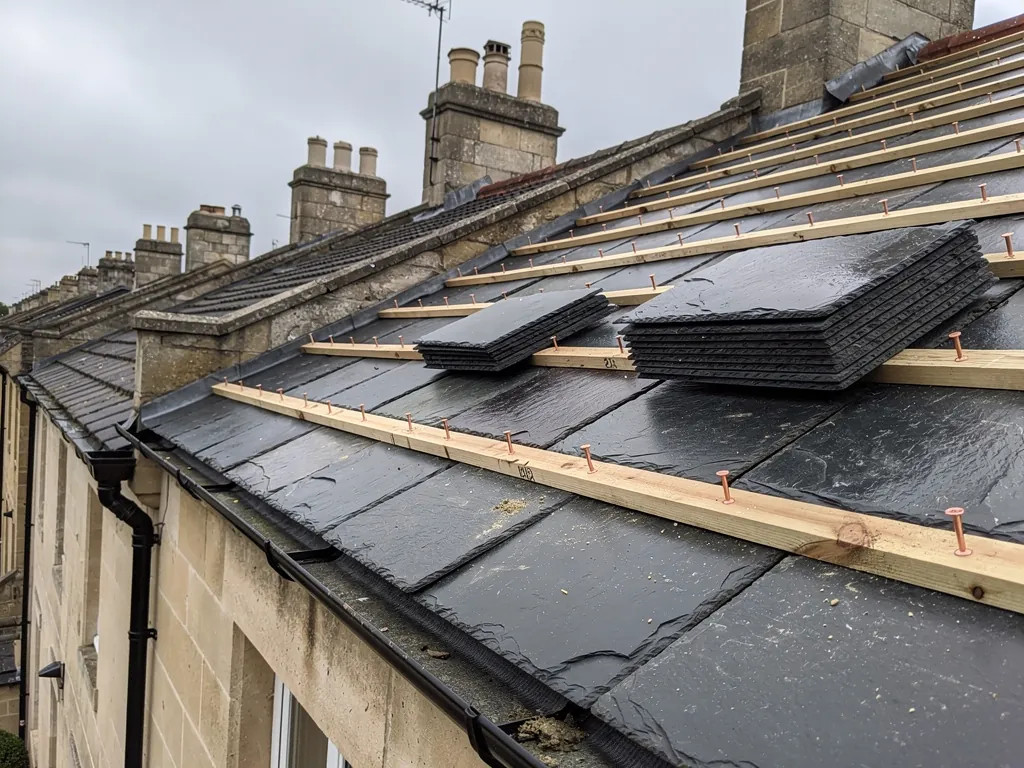
A slate roof is held by nails, and a slipped slate is almost always a failed nail. Older roofs were often fixed with iron nails, which rust and thin over decades. Once one gives way, the slate slides down until the course below stops it, leaving a gap at the top and a slate sitting proud.
One slate on a sound roof is a minor job. Slates that slip in a line across one course, or in clusters over a slope, suggest the nails are going everywhere, a condition called nail sickness. It is worth reading our page on nail sickness before deciding whether to repair or go further. For single slates, a roofer can fit a small strip of lead or a tingle, which is a lead or copper tab that holds the slate in place from below, without lifting the whole course.
MyBuilder lists minor roof repairs at £100 to £300, and that band is where an afternoon on a few slates tends to fall. Don't put it off, though. Rain that finds a gap in a roof with no underlay lands straight on the ceiling plaster, and the damp can spread long before a stain shows.
Lead flashings, soakers and valleys
Of all the details on a slate roof, the lead is usually the first to need attention. Lead goes in wherever slates finish against brickwork, whether a party wall, a stack or a dormer cheek, and the metal swells and shrinks with the weather. Years of that movement open cracks, while the pointing that pins the upper edge into the brickwork crumbles away.
Lead sheet comes in codes that run from 3 to 8. Code 3 is used for soakers, the small pieces laid between slate courses, and Leadworx describes Code 4 as the standard for ordinary flashings. A flashing that has been tightly fixed, or cut in lengths too long for the metal to move, is the one that splits. MyJobQuote reckons lead flashing, installed correctly, can outlast 80 years, so a cracked flashing on a Victorian roof often tells you it is simply past its time.
What goes wrong in a valley?
Where two slopes run together at an internal angle, the valley takes the rainwater of both. Debris, moss and slate fragments build up in it, and a blocked valley can overflow under the slates on either side. Clearing the valley is a quick and often useful job. The lining beneath, whether lead or a modern trough, may need repair if you see cracks, lifted edges or open laps. Our page on slate valleys goes through the options.
Checkatrade's repair guide, with a table dated June 2026, prices straight lead flashing at £50 to £70 per metre and stepped flashing at £80 to £120 per metre, excluding VAT.
Gutters, downpipes and the roofline
A gutter is the first thing to fail and the last thing most owners look at. Slate is a hard, smooth surface that sheds water fast, so a blocked or sagging gutter overflows readily. The water then runs behind the fascia and into the wall, where it looks very like a roof leak from inside.
Gutter manufacturers want the run tilted gently to the outlet, with figures from 1:600 to 1:350 depending on the system. Brett Martin sets its brackets no further than 900 mm apart, and FloPlast puts the limit at 500 mm for its MiniFlo range. A gutter that holds water along part of its length has dropped at a bracket and needs re-fixing, not just clearing.
Do leaf guards help?
Sometimes. They reduce the amount of leaf litter that reaches the gutter, and a roof close to trees will benefit. They do not replace a clear-out, because grit washed off the slates still collects in the bottom. Slate roofs shed a little grit as they weather, and it settles where water slows.
The roofline also matters. For the boards that carry the gutter, MyBuilder suggests checking the fascia and soffit boards every five years and replacing them at intervals of 10 to 20 years, depending on material and weather. Rotten fascia boards cannot carry a gutter, and slates that hang over a decayed board lose their support at the eaves. For the cost of gutters see MyBuilder's figure of £30 to £70 per metre for replacement. All three details can be put right in one visit when the scaffold is already up.
Moss, lichen and cleaning
Moss grows on slate where the surface stays damp and shaded, and a north-facing slope behind a tall hedge is the usual place. A thin film of lichen does little harm. A thick moss cushion does more, because it keeps the slate wet, props up the tail of each slate and traps debris in the gaps between courses.
The cleaning method matters more than the cleaning. MyBuilder's roof cleaning guide gives manual scraping at £5 to £10 per m², soft wash at £15 to £20 per m² and pressure washing at £10 to £15 per m², with a caution that a pressure wash could harm fragile tiles. Slate that is old and laminating is delicate. A hard jet can lift flakes from the surface and drive water under the laps. For slate the guide puts a typical roof clean at £500 to £1,000.
Keep a roof clean by scraping or soft washing, and have any treatment applied to growth rather than blasted at it. Never walk on a wet slate roof to do it yourself.
Our guide to walking on slate explains why: slates snap under a boot, and one cracked slate stays cracked long after the cleaner has gone.
Ridges, verges and the details at the top
The ridge along the apex and the verge at a gable end both sit where wind pulls hardest. On many older slate roofs they were bedded on mortar, which shrinks and crumbles. Under BS 5534:2014 bedding mortar by itself is no longer counted on for ridge and hip tiles, which now carry mechanical fixings too. A re-bed on an older roof is the moment to add them.
In MyBuilder's slate roof guide a ridge that is re-bedded or replaced runs £300 to £600, and simple repointing of ridge or hip tiles £200 to £400. A dry-fix ridge, which clips the tiles down and seals the joints without mortar, is covered by BS 8612:2018 and suits some roofs better than others. Which one fits depends on the ridge tile in place, so we look at it on the survey.
At the verge, look for mortar dropping from the edge and for gaps that birds or wasps might use. Flaunching, the sloping mortar cap around chimney pots, deserves the same look. Cracks in it let water into the stack, and the leak then shows indoors far from the real fault. If you see any of these from below, it is worth getting someone up there.
Listed buildings, conservation areas and satellite dishes
Upkeep on a slate roof is normally like-for-like, which seldom needs planning permission. Listed buildings and streets under an Article 4 direction are the exceptions, because more is controlled there. If your house is listed, speak to the planning officers at Swindon Borough Council first about anything that changes the roof's appearance.
The Railway Village is the local example. Its cottages were listed in 1970, and the Council's Railway Conservation Area appraisal says the roofs are generally slate. The same appraisal adds that new dishes and aerials fixed to chimneys or roof slopes will be resisted. If you live in a conservation area, the sensible approach is to repair in the same material and ask before changing anything visible. Our page on slate conservation covers matching, reuse and consent.
Upkeep and renewal are different jobs, though the line blurs on a roof that is half-worn. Our slate roofing page sets out the whole range of work.
Where a roof has reached the point of renewal, the line is clearer. If a survey finds that most of the nails have gone, the honest answer is a re-slate. Our reslating guide describes what that involves, and how long a roof that has been kept dry and clear can then go on for. Keeping water out is the whole point, and we explain how in our page on making a slate roof waterproof.