1980s estate houses with brown concrete tile roofs

Roofers in Woolton Hill

Tiling, slating, ridges, chimneys and low-slope roofs for the church village on the Hampshire side of the North Wessex Downs, from the first Victorian cottages to the housing that followed the 1950s.

Woolton Hill's roofs, from church to close

Brick cottages with tiled roofs and chimneys
The Victorian village

Until the middle of the nineteenth century this was farmland, woodland and scattered houses. St Thomas was consecrated in 1849 and Woolton Hill became its own ecclesiastical parish in 1850, split off from East Woodhay, so the oldest streets date from those first years of the village. Buildings of that age in southern England were covered in clay tile or Welsh slate, and which one a house carries is the first thing we check, because the faults differ. Slate fails at its nail fixings and its lead; old clay tiles fail through frost and softened bedding. Chimney stacks, which stand tall on these houses, take the weather hardest of all.

Large country house with hipped roofs
The big houses and their grounds

The parish includes East Woodhay House, Burley, The Mount, Woolton House, Harwood Lodge and Tile Barn, and Malverleys, a white brick house in the Italian style, stands in its own grounds nearby. Houses of this scale have roofs to match: long hips, several valleys, parapet gutters, tall stacks and lead flashings at every junction. Repairs on them are rarely a single tile. They are a matter of reading where water travels across a complicated roof and finding the one joint that lets it in. Access, and the scaffold it needs, usually shapes the plan from the first visit.

Estate houses with concrete tile roofs
Housing from the 1950s onwards

The village grew rapidly from the 1950s, and the roofs we are asked about on those streets belong to houses of that era and later. Concrete interlocking tiles were widely used for mid-century building, and they bring the familiar later-life faults: ridge tiles loosened where the original bedding has failed, cracked tiles, felt underlay that has dried out and torn under the battens, and fascia boards that have rotted behind the gutter. Garage, porch and extension roofs at the back are frequently built almost level, and they wear out sooner than the main pitch, so each one gets a separate look on the survey.

Chalk above the Enborne

Map showing Woolton Hill and central Swindon. 28 road miles south-east of central Swindon.

Distance
28 road miles south-east of central Swindon
Council
Basingstoke and Deane Borough Council
Council
Basingstoke and Deane Borough Council
Landscape
North Wessex Downs National Landscape
Setting
Chalk subsoil, with the land falling north to the River Enborne

Quick answers for Woolton Hill roof owners

Does my Woolton Hill address carry any listing or protection?

Basingstoke and Deane Borough Council can tell you for certain. Putting back what was there seldom triggers an application in either case. If your address is in doubt, we check before we quote, and we tell you what we found.

Does North Wessex Downs status change a re-roof?

Not a matching re-cover. It matters for new roof windows and dormers, and our roof window planning page explains how that works before you commit to a design.

What fails first on a post-1950s Woolton Hill house?

Usually the ridge bedding, the old underlay beneath the tiles and the rear flat roofs. The survey photographs show which of the three is the real fault.

Q1

What covers the older roofs of Woolton Hill?

Weathered brick chimney stack with eroded joints and cracked pot
Roofer repointing a stone chimney stack above lead flashing

The short answer

Clay tile and Welsh slate are the coverings we find on the first Victorian buildings in the village, with concrete tile on the housing that came after the 1950s. The first job on any visit is to identify the covering, because tile and slate go wrong in different ways.

The village is young by Hampshire standards. The church came first, then the parish, and the houses followed over the decades. That gives the roofs a fairly clear order, which helps when we are working out what went wrong and when it was last touched.

How do you tell tile from slate from the ground?

Slate lies flat in tidy courses and has a dull, even grey look. Clay plain tiles are smaller, with a slight curve and a warmer colour. From the pavement you can usually tell which you have, but the nails, battens and underlay beneath are what decide the repair, and those only show from the roof itself or from photographs taken there.

Why do Victorian chimneys cause so many leaks?

Tall stacks stand in the full weather, and the lead tray and flashings around them are the weakest link on most older houses. Mortar joints crack, the flaunching that holds the pots in place softens, and water finds the gap. Rebuilding a stack is sometimes unavoidable, but resealing the flashings and repointing is a smaller job where the brickwork is sound. Our chimney repairs page covers when each is right.

What about the porches and lean-tos?

Small roofs on older houses are often the most neglected. A scullery lean-to or a porch may carry a different covering from the main roof, laid at a lower pitch. Low pitches shed water slowly, so a tile or slate that works on a steep slope can let water through on a shallow one. We check the pitch against the covering before deciding whether a repair will hold, and when it will not, we tell you that at the survey, long before any work is booked. Sometimes a modest change to the detail at the eaves or the lap is all a shallow roof needs; sometimes only a different covering will do.

For the wider picture on tiled and slated slopes, see our pitched roofing page.

Q2

Do large houses near Woolton Hill need different roofing?

The answer

They need a different approach rather than different materials. Long hips, valleys and parapet gutters multiply the number of joints that can leak, so repair starts with tracing the water rather than replacing tiles. Scaffold access is a real part of the plan and of the cost.

Houses such as those in the parish record, and the white brick Italian-style house at Malverleys beyond, were built with roofs that have many parts. Each part has its own way of failing, and each is reached differently. The right fix is usually smaller than the building suggests.

Why is tracing a leak harder on a big roof?

Water runs along timbers and behind lead before it ever drips onto a ceiling, so the stain inside a room can be several metres from the entry point. We start at the stain, work upwards and sideways, and photograph each suspect joint, so that the written quote covers the actual fault and not a guess. Our 10-year workmanship guarantee, in writing, applies to the work we do.

What is a valley, and why does it matter?

A valley forms wherever two slopes meet in an inward corner, a kind of gutter running down the roof itself. It carries water from both slopes, so it is the busiest part of the roof. Lead-lined valleys can crack with age, and tiled valleys can clog with leaves and moss. A parapet gutter, where the roof drains into a lead-lined trough behind a low wall, needs the same care and often hides trouble for years before a ceiling shows it.

Will scaffolding be needed?

For work at height on a large house, nearly always. A safe working platform lets the roofer carry tiles and lead without risk, and it protects the gardens below. Check that every total you are given states whether scaffolding and VAT are in it, because that alone explains many of the gaps between prices on a tall house.

Where a sound roof only needs its lead renewed, our lead roofing page explains the work. The quote follows the survey, never before it.


Where we start

Find the one failing joint first, then decide how much roof the repair really needs.

Q3

Which rules apply to roof work in Woolton Hill?

Rolled lead roof covering over a bay above white windows
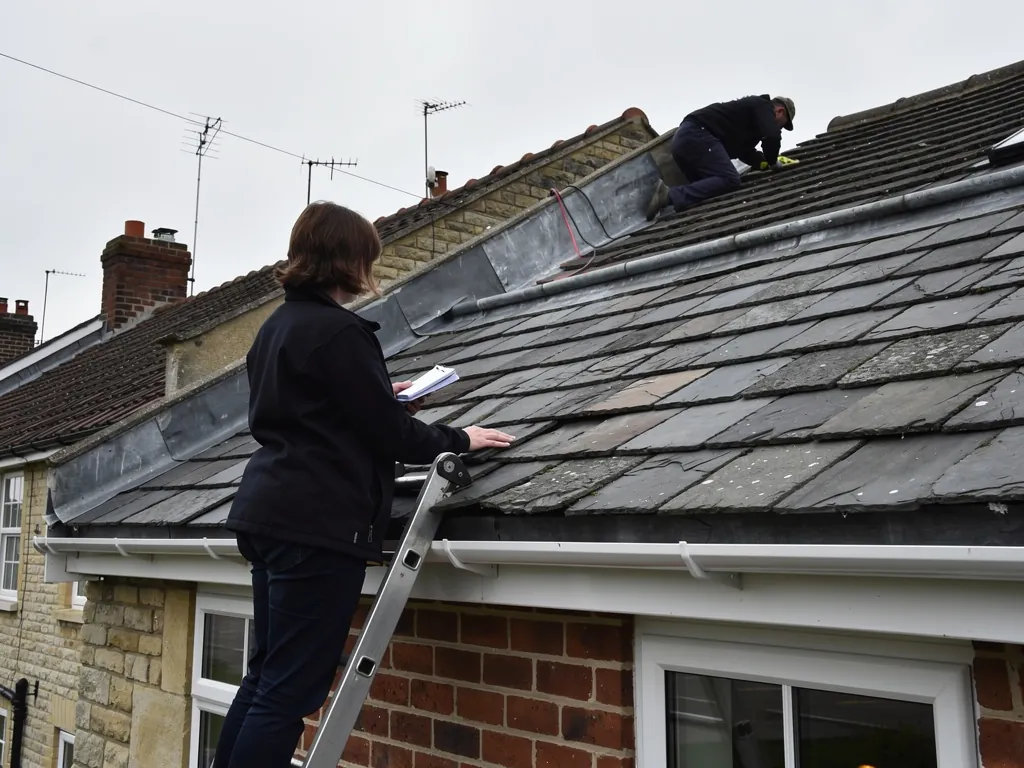
Surveyor on a ladder checking slates with a notebook

The short answer

Most repairs need no permission. Bigger re-roofs can bring in Building Regulations, and a house inside a protected area or a listed building has extra checks. Basingstoke and Deane Borough Council handles planning, and we explain consent and handle any building control notification.

Small mending jobs, such as refixing tiles or replacing one flashing, are maintenance and usually involve no application. Three situations alter that, and they are worth knowing before any quotes arrive.

At what point does re-roofing become notifiable?

The Planning Portal gives two limits: under 25 per cent of the total building envelope and under 50 per cent of the roof. While both hold, building control approval is not normally needed. Once either is passed, approval applies, and a better level of insulation can be required as well. A new covering that increases roof weight by 15 per cent or more also needs approval. We tell you at the survey where your job sits against these figures, and we file the notification ourselves when work is notifiable.

Does the National Landscape matter?

Woolton Hill sits in the North Wessex Downs National Landscape. Its role is to advise, while Basingstoke and Deane decides any application. Putting back the same covering is untouched by it. New roof windows raise a different question, and our roof window planning page sets out what to check first.

Does a listed Woolton Hill house need consent for a new covering?

Should the house be listed, listed building consent is needed for roof work that alters its character, and swapping tile for slate would be exactly that sort of change. The council's records are the authority on both listing and conservation areas, so ask Basingstoke and Deane Borough Council to confirm the status of your address before work starts. We can go through the answer with you, and we will not price a listed roof until we know what the consent position is.

Our roof replacement page covers the larger jobs where these rules begin to apply.

MythA National Landscape address turns every roof job into a planning matter.

FactMatching repairs and re-covers are left alone; the added controls apply to new roof windows, dormers and other alterations.

Roofing services in Woolton Hill

Questions from the lanes above the Enborne

Why are ridge tiles so often loose on Woolton Hill's mid-century houses?

Many were set in mortar alone, which cracks and crumbles with age. After the 2014 revision of BS 5534, a bed of mortar alone is no longer the accepted way to hold a ridge or hip, so a modern re-bed adds mechanical fixing, or uses a tested dry-fix system with dedicated clips and screws. That is often the first upgrade we raise on a mid-century roof, because the ridge takes wind along its whole length.

Can you work on the older cottages near St Thomas church?

Yes. Where the old covering is sound, the approach is same material, same fixing method. Before suggesting anything we inspect the nails, the battens and the lead, and the old tile or slate stays on the roof if it can. A listed house gets a conversation about consent before any work starts. The survey photographs show you exactly what we found up there.

Do you cover the lanes and hamlets around Woolton Hill?

Yes. The village lies a few miles from Newbury, and the lanes and hamlets around it fall within the reach of our Swindon base. The areas page lists every place, or ring 01793 626096 or message us on WhatsApp if yours is not obvious from the list.

Is a flat extension roof worth repairing or should it be replaced?

It depends on the deck beneath. A sound deck with a failed covering can be re-covered with EPDM, a rubber membrane, or with fibreglass (GRP). A soft or rotten deck needs replacing. We photograph the problem, explain which you have, and suggest just the work that cures the fault. Offcuts and old material leave with us at the end, and the garden is swept clear. On a small extension the whole job is often quick, but the deck decides that, not the size.

Ask us about your roof

Tell us what’s happening and we’ll call you back.

  • Photos of what we find
  • A written quote
  • 10-year workmanship guarantee

Or call 01793 626096

Call Get a quote