Clay tile and slate rooftops of brick market-town terraces

Roofers in Burghclere

Roof work in Burghclere, the long Hampshire parish on the Berkshire border, from cottages near the old church of All Saints to houses under the slopes that climb towards Beacon Hill.

Burghclere's roofs, from old church to Beacon Hill

Flint cottages under clay tiled roofs
The old church and its neighbours

The Victoria County History describes the old church of All Saints as having a nave of 1100 to 1120, with walls of flint and stone dressings under tiled roofs, and it was restored in 1861. That pairing of flint walls under a tiled roof is a useful clue to how a chalk-country building was put together, although we never assume a neighbouring cottage matches the church. Flint walls are thick and move little, but the roof above them takes everything the weather throws at it. On older cottages and farm buildings we look for peg or nail failure, slipped tiles and eaves that were patched badly in the past. Where tiles are replaced, we choose them by size, colour and texture so the mended area blends in with the rest of the slope.

Brick villas with bay windows and slate roofs
The village lanes and the railway years

Burghclere is a large parish, and its houses are spread out along lanes rather than gathered round a single green, which makes every roof a slightly different exposure. A weekly Monday market was granted in 1218, and the commons were inclosed in 1783, so building has gone on in the parish, in fits and starts, for a very long time. Roofs of every age and condition result, and each deserves to be read before it is priced. The village also had its own station on the Didcot, Newbury and Southampton Railway until it closed in 1960. Houses from the Victorian and later periods can carry slate or machine-made tile, with lead at chimneys and bay windows. Each of those parts ages differently, and a slope that appears tidy from the lane may hide a failing flashing or a blocked valley behind it. We therefore look at the back of a house as carefully as the front.

Barn and stable roofs beside a farm track
Farm buildings, barns and outbuildings

A parish that spreads over downland edge land has plenty of barns, stables, garages and converted outbuildings. These buildings have large roof areas with few internal walls to share the load, and they may be covered in profiled sheet, old clay tile or a patched mixture of both. Common problems include corroded fixings on sheet roofs, sagging purlins, broken rooflights and gutters left clogged through a whole autumn. Some have since become homes, offices or workshops, so condensation matters as well as leaks. A survey tells you whether to repair, re-cover or strip back to the frame, and which of those serves the building best.

From Swindon to the Hampshire downs

Map showing Burghclere and central Swindon. 29 road miles south-east of central Swindon.

Distance
29 road miles south-east of central Swindon
Council
Basingstoke and Deane Borough Council
Council
Basingstoke and Deane Borough Council
Setting
Downland-edge village on the Berkshire border, rising to Beacon Hill
Church
All Saints (Grade I) and the Church of the Ascension (1838, Grade II)

Roof questions from the lanes below Beacon Hill

Can old clay tiles on a Burghclere cottage be matched?

Usually, by size, colour and texture. Sound reclaimed tiles often give the best match, and the survey shows whether a patch repair will last or the slope needs re-hanging.

Is planning permission needed for a new roof in Burghclere?

Laying the same covering again generally does not. Switching material, or owning a house that is listed, changes that, and Basingstoke and Deane Borough Council is the body to ask.

Why are Burghclere roofs near the downs so exposed?

Open land rising to Beacon Hill leaves little to slow the wind before it reaches ridges, verges and gable ends, which is where weak fixings are found first.

Q1

How are Burghclere's flint and tile roofs repaired?

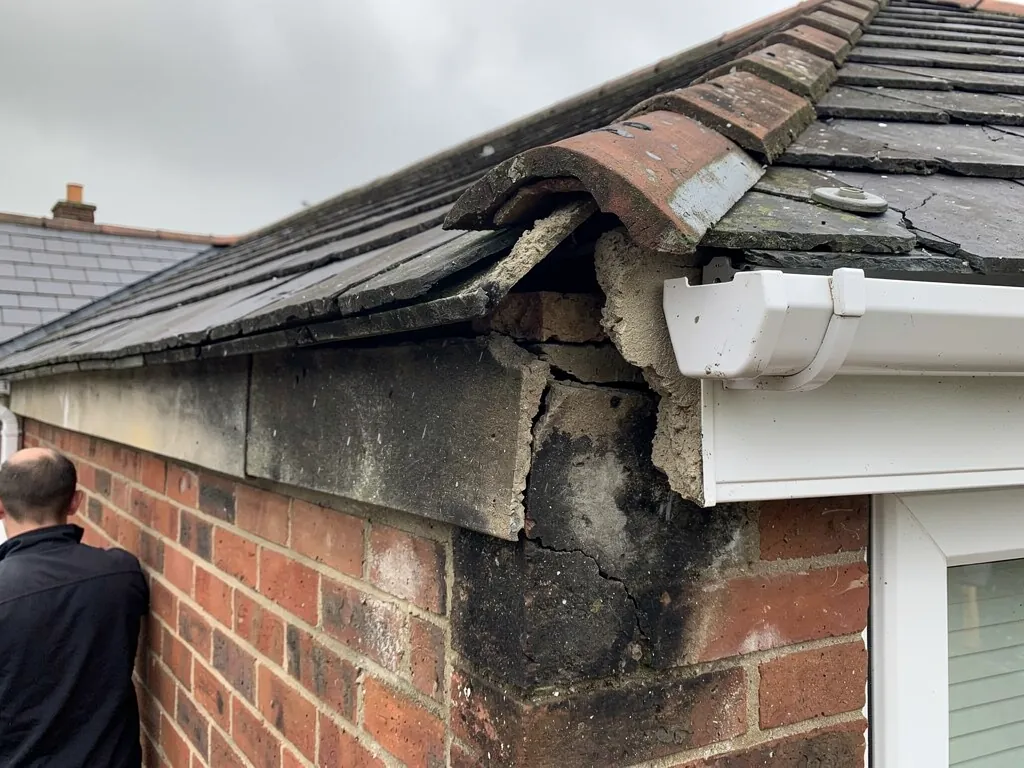
Crumbling mortar and cracked brickwork at a tiled roof eaves corner
Reclaimed Cotswold stone slates sorted by length beside a limestone wall

The short answer

By matching what is already there. Old clay tiles are sorted, sound ones reused, and gaps are filled with tiles of the right size and colour. Thick flint walls carry the weight, so the focus is on the battens, fixings, ridge and flashings, where most faults begin.

Burghclere's old church is described as flint with stone dressings under tiled roofs, though every other old building in the parish is read on its own merits. A flint wall is forgiving. A tiled roof above it is where the maintenance falls.

What goes wrong on an old tiled roof?

Age catches up in three places. Fixings corrode or timber pegs rot, so tiles slip; the battens beneath soften, so the whole slope sags; and the mortar at the ridge and verge cracks and falls away. Moss and lichen hold moisture against the tile surface, and in cold weather that water freezes and flakes the face. A leak that appears in one corner can come from a lifted tile many feet away, since water runs along battens before it drops through. Our roof repairs page explains how we trace it.

Can old tiles be reused?

Often, yes. When a slope is stripped, sound tiles are sorted and set aside, and cracked ones are replaced with matching second-hand or new tiles. The result is a roof that keeps its colour and texture and still performs. Where tiles have lost their face and absorb water, they are better replaced.

What about the ridge?

Ridge tiles on older buildings were usually bedded in mortar. Today the ridge is also mechanically fixed, and where the mortar has crumbled we re-bed it with fixings. See our ridge and verge dry-fix page for how that works on an exposed gable.

Q2

Does the wind on the downs damage Burghclere roofs?

The answer

Open downland gives wind a clear approach, so the exposed parts of a roof work hardest: the ridge, the verges and the eaves. Loose fixings, lifted tiles and failing flashings show up there first, and a survey that checks them is cheaper than waiting for a storm.

The Victoria County History describes the southern part of Burghclere as open downland rising to Beacon Hill, 842 feet above sea level. The shape of the land makes the point: high, open ground catches more weather than a sheltered street, and roofs on it work harder.

Where does the wind do most damage?

The ridge and the verges. A verge is where the roof finishes against the side wall of a gabled house, and wind gets underneath it and lifts. If the tiles there are held only by a strip of mortar, they can loosen over several seasons. The ridge, along the top, is under the same pressure. We check both from outside and from within the loft, where a chink of light or a stain shows where the wind has been working.

Is dry-fix better than mortar?

On exposed roofs it is often the right choice. Dry-fix systems clip or screw ridge, hip and verge tiles down, which leaves little mortar to crack, and BS 8612 covers the systems. BS 5534, as revised in 2014, no longer allows mortar alone to carry the ridge and hip tiles. A dry-fix upgrade can be done as part of a repair without re-covering the whole roof.

What should I do after a storm?

Look from the ground for slipped tiles, a bent ridge or debris in the gutter, and stay off the roof yourself. Call us. We put leaks and storm damage at the head of the queue. Water is stopped and the roof secured first; the lasting repair, with its quote, is a conversation for afterwards, when nobody is working against a rain forecast.


MythMortar alone is a perfectly good way to hold ridge tiles on an exposed roof.

FactAfter the 2014 revision of BS 5534, such tiles also need a mechanical fix, and exposed gables gain the most from it.

Q3

What rules apply to roof work around Burghclere?

Long flat roof on a 1960s brick building being re-covered
Rolled lead roof covering over a bay above white windows

The short answer

Matching repairs rarely need permission, but listed buildings, any Article 4 direction and larger re-roofs have rules of their own. Basingstoke and Deane Borough Council can confirm the position for an individual address.

Burghclere sits in Hampshire, so the planning authority is Basingstoke and Deane Borough Council, and a roof just over the county border in Berkshire answers to a different council. It is worth knowing which side of the line your house is on, because the contact for planning and building control changes with it.

Is Burghclere a conservation area?

The council's planning team can tell you in a short call whether a conservation area or a direction covers your address, and asking before you commit to a new covering costs nothing.

What about listed houses and the chapel?

Burghclere has historic buildings, including Sandham Memorial Chapel, known for Stanley Spencer's murals. The Church of the Ascension, built in 1838 and enlarged in 1875, is listed Grade II, and All Saints at Old Burghclere, which fell out of use once the new church opened and was restored in 1861, is listed Grade I. A listed building needs listed building consent before changes that touch its special interest, and the choice of roofing material can be one of those changes. A Church of England church in regular use follows the Church's faculty system instead, which is a separate route from the council.

When is a larger re-roof notifiable?

A bigger re-roof can need building control approval once it affects 25 per cent of the total building envelope, or 50 per cent of the roof, and the insulation may then have to be improved. We explain which side of the threshold your project falls on, and should the job be notifiable, the notification is ours to prepare and send, to a registered building control approver or to the council, and you are kept up to date throughout. Our chimney repairs page covers the lead and flaunching details that often come up during a re-roof.

Before you commit

Ask the council about listing and conservation status first, because it costs a phone call.

Questions from the old church to the old station

Why do Burghclere's older tiled roofs often have a wavy line?

Timber moves over the centuries. Rafters settle, battens soften and the load shifts, so a tiled slope can gain a gentle ripple, much as an old floor gains a slope. A ripple is not always a fault, and plenty of sound roofs have one. We check whether the timbers beneath are sound, and where they are, we repair the covering and leave the profile alone so the roof keeps its character.

Do you re-roof barns and stables in the Burghclere lanes?

Yes. Barns, stables, garages and converted outbuildings are all part of the work. With such large roof areas, the first questions are what covers them, how the fixings have aged, and whether the problem is condensation as well as leaking. The survey records every one of those points before the quote is written.

Is Burghclere within your area from Swindon?

Yes. It sits inside our 30 road mile area. We travel for a full survey with photographs, and the quote that follows is written as a total price.

What if my Burghclere house is near the Berkshire border?

The council that handles planning and building control depends on which side of the county line the house sits, so we name the right one at the survey and point you to it. The roofing work itself is the same either way, and so is the way we survey, photograph and quote it.

Ask us about your roof

Tell us what’s happening and we’ll call you back.

  • Photos of what we find
  • A written quote
  • 10-year workmanship guarantee

Or call 01793 626096

Call Get a quote