Concrete tiled estate rooftops towards green hills

Roofers in Uley

Slipped slates, failing flashings, leaking valleys and tired chimneys in Uley, the village in its wooded Cotswold valley under Uley Bury, from the cottages round the green to the old cloth and brewery buildings.

Uley's roofs, from the green to the hill fort

Stone cottages around a village green
Cottages by the green and St Giles'

St Giles' Church stands near the village green, a design by S.S. Teulon that replaced an earlier Norman church, and the older homes gathered around the green are where roofs shape the look of Uley most. The village has been a conservation area since August 1988. Where a cottage here still wears true stone slates, it wants a roofer who understands stone: big slates at the eaves, smaller ones working up towards the ridge, every one carried on its own peg. Where it wears something later, a slate or a tile, the repair is simpler, yet the tone and size still have to sit comfortably beside the neighbours. We confirm what covers a house on the survey rather than guess from the lane.

Old mill building with long pitched roof
Cloth, brewery and working buildings

In the early years of the Industrial Revolution Uley was renowned for producing blue cloth, and the Grade II listed building that houses Uley Brewery was part of the 1833 Price Brewery. Buildings from that working past tend to have wide spans, long plain slopes, rooflights, parapets and gutters that run a great distance. Their faults differ from a cottage's: a valley or box gutter that has silted up, a flashing along a tall wall, a rooflight upstand that has let go. Many are used today as homes, workshops or small businesses. The listed brewery building is a useful reminder that consent can be needed before the covering or the roofline changes.

Houses on a wooded hillside slope
Steep wooded ground

Uley lies in a wooded valley in the Cotswold escarpment, on the B4066 between Dursley and Stroud, with the Iron Age hill fort of Uley Bury just above it. Houses cling to sloping ground, so access is awkward, gable ends on the downhill side stand tall, and trees press close to the roof. Overhanging branches drop leaves into gutters, shade lets moss settle on cold slopes, and open ground along the valley sides exposes ridges and verges to gusts. Owlpen Manor, a Tudor manor house built between the mid-fifteenth and early seventeenth centuries, stands east of the village and shows how old building in this valley can be.

Swindon to the Uley escarpment

Map showing Uley and central Swindon. 30 road miles west-north-west of central Swindon.

Distance
30 road miles west-north-west of central Swindon
Council
Stroud District Council
Conservation area
Uley, first designated in August 1988
Landscape
Cotswolds National Landscape
Council
Stroud District Council

Roof questions from the Uley valley

Do Uley's conservation area boundaries stop me re-roofing?

No. Restoring the roof you already have seldom needs permission. A new covering is different, and so is any change visible from the green: Stroud District Council wants a word before those.

Can you mend a stone slate roof beside the green?

Yes. The slates stay, we refix or replace the failed ones with matching stone, and renew the pegs and battens, rather than covering the roof with something else.

Why do the trees round Uley punish a roof?

Leaves choke gutters and valleys, shade keeps moss alive, and a heavy bough in a storm can crack a tile. Clearing and a check each autumn deals with most of it.

Q1

What should I know about a stone slate roof in Uley?

Roofers on a slate roof along a limestone village street
Gloved hands fitting a weathered Cotswold stone slate

The short answer

If your Uley roof is Cotswold stone slate, it is heavy, laid in diminishing courses and held by pegs. It repairs best by refixing and patching in matching stone, not stripping. Second-hand slates belong back on the roof they came from. The survey confirms what yours actually is.

Uley sits on the Cotswold escarpment, so owners often ask about stone. Nobody can tell from the lane which roofs are stone slate and which were recovered in something else long ago, and we do not assume. Where a roof is stone, a few points are worth knowing before anyone quotes.

How are stone slates laid and held?

Traditional Cotswold practice puts the largest slates, normally about 600 mm long and sometimes reaching 750 mm, in a double course along the eaves. The courses then shrink as they climb, so the smallest slates, called short cocks, finish beneath the ridge. Near the top edge of every slate is a drilled hole, and a wooden peg, traditionally cleft oak, goes through it to hook the slate over its batten. Pitches were steep, commonly 47° to 55°.

How heavy is a stone roof, and does it matter?

It is very heavy. Cotswold District Council's technical guidance of April 2000 puts it at about 1000 kg for every 10 square metres. Weight like that means the timbers underneath matter as much as the stone, so a survey looks at rafters, purlins and wall plates as well as the surface. If the frame has sagged, slates loosen and the slope waves. Swapping the stone for something lighter is a structural decision, not a cosmetic one.

Where should replacement slates come from?

Policy from English Heritage, printed in that same guidance, favours newly cut stone slates rather than salvaged ones, and says that any salvaged slates ought to return to the very roof that shed them. It also warns against putting sandstone and limestone together on one roof, because the two weather differently. Our Cotswold stone roofing page covers repair, relaying and sourcing in more depth.


Q2

How does Uley's conservation area affect roof work?

The answer

Uley became a conservation area in August 1988. Work that restores the roof you have seldom needs an application, whereas a switch of covering, fresh roof windows or reworked chimneys may. Stroud District Council decides, and the Cotswolds National Landscape body only advises. Listed buildings need consent for changes touching their character.

Many owners assume that a conservation area means every roofing job needs permission. It does not. The boundary exists so the council can examine changes that would alter how the village looks, and a repair that puts back the existing roof does not do that. Knowing where the line falls, before any scaffold goes up, saves wasted effort for everyone.

What counts as changing the look of a roof?

A new covering, a change of colour, an opening formed in a front slope or a rebuilt chimney can all alter how a street reads. Re-bedding a ridge or renewing lead does not. If you are weighing a window in the slope, our guide to roof window planning sets out the rules, and Stroud District Council's planners can tell you what applies to your own address.

Does the Cotswolds National Landscape change anything?

The Cotswolds carry the National Landscape name nowadays, though in law the designation is still an AONB, short for Area of Outstanding Natural Beauty. The landscape body advises on planning and the district council makes the decision. Uley also has no adopted Conservation Area Statement, so no written appraisal exists to read, and a short call to the council is the fastest way to learn what it expects.

Who deals with Building Regulations on a Uley roof?

Most small jobs fall below the thresholds: a re-roof touching under 25 per cent of the total building envelope and under 50 per cent of the roof would not usually call for a building control application. Past either limit approval is required, and it comes from the council or from a registered building control approver. We tell you which route suits the job and, for notifiable work, send the notification ourselves.

Stroud District Council's list of Article 4 directions in conservation areas does not include Uley, so no permitted development rights are withdrawn there by that route.

Our rule here

Mend with what is already on the roof, and ask the council before altering how it looks.

Q3

How do you work on Uley's steep, wooded plots?

Lead-lined valley gutter between two slate roof slopes
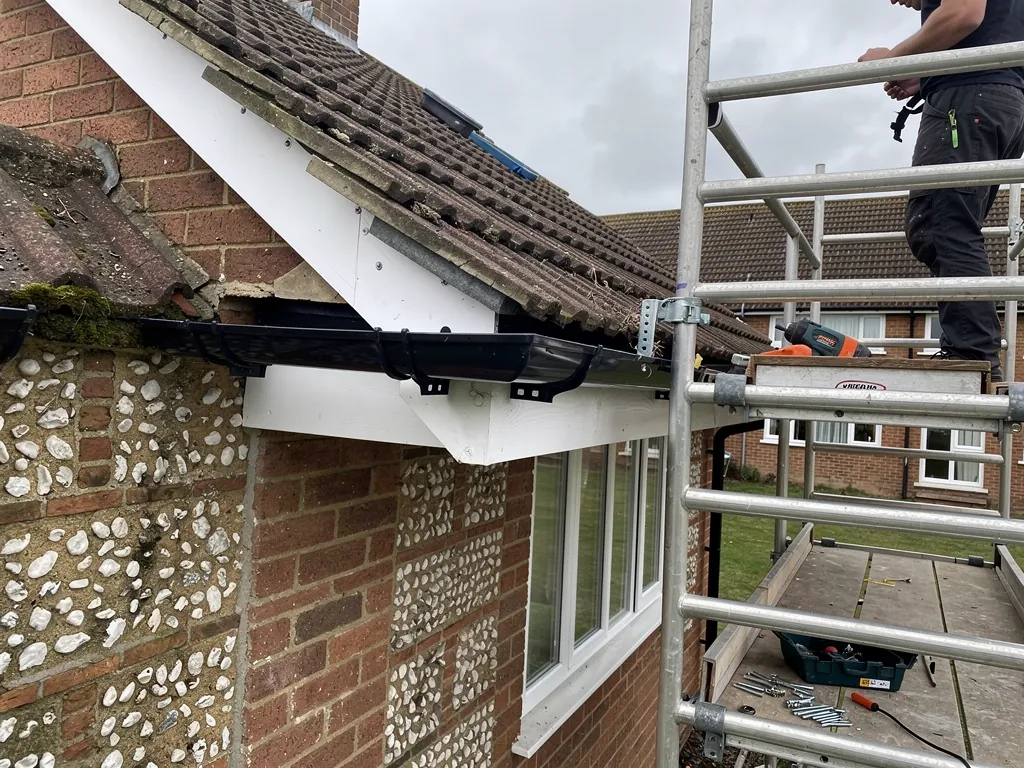
Roofer on a tower scaffold fitting new gutter and fascia

The short answer

Carefully, and with a proper access plan. Sloping ground, narrow lanes and trees close to the house change where scaffold stands, how materials reach the roof and what we look for. Branches, leaf fall and shade form part of the survey, as do the gutters on the downhill side.

A valley village does not hand a roofer a flat drive and an open sky. Houses in Uley step up and down the slope, some sit well above the lane, and branches crowd the roofline. That shapes how we plan and run a job, and what we look for once we are up there. A roof that is awkward to get at is not harder to mend well, but it does take more thought beforehand, and we would rather do that thinking at the survey than halfway up a ladder.

How is scaffold erected on sloping ground?

It needs level bases, so the poles stand on solid plates and each lift is measured against ground that falls away. A gable end on the downhill side may be a storey taller than it appears from the road. We settle the scaffold height at the survey, because a tower that proves too short wastes a visit. On a narrow lane, materials arrive in smaller loads and are carried up by hand or hoist.

What do overhanging trees do to a roof?

Leaves pile up in gutters and valleys and keep water against the roof edge, shade keeps moss alive on cold slopes, and a falling branch can crack a tile or dent a flashing. Nothing here argues for felling a tree. It argues for a gutter clear and a roof check booked every autumn. Our gutters, soffits and fascias page covers the rainwater side.

Do gusts along the valley matter?

Ridges, verges and hips meet each gust first, so we test their fixings before anything else. Under BS 5534:2014, mortar by itself is not what keeps a ridge or hip tile on the roof; a clip or screw backs it up. On an exposed ridge, that backup is a sensible safeguard against a tile dropping onto the lane below. Verges deserve the same attention, since the wind gets under them from the side.

Once the roof is done, we clear the plot and carry the waste off with us.

Questions from under Uley Bury

What fails first on a roof in Uley's wooded valley?

Usually the drainage. Leaves, seed and moss clog gutters and valleys, water backs up under the covering, and a damp patch shows on a ceiling weeks later. Slipped slates or tiles on the shaded side tend to follow. A gutter clear and a quick look from a ladder each autumn catches the early signs before the repair grows.

Will you work on a listed roof like the brewery building?

Yes, using matching materials and methods. Listed building consent is needed for any change that affects the building's special character, we agree the method with you before work starts, and we suggest a call to Stroud District Council if the plan departs from like for like. Finished work carries our 10-year workmanship guarantee, in writing.

Can you also take on roofs in Dursley, Stroud and the villages around Uley?

Yes. Uley is within the area we cover, as is Stroud with its neighbouring villages. For a hamlet you are unsure about, the areas page names every place.

Is a failing stone slate roof worth keeping, or is a new covering better?

Keep it when the stones are sound and the pegs, battens and timbers are what failed, since those can be renewed while the slates are re-laid. The council guidance observes that a stone roof scraped yearly could last twice as long. When the slates themselves have perished, we tell you so and lay out the options, with photographs.

Ask us about your roof

Tell us what’s happening and we’ll call you back.

  • Photos of what we find
  • A written quote
  • 10-year workmanship guarantee

Or call 01793 626096

Call Get a quote