Roofers on a slate roof along a limestone village street

Roofers in South Wraxall

Stone slate, lead, chimneys and the occasional flat roof in South Wraxall and Lower Wraxall, from rubble cottages to the roofs that sit near the manor and St James' church.

South Wraxall's roofs, from cottage to manor

Stone-slate roof on a rubble cottage
Cottages of dressed stone and rubble

Published descriptions of South Wraxall note that most of its buildings date from the 17th and 18th centuries, built in local dressed stone or stone rubble and roofed with stone slates. Such a roof is hand-sorted and hand-laid: the biggest slates go along the eaves, the stones shrink towards the ridge, and every one hangs on its own fixing. Trouble starts with slipped stones where pegs or nails have perished, valleys clogged with moss, and gaps where the covering meets a chimney. With old rubble walls underneath and a great deal of weight above, stripping the lot is seldom the right answer.

Lead flashing and stone on an old building
The manor, the church and listed roofs

South Wraxall Manor is a Grade I listed house dating from the early 15th century, with the manor farmhouse also rated Grade I, and St James' church is Grade II*, with an early 14th-century tower, a north aisle rebuilt in 1823 and a chancel and arcade from 1882. Buildings of this standing have long valleys, parapet gutters, abutments and lead flashings beside the main covering, and the leadwork is often what gives way first. Work on them is planned around saving the old fabric wherever that can be done, and listed status decides who must be asked.

Mixed tiled roofs on village outbuildings
Lower Wraxall and later buildings

The village takes in Lower Wraxall, and between the older stone houses you find barns converted to homes, extensions, and the odd newer house. Those can wear clay tiles, Welsh slate, concrete tile or a flat roof, and any repair has to suit what is genuinely there. Next to old stone slate, a patch of modern tile on a lane of stone roofs looks wrong, so we match colour and texture as far as the material allows. Where an extension butts against an older wall, the stepped flashing and the gutter behind a chimney get our first look.

From Swindon to the Wiltshire and Bath border

Map showing South Wraxall and central Swindon. 29 road miles west-south-west of central Swindon.

Distance
29 road miles west-south-west of central Swindon
Council
Wiltshire Council
Conservation area
South/Lower South Wraxall Conservation Area
Council
Wiltshire Council
Setting
A stone-built village north of Bradford on Avon

What South Wraxall stone roofs prompt people to ask

Can a stone-slate roof in South Wraxall be repaired without stripping it?

Frequently. Stones that have slipped can be hung again, and a failed valley or flashing renewed, with the sound stone left exactly where it sits. Stripping is reserved for slopes that have truly shifted.

Does the conservation area affect roof repairs here?

Restoring what stood there seldom calls for an application. Switching material, adding a roof window or touching a listed house is different, and Wiltshire Council should hear about it before work is priced.

Why does leadwork fail first on old manor-style roofs?

Lead sits in long, exposed runs that swell and shrink with every season. Over a long life it cracks at folds and laps, while the stone around it is still in good order.

Q1

What is on a South Wraxall stone cottage roof?

Reclaimed Cotswold stone slates sorted by length beside a limestone wall
Brick and limestone cottages around a small village green

The short answer

Usually stone slates over old timbers, in a village whose published description speaks of local dressed stone or rubble walls. The slates get smaller from eaves to ridge and hang on wooden pegs, so the roof is heavy, hand-laid and open to repair in small sections.

Walk any South Wraxall lane and the roofs explain how the village was put together. Stone walls, stone slates, stout chimneys and low eaves belong to one another, and the covering depends on the frame beneath.

Why does a stone roof get finer towards the ridge?

Stone splits into many small pieces for each large one. The roofer therefore sorts the stock and starts at the bottom edge with the biggest, laid in a double course at the eaves. Each course above takes slightly smaller stones, and the smallest end up beside the ridge. That stepping is called diminishing courses, and it gives an old stone roof its soft, rippled face. Our page on diminishing courses goes through the method.

What actually keeps them up there?

Traditionally each slate was hung from a wooden peg, often cleft oak, pushed into a hole near its top edge and resting over a batten. Stone outlasts wood, which is why a roof can begin to slip while the slates are still sound. Re-pegging a slope is a smaller job than replacing it, and we price it before anything larger.

Does all that weight change how you repair?

Cotswold District Council's technical guidance puts a stone-slate roof at around 1000 kg for every 10 square metres. Rafters, purlins and wall plates carry that, so before touching a slope we study the timbers from the loft and say if any need attention. A gentle dip or wave in an old roof is usually character, and we work with it rather than trying to straighten it. Our Cotswold stone roofing hub has the wider picture.

Q2

Should South Wraxall's stone slates be re-laid or replaced?

The answer

For a historic roof, re-laying is normally the better path. Stones are sorted, sound ones go back into their courses, and damaged ones are made good with fresh stone of a matching kind. Replacing the covering with another material alters the look, the weight and sometimes the rules.

When a stone slope starts to leak, the owner often fears that the whole roof has reached its end. That is rarely the position. The pegs, battens and valleys give up long before the limestone does.

When does a roof really need stripping?

A strip is worth it when a large area has slipped, when battens have turned soft, or when daylight and damp show across the loft. The slates come off in order and are sorted by size, and the sound ones are stacked ready to go back. Fresh battens and fixings follow, then the roof is laid again in its original courses, and any stone that has split is swapped for a piece of the same type, so the finished slope still reads as the old one. We photograph the roof before the first slate is lifted, which lets the courses return in the sequence they left, and a repeat visit is usually only needed if the survey finds rot in the timbers underneath.

Should replacement stone be old or new?

Policy reproduced in the council's guide favours buying new stone slates rather than second-hand stock, and says reclaimed stone belongs on the house or cluster of buildings it was taken from. Lifting old slates from someone else's roof can leave that building exposed. Limestone and sandstone slates should never be mixed. We name the source of any replacement stone.

Why not choose a cheaper covering?

The same guidance calls concrete and fibre-resin imitations unsuitable for historic buildings, and any covering adding 15 per cent or more to the roof's load calls for Building Regulations approval anyway. Our roof repairs work begins with the smallest fix that properly cures the fault, and where bare lead is the weak point our lead roofing page explains what a new valley or flashing involves.

Our view

Mend the fixings and valleys first; re-lay the stone only where the slope has truly moved.

Q3

Who decides what a South Wraxall stone-slate roof job needs?

Rolled lead roof covering over a bay above white windows
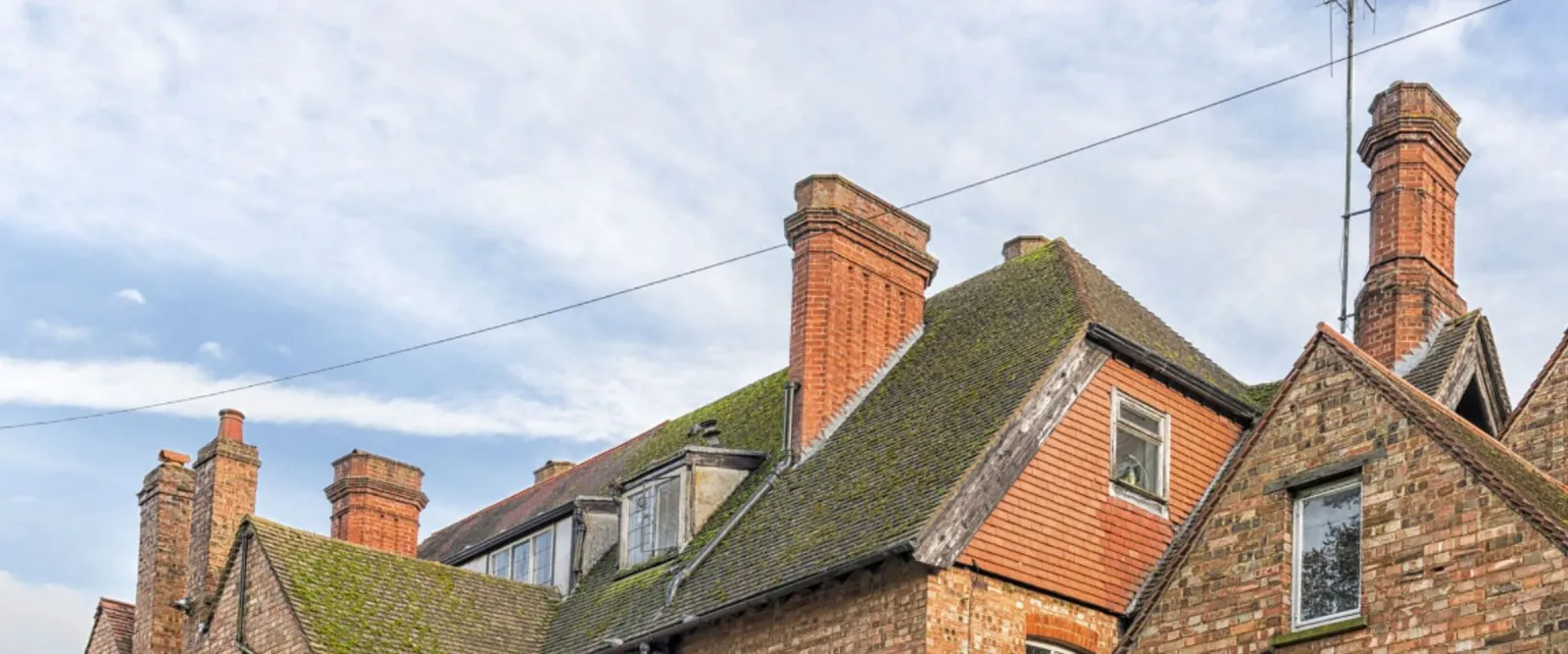
Tall brick chimney stacks rising from a mossy plain tile roof

The short answer

Wiltshire Council is the planning authority. Matching repair is seldom a planning matter, but the village has a conservation area and listed buildings, including the Grade I manor and the Grade II* church. Plans that alter the look or the material are best put to the council ahead of pricing.

For a small village, South Wraxall holds a good deal of protected fabric, so it pays to know which rules touch your own roof before scaffold goes up.

What does the South Wraxall conservation area change for my roof?

The South/Lower South Wraxall Conservation Area was drawn up to safeguard the village's appearance. Putting back what stood there, in stone of the same kind and laid to the old pattern, keeps that appearance intact and is upkeep. A different covering, new roof windows on a slope facing the lane, or alterations to a chimney are what the council may want to see first. Our roof window planning page covers the roof window side.

Is my cottage a listed building?

A listed house cannot have its character altered without listed building consent, and its roof covering is part of that character. St James' belongs to the Church of England; while a church of that kind is in use, alterations are authorised through the faculty system and not by the council. For a house you are unsure about, ask Wiltshire Council whether it is listed.

Who looks after building control?

Should the job be notifiable, you hear about it from us, and we file the Building Regulations notification with Wiltshire Council's building control team or a registered building control approver, as you choose. Bigger re-roofs and much heavier coverings are the cases that usually get that far.

Does timing make a difference?

It can. A quick word with the council ahead of the survey is free, and it saves booking scaffold for a job that then has to wait for a decision. Send us the photographs and written quote we provide with any enquiry, and we will explain in plain words which parts of the work are upkeep and which should be raised. Where a cottage has a tall stone chimney stack, repointing it in matching mortar is upkeep, but changing its height or material alters the street, and that conversation is better had early.


MythA listed village roof can only ever be mended with the original methods.

FactMatching materials and methods are the starting point, but modern concealed fixings can sit behind them where the right consent is in place.

Roofing services in South Wraxall

Questions from the Wraxall lanes

Why do stone-slate roofs in South Wraxall start slipping after many decades?

Slates are heavy, and the pegs or nails holding them rot or rust well before the stone wears out. Once a few drop, their neighbours shift and rain finds the gap. Re-pegging that area, or hanging the slates again on new battens, often cures it without disturbing the rest of the roof.

Is a roof next to the Grade I manor or the church something you take on?

We can carry out repairs on buildings of any grade in matching materials, once the right permissions are in place. Listed status means we agree the approach first, and a church still in Church of England use takes the faculty route. Photographs are taken before anything is touched, so the work can be put back as found.

My stone cottage has a lead valley that leaks. What is the usual cause?

Lead cracks where it has been folded or lapped repeatedly, and leaf litter trapped in a narrow valley holds water against the joint. A patch or a renewed section may be enough, though a valley failing in several places is better re-lined in a single job, with the lead code and laps chosen to suit the length of the run.

Do you cover Lower Wraxall and the lanes around South Wraxall?

Yes. Lower Wraxall belongs to the village, and we work in the surrounding hamlets and lanes as part of the area within 30 road miles of Swindon. Narrow access is dealt with at the survey, so the quote allows for it. Lanes that are too tight for a lorry can mean smaller delivery vehicles and stone carried up by hand, and we plan for that rather than discovering it on the day.

Ask us about your roof

Tell us what’s happening and we’ll call you back.

  • Photos of what we find
  • A written quote
  • 10-year workmanship guarantee

Or call 01793 626096

Call Get a quote