Flat-roofed garages behind brick semi-detached houses

Roofers in Netheravon

Roof repairs, re-roofing, flat roof coverings and chimney work in Netheravon, the Avon valley village on Salisbury Plain, from the cottages near All Saints church to the buildings that grew up with the army and the airfield.

Netheravon's roofs, from the Avon to the airfield

Village house roofs in a river valley
Village houses beside the river

Netheravon lies on the River Avon about four miles north of Amesbury, inside Salisbury Plain. Houses on a river-valley floor in downland country sit low, take rain from every direction, and the open plain above them gives the wind a clear run along the valley. On older village roofs that means close attention to the edges: eaves that have drooped, verges where the cement or mortar has cracked, and ridges that have loosened. Tiles on a roof like this are rarely the problem. The fixings, the battens beneath them and the lead at the chimneys usually give way first, and that is where we start looking, working from the ridge down to the gutter line so nothing is missed.

Rendered flint walls beneath an old roof
All Saints and the older core

All Saints is an Anglican parish and prebendal church, Grade I listed in 1964, built of rendered flint with a west tower whose lower stages survive from the eleventh century. Netheravon House was built after 1734 as a hunting box for the Dukes of Beaufort's sporting estate, which sets one grand house among far plainer neighbours. Buildings of this standing sit among humbler cottages and barns, and the roofs around them are a mixture of ages and coverings. Rendered or flint walls need careful handling at the eaves and verges, because the wrong repair can crack the render or let water in behind it. We protect the wall finish as part of the roof job, and we tell you honestly if a stretch of render needs its own repair afterwards.

Plain pitched and flat roofs on larger buildings
The military years and later building

The War Department bought much of the parish in 1898, a cavalry school was founded in 1904, and Netheravon Airfield was created for the Royal Flying Corps in 1913. Estates tied to that history brought larger, plainer buildings than a typical downland village would otherwise have, and wherever they stand they tend to carry bigger roofs, flat or low-pitched sections, and long gutter runs. Later housing and extensions add concrete tile, felt and single-ply coverings to the mix. For roofs like these the decisions are about access, drainage and the right covering for the span, not about matching an ancient material. A fresh covering on a plain larger roof is judged on how long it will keep water out and how easily the next owner can maintain it.

From Swindon down to the Avon valley

Map showing Netheravon and central Swindon. 27 road miles south of central Swindon.

Distance
27 road miles south of central Swindon
Council
Wiltshire Council
Council
Wiltshire Council
Church
All Saints, Grade I listed in 1964
Setting
The Avon valley, on Salisbury Plain

Short answers for Netheravon roofs

How should roofs around All Saints church be approached?

With care. Houses near a Grade I church are often in the conservation area, so changes of covering are worth raising with Wiltshire Council first, while matching repairs normally carry on as maintenance.

Why do ridge tiles loosen on valley-floor houses here?

Mortar beds crack as the roof moves and weathers, and a ridge relying on mortar alone can slide. We re-bed ridges with added mechanical fixings, or install a system tested for dry fixing.

Can larger flat roofs on older buildings be recovered?

Yes. A survey checks the deck, the falls and the outlets first, then we recommend felt, single-ply or GRP chosen to suit the roof's use and its size.

Q1

How does Netheravon's open valley affect a roof?

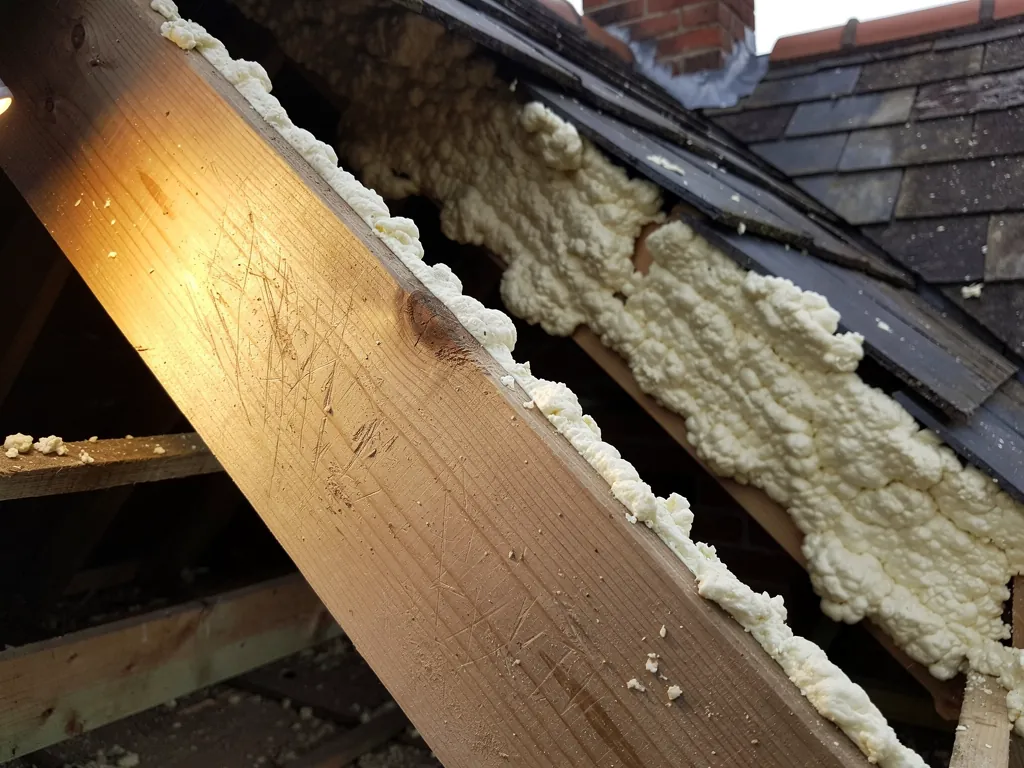
Scraped-back rafter beside thick spray foam under a slate roof
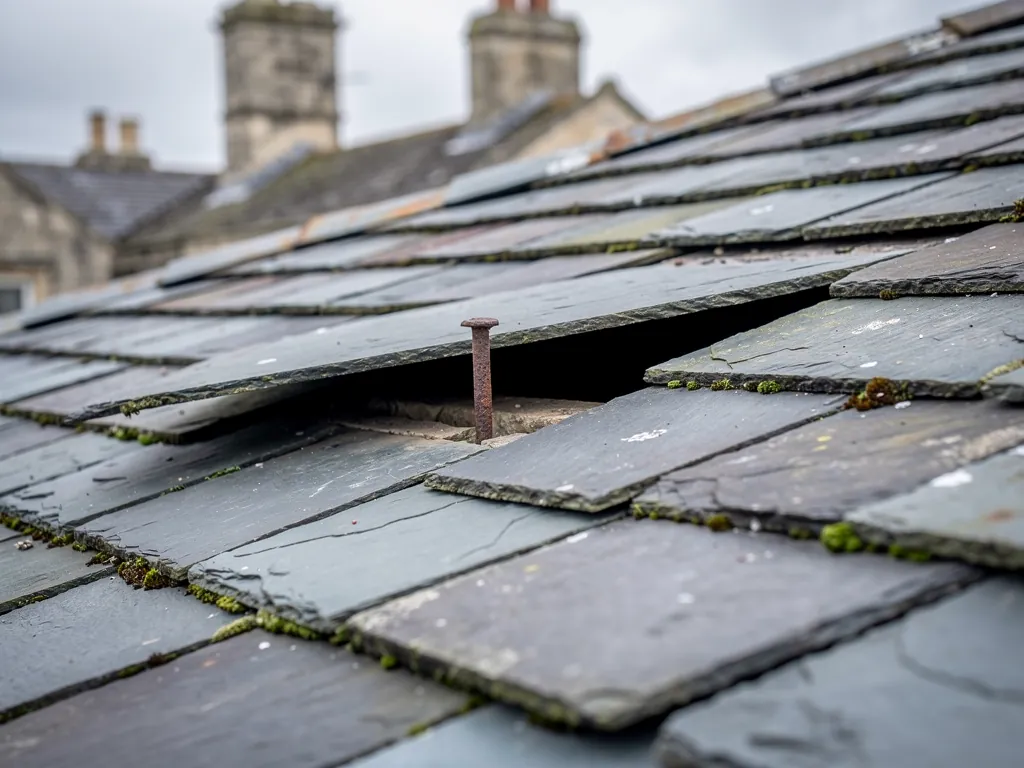
Slipped natural slate with an exposed nail on a weathered roof

The short answer

The Avon valley is open downland, so roofs take rain and wind from many sides. The perimeter is where trouble begins, and the fixings matter more than the tile. BS 5534:2014 stopped mortar being relied on alone for ridge and hip tiles, which are now fixed mechanically too.

Standing in the middle of Netheravon you can see how little there is to break a gale: the river valley is wide, and Salisbury Plain rises on either side. Roofs here live in the open, and how well one is fastened matters more than how it looks.

Which parts of the roof take the punishment?

The perimeter. Gable verges, the line of the ridge and the eaves all face the air directly, so loosened tiles tend to start there and work inward. A verge held with a smear of mortar can lose its cement in a few winters, and once the first tile lifts the one beside it follows.

What does a mechanical fix look like?

Ridge and hip tiles are secured with stainless clips, screws or a proven dry-fix system, instead of trusting a mortar bed on its own. BS 8612:2018 is the specification dry-fix systems are tested against. The result is a ridge that holds when the mortar eventually ages, and one that needs no re-pointing every few years. Our ridge, verge and dry-fix page explains the options and what they involve.

Does slate need different fixings?

Natural slate follows its own rules. The slate maker Cupa reads BS 5534 as setting 20 degrees as the lowest pitch for natural slate at moderate exposure, and advises against hook fixings on anything under 25 degrees. On an open site, a slate roof often wants nails and a deeper headlap than a sheltered one would, which a survey sorts out before the quote.

Where a roof is old and exposed, we would rather fix it once properly than return for the same loose tiles after the next gale. The survey photographs show which edges are sound and which are working loose, so the scope of any repair is clear before you agree to it.


Q2

What changes when a house is near Netheravon's listed church?

The answer

Very little for a plain repair, more for a change. The church itself is a Grade I building in Church of England use, dealt with through the faculty system. A house nearby may be in the conservation area or listed in its own right, and either can bring a consent question when the covering changes.

All Saints has stood on its site since the eleventh century, to judge by the lower stages of its tower. Anything near a building like that deserves a moment of care before the scaffold goes up.

Does the church's status apply to the houses beside it?

No. All Saints is a working Anglican church, so its own works are routed through the faculty system rather than the council's consent process. That arrangement belongs to the church alone. Cottages, farmhouses and barns around it follow the ordinary rules, and a cottage with a Victorian slate roof gets the same treatment as one anywhere else in Wiltshire.

Who can say whether my house is protected?

Wikipedia's account of the village refers to a Netheravon Conservation Area Statement from 2002, produced by the former Kennet District Council, and Wiltshire Council now holds that role. Its planners can confirm whether your property lies in the conservation area or is listed on its own account. Ask before choosing a covering: alterations that change the special character of a listed house need listed building consent first.

How do you handle a protected roof?

We photograph it before touching it, stay with the original material where we can, and agree changes with you beforehand. A larger re-roof may fall under Building Regulations; if it does, the notification goes through Wiltshire Council's building control team or a registered building control approver, and we arrange it.

None of this stops a roof being repaired. It makes the repair slower to plan and quicker to finish, and it preserves the original character of an older Netheravon house.

Our view

Near a Grade I church, keep the covering the house already has and ask the council before changing it.

Q3

Which flat roof covering suits a Netheravon outbuilding?

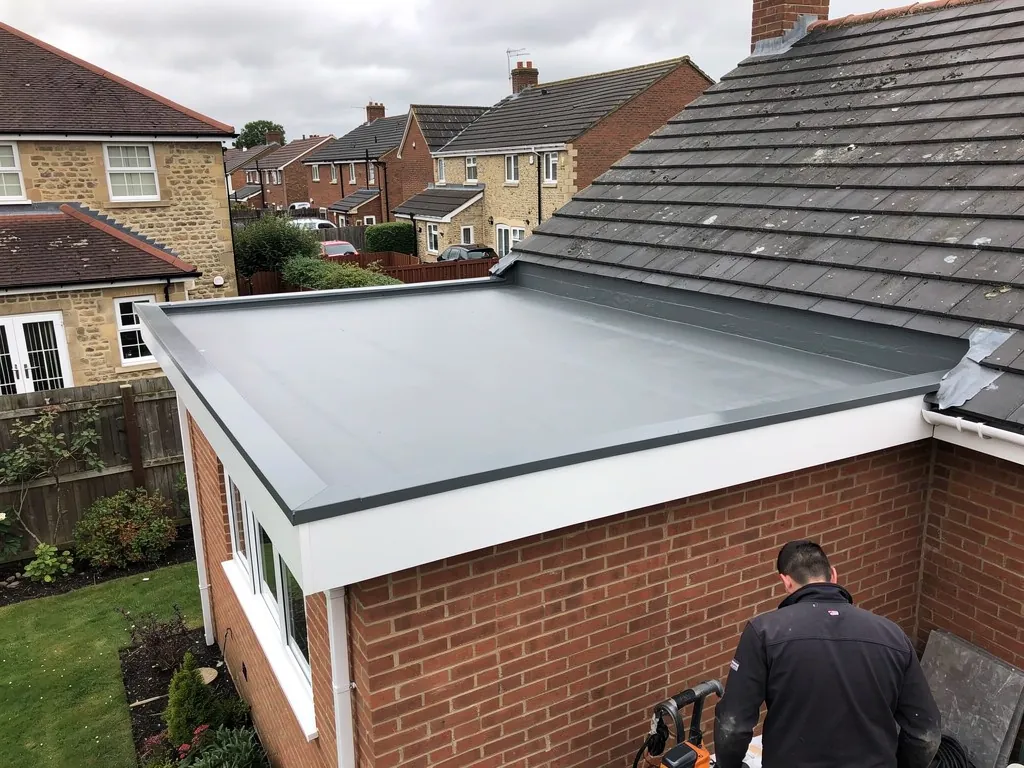
Finished grey GRP flat roof on a single-storey brick extension
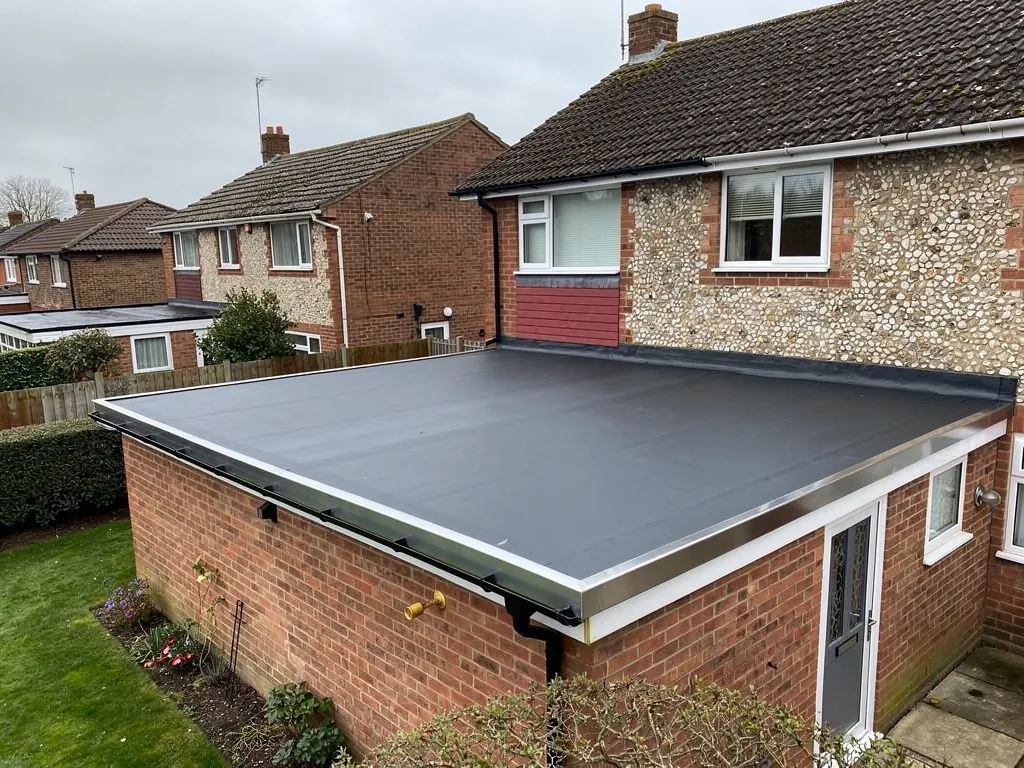
Finished black rubber flat roof on a brick single-storey extension

The short answer

It depends on size, access and use. Felt costs least to lay and is the shortest-lived, EPDM suits clean simple shapes, and GRP gives a hard, jointless finish on smaller roofs. The deck, the falls and the drainage decide as much as the covering you choose.

Netheravon's military history means larger and plainer buildings than most downland villages carry, and many houses in the area have flat-roofed garages, annexes or extensions. These roofs fail differently from pitched ones, and the fault is usually ponding water, a worn seam or an upstand where the covering has pulled away from the wall. A bubble in the surface or a soft spot underfoot tells us the deck may be wet beneath, and that changes the repair completely.

How long does a flat roof last?

MyBuilder says a flat roof typically lasts 15 to 30 years, though torch-on felt can fall short of that if the job is poor, and EPDM is often quoted at 20 to 30 years or more. The difference comes down to the deck, the detailing at upstands and how rainwater drains away.

What should a flat roof fall be?

BS 6229:2018 recommends a finished minimum fall of 1:80, and a design fall of 1:40 to allow for tolerances in the deck. A roof that holds water long after rain is not meeting that, and recovering it without correcting the falls just buries the problem. Outlets and gutters matter just as much: a blocked outlet will flood even a well-laid roof, so we clear and check them at every visit.

Is it worth recovering a big plain roof?

For larger roofs a single-ply membrane is often the neatest answer, while smaller ones suit GRP, whose one-piece finish copes well with awkward upstands on garages and porches. Our flat roofing page sets out each covering and when we recommend it.

The chart below gives national typical figures per square metre, and the total for your own roof comes in the written quote after our survey.

What it typically costs

  • Torch-on bitumen felt£70 to £100 a square metre
  • EPDM rubber membrane£90 to £130 a square metre
  • GRP fibreglass laid in situ£95 to £150 a square metre
  • PVC single-ply sheet£95 to £140 a square metre
Typical UK ranges for replacing a flat roof covering. Roof size, access, the deck beneath and any scaffold all push the final figure either way. MyBuilder, flat roof cost guide, updated 21 August 2026.

Roofing services in Netheravon

Questions from the Avon valley

Does rendered flint need special care at the roof edge?

Yes. Render can crack if a verge or eaves is disturbed carelessly, and water that gets behind it is hard to trace. We protect the wall finish while we work, repair only what the roof job disturbs, and tell you if the render itself needs a separate look.

Can you work on homes tied to the old military estate?

Yes, as long as the owner or landlord agrees to the work before it starts. Some properties have restrictions on what can be changed, so we find out who owns the roof and who has to sign off a change of covering, then price from the survey.

Is Netheravon within your area?

Yes. Netheravon lies on the Avon in Wiltshire, inside our Swindon service area. Places further down the valley, such as Amesbury, may sit outside it, so if you are not sure, ask us before assuming either way.

What does your 10-year guarantee cover on a Netheravon roof?

The guarantee is a written 10-year promise on our workmanship. It does not cover storm damage or wear in materials, and it is not insurance. The written quote after the survey spells out what the job includes, and at the end of the job we leave the site clear and haul the waste off.

Ask us about your roof

Tell us what’s happening and we’ll call you back.

  • Photos of what we find
  • A written quote
  • 10-year workmanship guarantee

Or call 01793 626096

Call Get a quote