Concrete tiled estate rooftops towards green hills

Roofers in Liden

Roof repairs, re-roofing, flat roofs and gutter work across Liden, from the houses developed here since the 1960s to the shops and flats around the Liden Drive local centre.

Liden's roofs, from Liden Drive to the lagoon

Terraced homes with concrete tile roofs
Housing from the 1960s onwards

Liden is a residential area of east Swindon that was developed from the 1960s onwards, which means its streets were not all built at once. A house from the first phase has a roof approaching sixty years old, while one from a later phase may be a decade or two younger. Concrete tile is a common covering for homes of that era, and sources put its typical life at somewhere between 30 and 60 years. So the questions on a Liden street depend on the date of the build: ageing underlay and tired ridge bedding on the older homes, and early cracked tiles or failed sealant on the newer.

Flat-roofed shop parade with parapet
The Liden Drive local centre

Liden Drive is the local centre, with supermarkets and convenience stores, and shop buildings bring a different kind of roofing. Large flat or low-pitched roofs, parapet walls, rooflights, rainwater outlets that must carry a lot of water, and plant standing on the deck. Leaks in a shop roof stop trade as well as damaging stock, so the first job is a safe, quick make-safe, then a proper survey of the whole covering. Landlords and shopkeepers are told plainly in writing whether the job is a repair or a replacement, so a patch is never sold as a new roof.

Gutter and eaves on an estate house
Homes facing open green space

Liden Lagoon is a green space in the area, and houses that face open ground rather than another row of roofs deal with it in small ways. Wind reaches gable ends and verges directly, falling leaves collect in gutters and hoppers, and moss gathers along shaded tile edges. Birds look for gaps beneath eaves and at broken ridge ends. None of this is dramatic. A gutter clear-out, a refixed verge tile and a sealed eaves gap are cheap jobs that stop a stain on the bedroom ceiling from becoming a repair to the plaster.

Between Swindon and Liden Lagoon

Map showing Liden and central Swindon. 3 road miles east-south-east of central Swindon.

Distance
3 road miles east-south-east of central Swindon
Council
Swindon Borough Council
Council
Swindon Borough Council, for planning and building control
Ward
Liden, Eldene and Park South
Conservation area
None: Liden is not among the 27 the council lists

Liden roof questions

Is a 1960s concrete tile roof in Liden due for replacement?

Not automatically. Sources give concrete tile a typical life of 30 to 60 years, so condition decides. A survey checks the tiles, underlay and fixings before anything is recommended.

Can a Liden Drive shop roof be made safe quickly?

Yes. A leak goes to the top of our list, and the first visit stops the water getting in. The lasting repair or replacement follows after the survey has shown what the whole covering needs.

Do I need the council's say-so to re-roof a Liden home?

Planning permission is not usually needed when a roof is re-covered like for like, and Liden is not a conservation area. Switching material, or adding roof windows, is worth raising with Swindon Borough Council beforehand.

Q1

How long should a Liden roof from the 1960s last?

Long flat roof on a 1960s brick building being re-covered
Torch showing a water-stained rafter beneath slates in a loft

The short answer

There is no single answer, because roofs from the 1960s onwards sit at different points in their life. Sources give concrete tile a typical life of roughly 30 to 60 years, and flat roofs 15 to 30. Condition, upkeep and workmanship matter more than the build date, so the survey judges your roof, not its age.

People often ask us the age of a roof as though it were a use-by date. For a Liden home built any time from the 1960s onwards, the date tells you what to look at, not what has failed. A well-kept roof of fifty-odd years can have more life ahead than a neglected one of thirty.

What do the published lifespans really mean?

Published lifespans are typical ranges and never promises. Marley, a tile maker, expects its concrete tiles to serve for about 60 years yet says plainly that this is not a guarantee. MyBuilder suggests concrete tiles typically need replacing after 30 to 50 years. The gap between those two figures is the difference between a roof that has been looked after and one that has not, and it is why we give a written assessment and not a verdict from the pavement.

Where does the wear show first?

On a concrete tile roof the covering usually outlasts what holds it. Underlay behind the tiles perishes, battens soften where the nails have worked, and ridge mortar lets go. Edges and abutments wear sooner than the open slope. When these parts are repaired the tiles can keep working, which is often the better value than a strip and re-cover.

When does replacement make sense?

A re-roof earns its cost when the failure is widespread: tiles breaking in many places, underlay torn across a whole slope, or battens rotted through. Our roof replacement page explains how we decide, and what is included in the quote. Even then the advice we give is the smallest job that sorts the fault, not the biggest one on offer.

Photographs of your own roof, taken at the survey, arrive alongside the written quote, letting you look at the faults we describe and judge for yourself. Anyone who has owned a house for a while will know the feeling of being told a roof is finished by someone who has only looked at it from the road. A survey from the roof itself, and a loft inspection from beneath, is how that guesswork is avoided.


Q2

How is a Liden Drive shop roof repaired?

The answer

Expect a safe, temporary stop to any leak first, then a survey of the whole roof, then a written quote that says plainly whether repair or replacement is the right answer. Patching one failed seam is right when the remaining covering is sound. If the membrane is failing everywhere, patching only delays the bigger job.

A leak in a unit at the Liden Drive centre costs money every day it drips. Our approach is to protect the stock and the trade first, then settle the long-term fix once the facts are in front of us.

What happens on the first visit to a leaking shop?

We treat a leak as urgent, and the first task on site is to keep water out of the unit. That may be a temporary patch, a sealed outlet or a tarpaulin fixed securely in place. It is a stopgap and we do not describe it as a repair. The survey that follows looks at the membrane, the upstands, the outlets and the parapet junctions together, because water entering at one point can run a long way across the deck before a stain appears inside the unit.

Should the roof be repaired or re-covered?

If the deck is sound and the membrane is failing at isolated seams, a repair is the proportionate answer. If water has spread under the covering, or the deck is wet, patches will keep failing and money is wasted on them. The options then are a new single-ply membrane, a GRP finish or a built-up felt system, each with its own cost and lifespan. Our commercial roofing and flat roofing pages describe how those compare.

Why do outlets, parapets and plant matter?

On a shop roof the detail around the edges often decides how long the new surface lasts. Outlets need to be clear and the right size for the area they drain. Parapet walls need a sound flashing or coping at the top and a waterproof upturn at the base. Any plant standing on the deck, such as extraction fans or condensers, needs its own sealed upstands, since every penetration is a place water can enter. We photograph each of these so a landlord and tenant can see the same detail.

Can the shop keep trading during the work?

Shops cannot always close, so we agree access, noise and working hours with the tenant and the landlord before starting. Waste is cleared and taken away at the end of the job.

What it typically costs

  • Bitumen felt£70 to £100 per m²
  • EPDM single-ply£90 to £130 per m²
  • PVC single-ply£95 to £140 per m²
  • GRP fibreglass£95 to £150 per m²
These are typical national figures for replacing a flat roof, not our prices. Access, deck condition, outlets and parapet detail move a commercial roof's cost, and the survey comes before any written quote. MyBuilder flat roof cost guide, updated 21/08/2026.
Q3

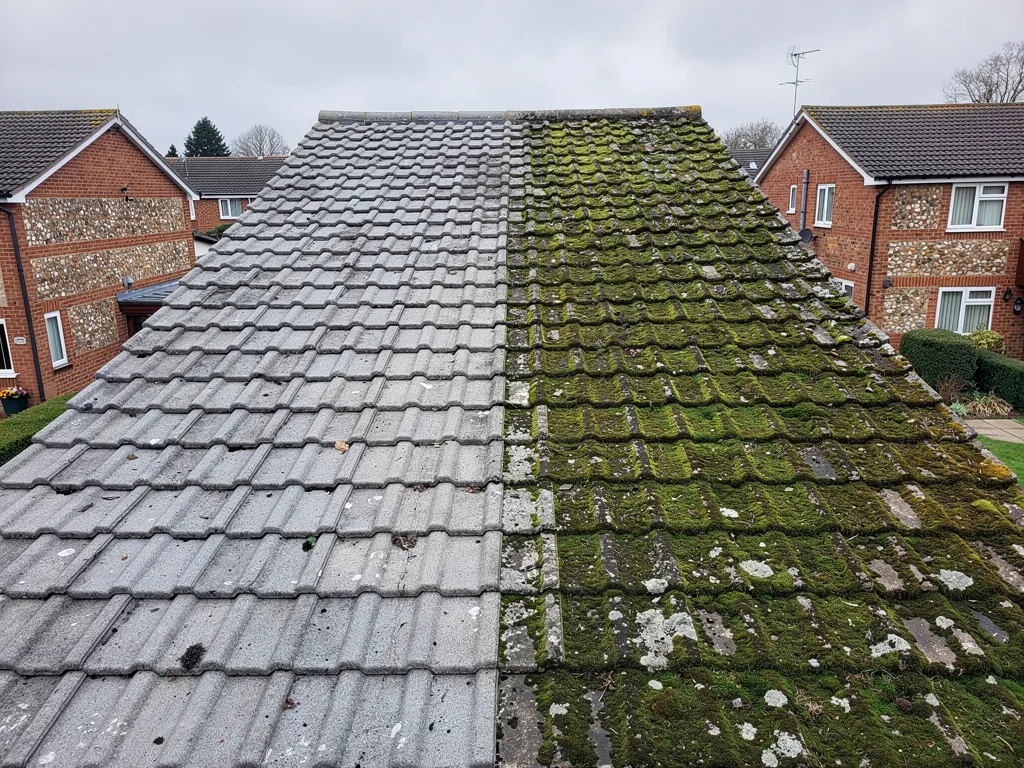
Can a mossy Liden tile roof be cleaned instead of replaced?

Blocked gutter full of leaves overflowing down a brick wall
Roof half cleaned, grey tiles beside a moss-covered side

The short answer

Often, yes. Moss on sound tiles is mainly a maintenance matter, and careful scraping or soft washing can clear it. Cleaning does not repair a failed underlay or cracked tiles beneath, so the condition of the roof is checked before anyone brushes or washes anything. Harsh washing can damage tiles.

Moss looks alarming from the street. A green mat along the lower courses of a concrete tile roof tends to prompt a phone call, and the sensible first question is whether the roof under it is sound.

Why does moss matter at all?

Moss holds water against the tile surface and can lift the edges of tiles over time. It also drops into gutters and blocks outlets, so water spills where it should not. Houses facing the open ground around Liden Lagoon, with shade and leaf fall nearby, may see it settle sooner. The moss itself rarely causes a leak. What leads to a leak is what it hides or blocks.

Which cleaning method is safest?

MyBuilder's cleaning guide sets out manual scraping, soft wash and pressure wash as the usual choices, with a warning that the last can harm delicate tiles. On concrete tile we generally prefer scraping and a soft wash with a treatment, then a check of every tile that was hidden. Any tile that cracks under the brush is replaced there and then. Our roof cleaning and moss removal page covers the methods in full.

What happens to the gutters afterwards?

Cleaning sends debris down the roof, so we clear gutters and hoppers as part of the job. If the gutters have sagged or joints are leaking, we show you in the photographs and quote for the repair separately. Nothing is added to the job without being written down first.

A clean roof is also easier to inspect, so any future survey can read the condition of the tiles, ridge and verges without moss in the way. Many owners book a clean and a check together for that reason, and then leave the roof alone until the next time the gutters need clearing. Moss grows back where the conditions favour it, so regular gutter clearing and an occasional look from the ground do most of the work between cleans.

Our view

Clean it when the tiles are sound, and repair what the moss has been hiding.

Questions from around Liden Drive

Do roofs on Liden's older streets need replacing now?

Not necessarily. Homes built from the 1960s onwards are at different stages, and published lifespans for concrete tile run from roughly 30 to 60 years. We inspect the tiles, underlay, battens and ridge, and recommend a repair if that properly fixes the fault, or a re-cover if the failure is widespread.

Can you work on a flat roof over a Liden Drive unit?

Yes. We repair and replace flat roofs on shops and commercial units, agreeing access and working hours with tenant and landlord. A leak is made safe first, and the survey then shows whether repair or replacement is the right answer.

Is any part of Liden a conservation area?

No. Swindon Borough Council lists 27 conservation areas and Liden is not one of them. Individual buildings can still be listed, so check with the council if you think yours might be, before any change to the roof covering.

Do you cover Eldene and Park South as well?

Yes. They share a council ward with Liden and sit within the area we serve around Swindon. Ring 01793 626096 or reach us through WhatsApp or the website form, giving the street name so the survey can be planned.

Ask us about your roof

Tell us what’s happening and we’ll call you back.

  • Photos of what we find
  • A written quote
  • 10-year workmanship guarantee

Or call 01793 626096

Call Get a quote