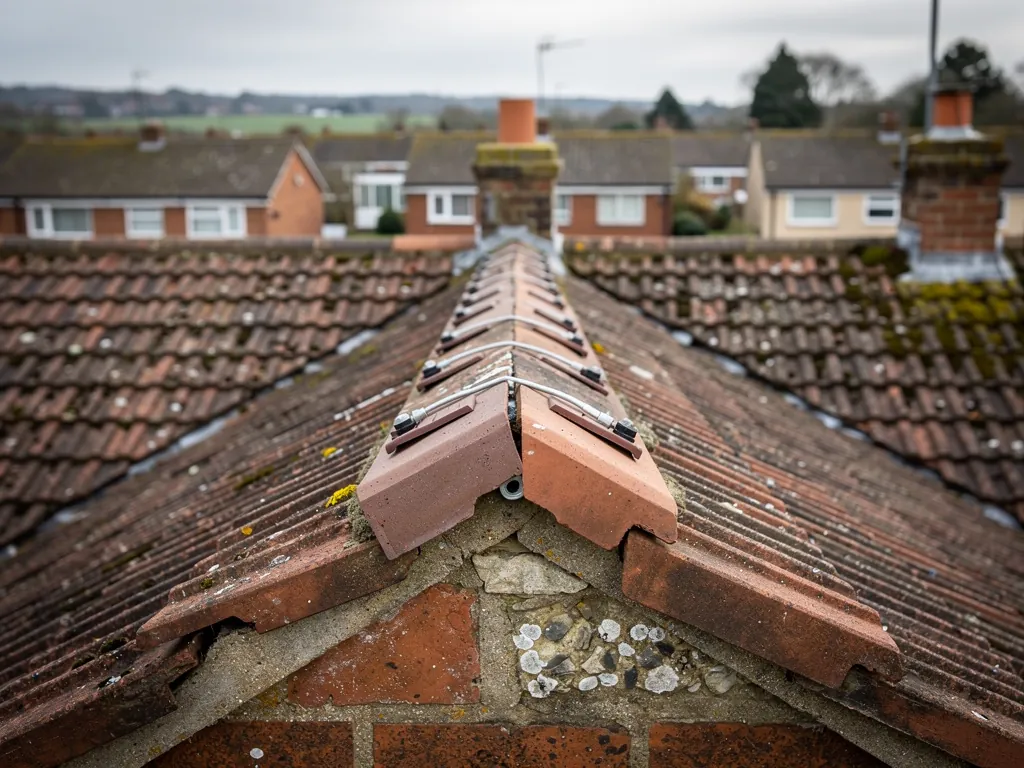
Rear tiled roof of a brick semi seen from the garden

Roofers in Dorcan

Repairs, re-covering, flat roofs and fascias right across Dorcan, from the family houses laid out beside the brook to the self-built homes and garages on the estate's quieter roads.

Dorcan's roofs, from brook to bypass

Rows of pitched-roof houses on an estate
Council and builder estates

Swindon Borough Council took over roughly 600 hectares of former Highworth Rural District farmland at Dorcan in the late 1960s, and part of it was built up by the council itself or by private builders. Houses laid out on one plan by one builder tend to age in step, so a fault on one roof often turns up on the next ten. Where the covering is concrete tile, we look first at the ridge and hip bedding, the verge mortar and the tiles around the chimney. Where the roof is a shallow pitch, we check the valley gutters and the junction with the neighbouring house, because the party wall is where water gets in. Each house gets its own survey, though, not an estate-wide guess.

Detached houses with differing roof shapes
Self-build plots

Not all of Dorcan was built to a single design. Some of the land, including Okebourne Park, was sold in plots for people to build their own houses, which is why a walk through the estate turns up roofs of different pitches, different coverings and different ages sitting side by side. A self-built house may have a hipped roof, a dormer, a cut-up roof over an integral garage or a flat section where two ranges meet, and each of these has its own weak points. Odd shapes mean more valleys, more abutments and more lead or flat-roof junctions than a plain gable, so each of them is photographed at the survey and then covered in the written quote. That level of detail is what lets you test whether another firm has priced the same roof honestly, because a vague price for an irregular roof tells you very little.

Garage and extension roofs beside a house
Garages, porches and extensions

On an estate of this age the roof that fails first is rarely the main one. Garage roofs, porch canopies, lean-to utility rooms and kitchen extensions are often low-pitched or flat, and they are the ones that collect moss, hold puddles and let the felt or membrane go brittle. Some garages still have corrugated sheet roofs, and if that sheet is cement-based it needs asbestos care before anyone cuts or breaks it. A flat roof can be renewed on its own, so there is seldom a reason to let a leaking extension push you into replacing the whole house roof. Fascias and gutters on these low roofs are worth a look at the same visit, since they are within reach and tend to be neglected until a stain appears indoors.

From Swindon out to the A419

Map showing Dorcan and central Swindon. 3 road miles east-south-east of central Swindon.

Distance
3 road miles east-south-east of central Swindon
Council
Swindon Borough Council
Conservation area
None in Dorcan, according to the council's list
Setting
East Swindon beside the Dorcan Brook, near the A419
Civil parish
Nythe, Eldene and Liden

Dorcan roof questions

Does Dorcan's estate need planning consent for a re-roof?

A like-for-like re-roof normally does not, as Dorcan has no conservation area. Changes to the shape, or new openings, are worth checking with Swindon Borough Council first.

Why do roofs on one Dorcan road fail together?

Houses built in the same programme share materials, ages and details, so the same ridge bedding, felt or fixings tend to tire at about the same time along a road.

Can a leaking garage roof by the brook be done separately?

Yes. A garage or extension roof is a separate job from the main roof, and fixing it on its own is often the right and smaller answer.

Q1

What went into the roofs of Dorcan's estate?

Close-up of clay ridge tiles meeting a brick gable end
Blocked gutter full of leaves overflowing down a brick wall

The short answer

Dorcan was farmland until the late 1960s, when Swindon's eastward growth brought council and private building and some plots sold for self-build. So the area has a run of ordinary family houses plus individual designs, and no single roof type describes the lot.

Dorcan takes its name from the Dorkerne Brook, now the Dorcan Brook, and it sits in the east of Swindon close to the A419. A Geograph caption records that Swindon Borough Council took over about 600 hectares of mostly farmland in the late 1960s for housing and commerce. Some of it was developed by the council or by private builders, and some was sold as plots for people to build their own designs.

What does that history mean for the roof overhead?

A scheme developed by a few builders over a limited period gives you shared details. The roof pitch, the eaves, the way a roof meets its neighbour at a party wall and the type of ridge treatment are repeated down a street. For us that is useful, because we know the places where a house of this kind tends to leak. It also means a neighbour's repair is a fair hint about your own roof, though never a substitute for looking at it.

The self-build plots add variety. You might see a long hipped roof beside a plain gable, or a house with a flat-roofed extension that was added a decade after the main build. We do not assume anything about the covering from the postcode. We climb up, photograph what is there and write down what we found.

Which parts of the roof give way first?

Whatever the covering, the same three places let you down first. Ridge and hip tiles lose their bedding, verge edges at the gable crack and loosen, and valleys, where two slopes meet, collect leaves and silt. Our roof repairs page sets out how we fix each. BS 5534 was revised in 2014, and since then mortar alone is not accepted as enough to hold the ridge and hips, so a re-bed now includes mechanical fixings.

A repair that deals with one of these places usually costs far less than people expect, which is why the survey comes before any talk of replacement.

Q2

Should a flat extension roof on a Dorcan house be replaced?

The answer

Often a repair is enough. A flat roof with a split seam, a blown patch or a blocked outlet can be mended for a small fraction of the cost of a new one. Replacement is the better answer when the deck is soft, water is trapped under the covering, or it has been patched repeatedly.

Flat roofs on garages, kitchens and rear extensions are the commonest source of ceiling stains on estates of Dorcan's age. They are a different trade from pitched roofing, and the diagnosis is different too.

How do you find where the water gets in?

We start by finding where the water is coming in, which is rarely where the stain shows. A blister may be the visible sign of a seam that opened a metre away. A stain at the wall may come from a failed upstand rather than the membrane. Puddles that sit for more than a day or two tell us the falls have settled, and ponding water ages any covering faster. A damp meter and a hose test are both useful here, and neither costs anything extra to use.

When is a repair enough, and when is renewal better?

A tidy repair makes sense where the deck is dry and firm, the covering is otherwise sound and the fault is local. Where the felt is crazed all over, or the deck boards flex underfoot, patching just moves the leak. Renewing a flat roof properly means a sound deck, correct falls, insulation to the current standard and a covering such as EPDM rubber or GRP fibreglass, fitted by someone who will take the time over edges and upstands. Our flat roofing page covers the options, and the written quote sets out which one we recommend and why.

A replacement flat roof on a small extension is not a big structural job, but it can still be notifiable under the Building Regulations when it changes the insulation, so we explain that before work starts.

Our view

Mend the seam if the deck is dry and firm; renew the roof if it is soft.

Q3

Who signs off roof work beside the Dorcan Brook?

Long flat roof on a 1960s brick building being re-covered
Roof half cleaned, grey tiles beside a moss-covered side

The short answer

Dorcan falls under Swindon Borough Council, whose building control team, or a registered building control approver of your choosing, covers any notifiable roof work. Dorcan does not appear on the council's conservation area list, which keeps most like-for-like roof work simple and quick to arrange.

Most jobs on a Dorcan roof need no application at all. Swapping broken tiles, replacing a flat roof covering of the same kind, renewing fascias and re-bedding a ridge are repairs and maintenance. Three questions decide whether anything more is needed.

How much of the roof is being re-covered?

Building Regulations stay out of the way when less than 25 per cent of the total building envelope and less than 50 per cent of the roof is being re-covered. Above those figures building control sign-off is needed, and the thermal performance of the roof may have to be upgraded as part of the job. Weight is a second test: the Planning Portal says one that is 15 per cent or more heavier needs approval. The council runs its own building control service, and the notification for a job that needs one is something we explain and arrange, so you are not left chasing forms. A quick call to us before you commit is enough to find out which side of the line your roof falls on.

Does changing the shape of the house need planning?

Dorcan has no conservation area, and the council's list also shows no Article 4 direction here, so a matching re-roof does not call for a planning application. Extending upward, adding a dormer or changing the footprint is another matter, and the council's planning team is the right place to ask before a design is drawn.

What if bats or birds are living in the roof?

Dorcan lies beside a brook, and bats and nesting birds are protected wherever they find a way in. If we find signs of either during a survey, we stop, explain what we have seen and agree the next step with you before anything is disturbed.

We also tell you plainly when no consent is needed, which is the more usual case. Once the job is finished, the site is cleared, the waste is taken away, and the written 10-year workmanship guarantee goes to you with the final paperwork.

MythA new estate-age roof can only be done by stripping the whole thing.

FactMost Dorcan roof faults sit at a ridge, a valley or a flat extension, and are mended without touching the rest.

Questions from along the Dorcan Brook

Why do the roofs on my Dorcan street seem to age at the same rate?

Many were put up within a short period by a limited number of builders, using the same tiles, felt, mortar and fixings. Those materials reach the end of their working life at similar times, so a fault that appears on one house is worth checking for on the next. We survey each roof separately, because maintenance history and exposure differ from house to house, and the written quote follows what we photographed on yours.

My garage still has a corrugated sheet roof. Is that a problem?

It can be. Older corrugated sheets were sometimes made of asbestos cement, and careful removal of that is non-licensed work with rules about breakage and disposal. If we cannot tell what a sheet is made of, we treat it as asbestos cement until it is checked, and we explain how it will be removed before any price is agreed.

Do you work on self-built houses with unusual roof shapes?

Yes. Dorcan's self-build plots produced hipped roofs, split levels, dormers and flat sections that need more flashing and more valley work than a plain gable. Every junction is photographed at the survey and listed in the written quote, and the fix is matched to the way that particular roof was put together. A hipped roof with a flat link to the garage, for instance, is priced as the three separate pieces of work it really is, not as one vague lump.

Are fascias and gutters on Dorcan houses worth renewing with the roof?

Often, yes, if they are already showing their age. Scaffolding or access equipment is on site for the roof, so replacing worn fascias, soffits and gutters at the same time avoids paying for access twice. If they are sound, we leave them alone and say so, because our advice is to do the smallest piece of work that properly cures the problem. If the boards behind a rotten fascia have also gone, or the gutter run has lost its fall, we show you that on the photographs, so the extra work is something you can see for yourself.

Ask us about your roof

Tell us what’s happening and we’ll call you back.

  • Photos of what we find
  • A written quote
  • 10-year workmanship guarantee

Or call 01793 626096

Call Get a quote