1980s estate houses with brown concrete tile roofs

Roofers in Kingston Bagpuize

Tile repairs, new coverings, chimney leadwork and flat roofs for homes in Kingston Bagpuize, from the old streets near St John the Baptist's church to the housing that has grown along the A420.

Kingston Bagpuize's roofs, from the house to the bypass

A large old house beside a village church
The old village and Kingston Bagpuize House

Kingston Bagpuize House was built around 1660 and extensively remodelled around 1720, and it gives the old village its architectural centre. Nearby, St John the Baptist's, designed by John Fidel of Faringdon, went up in 1799 and 1800 and was remodelled in 1882. Buildings from these periods usually have steep pitches over solid walls, chimney stacks rebuilt a time or two and valleys where roof planes meet at awkward angles. If a building is listed, even a small change to the roof covering needs the right consent, and we say at the survey whether we think that applies. A reliable repair here keeps the existing material wherever it can be saved, and a replacement uses the nearest match in size, colour and texture.

Small cottages with patched tiled roofs
Cottages and farm buildings

Between the big house and the modern roads are the smaller buildings a village this old collects: cottages, former farm buildings and outbuildings converted to homes. Their roofs are rarely a single covering laid in one go. Patches of tile sit beside patches of slate, lean-to roofs meet the main roof without much of a flashing, and a modern rooflight may have been cut into a slope that was never built for it. On roofs like these, the cost of a fix is set by how many separate faults are hidden behind the visible one, which is why the survey looks at every junction, not just the stain on the ceiling.

Estate houses with concrete tiles and porches
Growth along the A420

Kingston Bagpuize had 166 residents in 1961 and 2,349 at the 2011 census when counted with Southmoor, which tells you how much of the village is recent. Housing from that growth is covered with tiles on the main roofs, with flat roofs over garages, porches and kitchen extensions. Faults on these are repeating ones: ridge and hip tiles with cracked bedding, verges that have lost their mortar, tired felt on a garage or conservatory and gutters that overflow because the falls have settled. The village sits at the junction of the A420 and A415, so access for a van and ladders is seldom the difficult part.

From Swindon along the A420

Map showing Kingston Bagpuize and central Swindon. 20 road miles east-north-east of central Swindon.

Distance
20 road miles east-north-east of central Swindon
Council
Vale of White Horse District Council
Council
Vale of White Horse District Council
Conservation area
Kingston Bagpuize, listed by the council
Setting
About six miles west of Abingdon, where the A420 meets the A415

Asked about Kingston Bagpuize roofs

Does Kingston Bagpuize have a conservation area?

Yes, the Vale of White Horse lists one for the village. Check its boundary with the council before changing the look of a roof.

Will you repair a roof as old as Kingston Bagpuize House's?

We repair roofs of that age, using matching materials and keeping what can be saved. A listed building needs consent for anything that alters its character.

Do Southmoor roofs need the same care as the village centre?

Newer roofs need the same survey but usually less intervention, because their faults sit at ridges, flashings and flat sections rather than in the structure.

Q1

What sets Kingston Bagpuize's older roofs apart?

Roofer repointing a stone chimney stack above lead flashing
Lead-lined valley gutter between two slate roof slopes

The short answer

Age and alteration. The village has a house from around 1660 remodelled around 1720, a church built in 1799 and 1800, and cottages that have been extended and re-covered over generations. Old roofs rarely behave like new ones, so the repair has to be fitted to the building.

A village that was part of Berkshire until 1974 and now sits in Oxfordshire has a mixed building history, and its roofs show it. The grandest buildings were designed, but most of the roofs around them were simply repaired when they leaked. By now many carry the evidence of different eras and different hands.

How is a leak traced on an old roof?

Water travels along rafters, down chimney breasts and across ceilings before it shows itself. A stain in a bedroom can sit several metres from the entry point. On old roofs we trace the leak upwards until we find where the covering, the flashing or the structure has failed, then repair that point and check the rest of the slope.

How do repairs get fitted to an irregular old roof?

Old tiles vary in thickness and colour, and old slates vary in size. Pushing new, uniform material into such a roof leaves it uneven and lets the wind in. We use reclaimed stock or carefully chosen new material and bed it so that the lines of the old roof carry on through the repair.

Why are chimneys and valleys the usual culprits?

Original chimney stacks often lean slightly and the flaunching on top may have gone. Valleys, where two slopes meet, are the next most common entry point. A chimney repair and a roof repair are often done together for that reason.

Some roofs in the older streets also carry a history of well-meant but mismatched repairs: a cement fillet where lead should be, a run of machine-made tiles in a slope of hand-made ones, a bitumen strip pressed over a failed joint. Those patches hold for a season or two and then fail. We separate what is worth keeping from what has to come off, and that decides whether the answer is a repair or a re-cover.

The survey photographs show each of these points, with the quote written afterwards.

Q2

Why do Southmoor-side houses need regular roof checks?

The answer

Because their problems start small. A ridge that has loosened, a lead strip that has lifted or a gutter that overflows costs little to fix now and a good deal more after a winter of water getting behind it. A short check every few years is cheaper than a repair after damage.

Houses built within the last half century have a different failure pattern from older ones. The structure is generally sound and the covering often has years left. What lets water in is a handful of details, and those are the ones that go unnoticed because they sit out of sight.

Why do ridges and verges need the first look?

Ridge tiles and verge tiles take the most wind. When the bedding cracks, a tile can slide, and the first anyone knows of it is a thud in the garden. BS 5534:2014 changed this, because the standard stopped treating mortar by itself as sufficient, and a proper repair now uses clips, screws or a dry-fix system. The ridge, verge and dry-fix page sets out what each kind of repair involves.

How long do flat roofs on extensions last?

Kitchen extensions, garage roofs and porches use flat coverings, and these have a shorter life than tiles. EPDM runs for 20 to 30 years or more, GRP for 25 to 40, torch-on felt for 10 to 20, according to the guides we use. Their performance depends on the fall, the edge trims and the standard of the original laying. A blocked outlet or a branch scraping the surface cuts that time sharply.

What do overflowing gutters do to the roof edge?

Water that overflows soaks the fascia and soffit and then rots the rafter ends. Clearing a gutter is routine; renewing a failed run is a small job compared with replacing timber behind it.

Roofs that sit above a conservatory or a single-storey extension need particular care, because the lower roof catches everything that runs off the higher one. A split gutter on the upper roof can wear a path through the felt below within a couple of winters, which is why we look at both roofs together. Scaffold is only needed when the work is high or the access is poor, and the quote tells you if it is.

Q3

Is roof work in Kingston Bagpuize a planning matter?

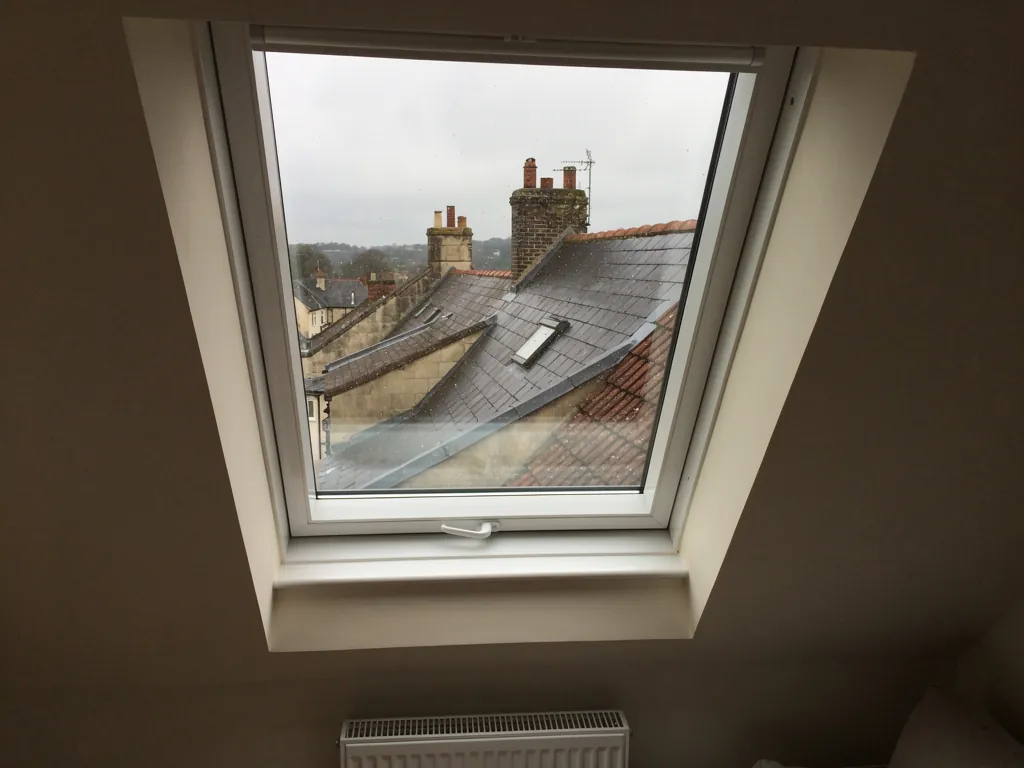
White roof window seen from inside a loft room
Rolled lead roof covering over a bay above white windows

The short answer

Rarely for like-for-like repairs. The village has a conservation area listed by the Vale of White Horse, so a change to appearance should go to the council first, and listed buildings need consent for alterations to their character. Bigger re-roofs also involve building control.

Most roof jobs in the village are repairs, and repairs in matching materials keep a building's appearance unchanged. They count as maintenance, which planning law does not treat as development, so no application follows. Trouble comes at the edges.

What does the village conservation area mean for a roof?

The council lists a Kingston Bagpuize conservation area, though it has no formal appraisal published. That means the boundary and the reasons for it are less clear than in towns with a full document, so it pays to ask the planning team where your house stands. It also pays to ask before swapping tile for slate or the reverse.

How do listed buildings and the church differ?

Kingston Bagpuize House is the village's best-known historic building, and for any listed building, consent is required before works that touch its character, roof covering included. St John the Baptist's, as an Anglican parish church still in use, falls under the faculty system instead. For houses nearby, the question is simply whether yours is listed, which the council can confirm.

When do Building Regulations apply to a re-roof?

Approval is needed when a re-roof reaches 25 per cent of the total building envelope or half the roof, and also when the new covering is 15 per cent or more heavier. In the Vale of White Horse, building control is the shared Southvale service, or a registered building control approver. For roof windows, the planning rules are on our roof window planning page.

If you plan to convert the loft, add a dormer or fit a larger roof window, speak to us before drawing anything up. The route through planning and building control depends on the side of the house, and on whether the conservation area boundary reaches your plot. The written quote says which of these applies to your roof, so there are no surprises later.


MythLiving near a listed house means every roof in the street is protected.

FactProtection attaches to each listed building itself, so the council confirms whether yours is one.

Roofing services in Kingston Bagpuize

Questions from the A420 side of the village

Why does a Kingston Bagpuize chimney keep leaking after repointing?

Pointing only seals the brickwork. A leak at a stack more often comes from the lead flashing at its base, the flaunching holding the pots, or cracked brick faces letting water through. We check all of these on the same visit, so the repair is aimed at the actual entry point rather than the most visible one.

Can you work on a house that was part of Berkshire until 1974?

The old county line makes no difference to the work. Kingston Bagpuize is in Oxfordshire today, in the Vale of White Horse district, and so planning and building control questions go to that council. We work to the same standards whichever county a village once belonged to.

Do you cover Southmoor, Fyfield and the villages near the A420?

Yes. Southmoor, Fyfield, Marcham, Frilford and the other villages around Kingston Bagpuize all sit within 30 road miles of Swindon. If yours is not in that list, send the enquiry form or ring 01793 626096 and the answer comes back quickly.

Should the gutters on a Kingston Bagpuize estate house be replaced or cleared?

Cleared if they are sound and simply full. Replaced if they sag, split at the joints or leave marks down the wall. A failed run left alone soaks the fascia and soffit, so the earlier it is dealt with, the smaller the job.

Ask us about your roof

Tell us what’s happening and we’ll call you back.

  • Photos of what we find
  • A written quote
  • 10-year workmanship guarantee

Or call 01793 626096

Call Get a quote