Concrete tiled estate rooftops towards green hills

Roofers in Chedworth, Gloucestershire

Chedworth's houses crowd a narrow Cotswold valley, and the stone roofs above the stream call for patient hands. Every job begins with a survey of your roof and ends with a written quote.

Chedworth's roofs along the stream valley

Stone houses stepping down a hillside lane
The church, the Seven Tuns and the old lanes

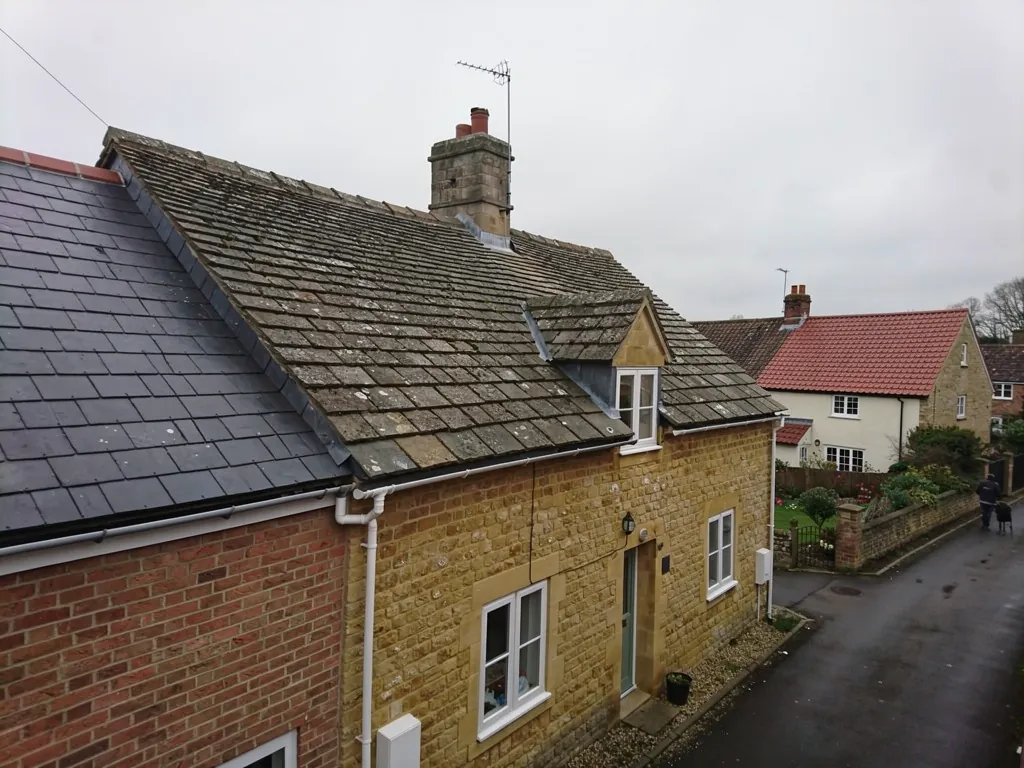
The church of St Andrew is of twelfth-century Norman origin, much rebuilt in the second half of the fifteenth century, and the Seven Tuns Inn near it is Grade II listed. Around them the lanes follow the Chedworth Stream, which rises near the village and runs east through a narrow valley towards the River Coln. Roofs in a valley like this step down the slope, so valleys, abutments and chimney stacks sit close together, and rain leaving one roof often lands on the next. Where a house wears Cotswold stone, the big stones sit low at the eaves and the sizes dwindle towards the ridge. Repairs must respect that rhythm, or new work stands out from across the valley.

Terraced cottages with chimney stacks
Cottages, terraces and the railway years

A railway station served the village from 1892 to 1961, a reminder that Chedworth kept changing long after its oldest stone houses went up. Later cottages and terraces are usually plainer than old farmhouses, with gutters tight to the wall, short chimney stacks and flashings where neighbours share a party wall. Their coverings may well differ from the Cotswold stone nearby, and then the faults differ too: nails rusted through, tiles that have lost their edges, and lead that has thinned. Because pitch and covering were chosen together, we check one against the other before suggesting any change of material, since a covering laid below its proper pitch lets wind-driven rain in under the laps.

Newer homes with garages and porches
Modern houses, extensions and outbuildings

Around the old core, newer houses, extensions and converted outbuildings add other coverings: concrete or clay tiles, slate, profiled sheet. Their faults are of another kind. Bedding drops out of ridge tiles, underlay tears at the eaves, and flat roofs on porches and garages turn out never to have had enough fall. In a protected landscape a roof seen from the road or across the valley carries real visual weight, so colour and texture matter, and we choose repairs and replacements that sit comfortably beside their neighbours. Sample tiles are laid next to the old covering and viewed in daylight before anything is ordered, because a colour that looks right on a sheet can look wrong on a hillside. Chedworth sits in the Cotswolds National Landscape, which does not change how a leak is mended but does raise the bar for the finished look.

From Swindon up into the Chedworth valley

Map showing Chedworth and central Swindon. 24 road miles north-north-west of central Swindon.

Distance
24 road miles north-north-west of central Swindon
Council
Cotswold District Council
Conservation area
Chedworth Conservation Area, designated 1977
Landscape
Within the Cotswolds National Landscape
Council
Cotswold District Council

Chedworth roof questions, from the stream to the villa

Can you repair Chedworth's Cotswold stone roofs rather than replace them?

Usually. Slipped stones are re-hung, rotten pegs and battens renewed and ridges re-bedded, with sound stones left in their original courses.

Does Chedworth's conservation area make roof repairs harder?

Not for a matching repair. A different material, or anything touching a listed property, is the moment to ask Cotswold District Council before pricing.

Why do roofs in a narrow valley like Chedworth's suffer from damp?

Shade and slow-drying air let moss and algae settle, and water from one roof often runs onto the next. Clear gutters and sound valleys do most of the protecting.

Q1

How is a Chedworth stone slate roof repaired?

Gloved hands fitting a weathered Cotswold stone slate
Reclaimed Cotswold stone slates sorted by length beside a limestone wall

The short answer

By keeping the stones and renewing whatever holds them. The wooden pegs go first, then the battens beneath, then the ridge bedding, and the stone outlasts all three. A typical repair lifts the failed area, renews what carries the stones and relays them in their original order, adding matching pieces only where some have broken. Taking off an entire slope is the final option, and the survey tells you if that point has come.

A stone roof in the Cotswolds is a heavy, slow-moving structure, and its failures are slow too. Cotswold District Council published a technical guide to these roofs in 2000. It is dated, but the way a stone roof is built has not changed, and it remains the clearest account of the traditional method.

How was the roof built in the first place?

The stone is oolitic limestone from two sources, Forest Marble and Stonesfield Slate. The first is split by hand soon after digging; the second needs frost to split it. Since quarried stone yields small pieces in far greater number than big ones, the largest stones, called cussoms, are laid along the eaves, doubled up, with followers above them and the shortest pieces near the top. The guide also notes that locals in the southern half of the district say tile, while the north says slate, so both words describe the same roof.

What goes wrong with it?

Pegs rot, battens soften and stones slip. At stripping, the guide says, about half the stones have commonly perished, so a slope that looks fine from the lane may still hide a good deal of tired stone. It adds that annual scraping could give a roof twice the life, which makes the case for dealing with moss early rather than late. For smaller faults our roof repairs page explains how we scope a job.

Where do swept valleys come in?

The traditional valley is formed from specially cut stones that curve gently into the roof. Lead valleys are cheaper, but the guide advises against them on a traditional roof. Our Cotswold stone roofing page explains how we rebuild them.


Q2

Can reconstituted stone replace Chedworth's stone slates?

The answer

On a historic building it should not. The English Heritage policy set out in Cotswold District Council's guide treats concrete tiles and artificial stone as poor stand-ins for real stone slates. A newer, unlisted building raises a different question, and the structure and the council both have a say.

People ask because a concrete lookalike is lighter, and its price on a list can look lower. The question deserves a straight look at the building rather than the brochure. Whether a substitute is acceptable turns on the age and status of the building and on what covers it today.

What does the guidance say?

The English Heritage policy the council reproduces favours newly cut stone slates over salvaged ones, and wants salvaged slates reused solely on the building that lost them. Substitutes, including concrete tiles and reconstituted stone, are not suited to historic buildings, and slates of sandstone and of limestone are never to be exchanged or mixed. A local plan policy printed in the same guide refuses removal of natural roofing from listed buildings where a modern replacement would do significant harm.

What about a modern lookalike?

Some products are made to resemble Cotswold slate. One manufacturer's data sheet describes a concrete slate in random widths and diminishing lengths, suitable down to a minimum pitch of 30 degrees and weighing about 84 kg per square metre. It is concrete, not stone. It may suit a house built in the last few decades; it would not suit a medieval farmhouse, where the original stone is part of what makes the building significant and where any substitute would show from the lane.

Does weight come into it?

Always. Any change of covering means checking the structure, and where the weight changes by 15 per cent or more, Building Regulations approval can follow. Cotswold District Council runs its own building control service, and where work is notifiable we take on the notification.

Our view

On an old Cotswold house, repair the stone you have; keep lookalikes for buildings that were never stone.

Q3

Who decides roof work in Chedworth's conservation area?

Cotswold stone cottage with a steep stone slate roof
Long flat roof on a 1960s brick building being re-covered

The short answer

Cotswold District Council decides. Chedworth's conservation area was designated in 1977, and Chedworth falls inside the Cotswolds National Landscape, whose body offers advice but never grants consent. A repair in identical stone seldom needs an application, whereas new materials and listed buildings are the cases to check.

Two designations overlap in Chedworth, and people often assume the stricter one governs every job. In practice neither stops routine maintenance, and both can be explained in a few lines. The question that matters is whether the finished roof looks any different from the street.

How does the conservation area affect Chedworth roofs?

It adds scrutiny to changes that alter how a building looks. Renewing a covering with identical stone, laid identically, is upkeep and seldom needs planning permission. A different covering, a rebuilt chimney or new openings are the kinds of change to put to the council. Our page on tiled roofs in conservation areas covers the common questions.

What does the National Landscape change?

Since 22 November 2023 the Cotswolds area has carried the name National Landscape in place of area of outstanding natural beauty, and its legal protection is unchanged. Its body is a consultee with an advisory role, while the council decides planning matters. The designation does not alter how a repair is carried out.

What about listed buildings?

The Seven Tuns Inn is Grade II listed, and neighbouring buildings may share that status. Alterations that change a listed building's character need consent, and roofing material falls under that. A church in use is treated differently: work at St Andrew's would go through the faculty system, led by the parochial church council.

What does this mean for a quote?

The survey tells you which route a job takes, so the quote already allows for it and nothing arrives as a surprise.

MythA National Landscape body has to approve every new roof in Chedworth.

FactThe council makes planning decisions; the landscape body is an adviser and is not obliged to be consulted on every application.

Chedworth roof queries, from the villa to the stream

Why do Chedworth's stone roofs need so much attention at the valleys?

A valley gathers water from two slopes into one narrow channel, so it takes the heaviest flow and wears first. A traditional swept valley depends on carefully cut stones, and a lead one on sound sheet and fixings. Either can be repaired locally without stripping both slopes, which keeps the cost down and the stone in place. A written guarantee of 10 years covers our workmanship.

Do you cover Chedworth and the villages around Cirencester and Northleach?

Yes. Chedworth lies inside the area we serve from Swindon, and so do the villages around it. Every place we work in is on the areas page. To book a survey, ring, write on WhatsApp or fill in the form on this page, and expect photographs of your roof alongside the written quote.

Is a chimney stack on a Cotswold stone cottage repaired differently from a brick one?

The stonework is different, and so is the mortar, and the order of work matters: the flashing is fitted only after the stone is sound. Lime mortar suits old stone, whereas a hard cement repoint can trap moisture and damage it. At the base of the stack, the lead is shaped to the stone, stepped course by course. Our chimney repairs page explains the sequence.

Can a converted outbuilding roof near Chedworth Roman Villa be repaired quietly?

Yes, in most cases. Repairs to an existing roof are done from the roof or a mobile platform, planned around neighbours and visitors. If the building is listed, or the repair would change how it looks, ask the council first; the survey is the moment we raise it.

Ask us about your roof

Tell us what’s happening and we’ll call you back.

  • Photos of what we find
  • A written quote
  • 10-year workmanship guarantee

Or call 01793 626096

Call Get a quote