Victorian brick terrace street with slate roofs and chimneys

Roofers in All Cannings

Tiled extensions, chimney stacks, leadwork and flat roofs around All Cannings, from the thatched cottage groups and the Grade II* church of All Saints to the outbuildings and newer houses beside them.

All Cannings roofs, from thatch to tile

Thatched cottages along a village lane
The thatched cottage groups

All Cannings has several cottage groups that are mostly thatched, and Rustic Farmhouse is a late sixteenth century timber-framed house with a thatched roof. Thatching is a trade of its own, and the straw is best left to a thatcher. What reaches us is the roofing that surrounds it: the brick or tiled extension added to a cottage, the lean-to at the back, the chimney that rises through the thatch and the leadwork where a newer roof meets an older wall. Those junctions take the weather first, and an old repair in mastic or cement often hides the real fault, and they are where a cottage most often starts to leak. Timber-framed walls shift through the seasons, so anything fixed to them has to allow for that movement.

Old brick and timber farm buildings
Around All Saints

The Church of All Saints took its present form in the fourteenth and fifteenth centuries, and its chancel was rebuilt in Bath stone in 1868 and 1869. A church like this sets the scale for the older part of the village, where houses and farm buildings of sarsen, brick and timber frame gather near it. Walls built from irregular stone and brick are rarely straight, so a roof laid on them follows every dip. When we repair tiles, slates or leadwork on a building like that, the new work is fitted to the old line rather than forced level, and we photograph each detail so you can see exactly what was found under the covering.

Tiled roofs on newer village houses
Later cottages and newer houses

Not everything here is medieval or thatched. In 1868 Lord Ashburton built a pair of shuttered reinforced concrete cottages in the village, which shows that All Cannings has tried new methods before. Later houses, bungalows and farm conversions bring the usual coverings, whether concrete or clay tile or slate, with a flat roof over the garage or a kitchen addition. The faults are familiar. Ridge tiles loosen, felt tears on a flat roof, and gutters drift away from the fascia board. Each has a repair sized to the fault, and the survey tells you which one you have before any money is spent. A garage roof that has simply reached the end of its felt does not need the same answer as one that has been leaking at a single upstand.

Out to the Vale of Pewsey and the Downs

Map showing All Cannings and central Swindon. 20 road miles south-south-west of central Swindon.

Distance
20 road miles south-south-west of central Swindon
Council
Wiltshire Council
Council
Wiltshire Council
Conservation area
All Cannings
National Landscape
North Wessex Downs

What All Cannings householders want to know

Will you go up beside a thatched cottage?

Yes. We repair the tiled, slated and leaded parts around the thatch, such as extensions, stacks and flashings, and keep ladders and tools well clear of the straw.

Does the All Cannings conservation area affect a repair?

A matching repair on an unlisted house normally goes ahead without consent. Planning to alter the covering, or living in a listed house? Put the question to Wiltshire Council before work begins.

Is All Cannings inside the North Wessex Downs?

Yes, it lies within the North Wessex Downs National Landscape. That leaves like-for-like roofing alone but narrows what you can alter, for example a new dormer.

Q1

What goes wrong where tile meets thatch?

Blocked gutter full of leaves overflowing down a brick wall
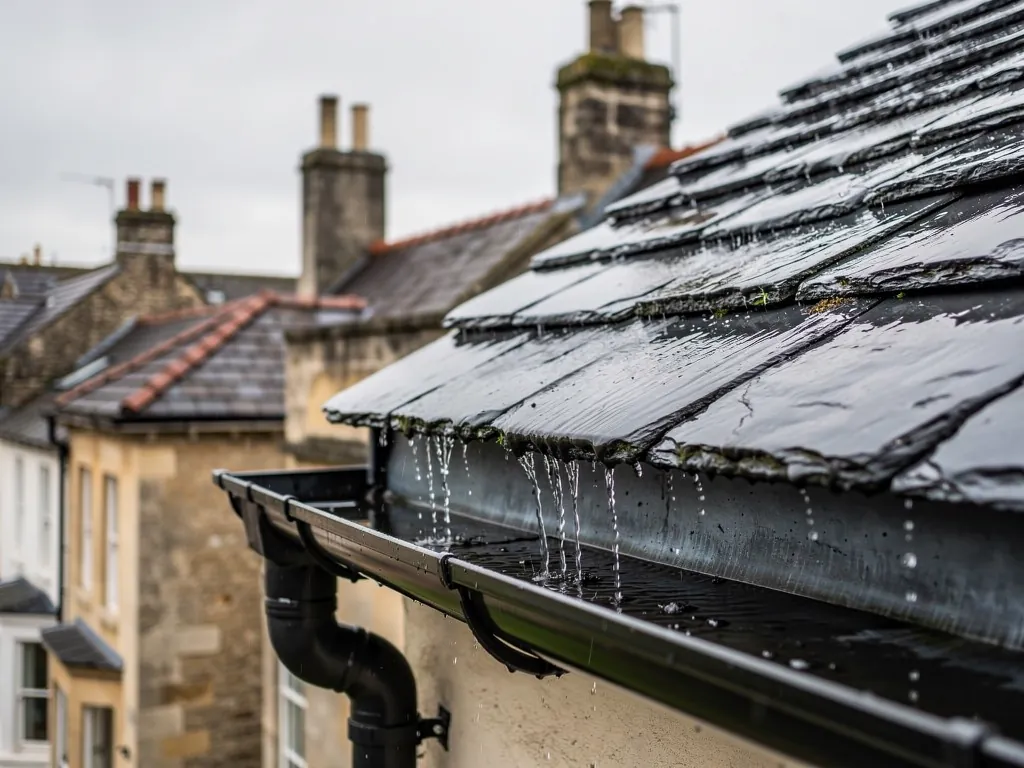
Rainwater running off slates into a black gutter and downpipe

The short answer

The joint is the weak point. Where a tiled or slated roof, a chimney or a lead flashing meets an older wall or a thatched cottage, water finds the gap first. Most of our work in All Cannings starts at those junctions, because the thatch itself belongs to a specialist.

A cottage that has grown over four centuries has been added to many times. Each addition brought a new roof, and each new roof had to meet the old building somewhere. That meeting line is where we spend most of our time in villages like this one.

Why do flashings fail at the cottage wall?

Flashing is the thin metal, usually lead, folded into a wall and over the roof edge so water cannot slip between them. On a timber-framed cottage the wall moves with the seasons, and a stiff or badly dressed flashing lifts away from it. Rain then tracks behind the metal and into the structure. The repair is rarely dramatic: the old lead is lifted, the wall behind it is checked, and a new strip is dressed in with a fold that can flex. Our page on lead roofing explains how the metal is chosen and fixed, and the roof repairs page covers the wider picture of tracing a leak.

What about a stack rising through thatch?

A chimney rising through a thatched roof needs careful attention, because the stack, its flashing and the flue lining all matter at once. We look at the pointing, at the flaunching (the cement collar that seats each chimney pot), and at any cracks running through the brickwork. Where a flue is in use, the condition of the stack is a safety matter as well as a damp risk, so we describe what we see and what we would leave alone. More detail is on our chimney repairs page.

Which lean-to roofs give up first?

Lean-to roofs are often the first to need work. They are low, shaded and fitted with gutters that collect leaves from nearby trees. A blocked gutter spills down the wall, and damp shows indoors long before the covering itself has failed. Clearing and resetting the gutter is a small job; leaving it can grow into a large one. We also look at what the overflow has already done to the fascia and the wall plate behind it, because rot there changes the repair.

None of this needs the thatch to be disturbed. We work from ladders and roof ladders positioned clear of the straw, and we agree access with you before the day.


Q2

Does the North Wessex Downs change roofing rules here?

The answer

Not for matching repairs. All Cannings has a conservation area and sits in the North Wessex Downs National Landscape, which together limit some alterations such as dormers. Wiltshire Council decides planning questions; the National Landscape body only advises.

People often assume that a protected landscape means every roofing job needs an application. It does not. What it does is tighten the rules on changes, and it is worth knowing where that line sits before you commit to a job.

Does a matching repair need permission?

Putting back the same covering, fixed in the same manner, rarely calls for a planning application. That holds inside a conservation area too, provided the building is not listed and no Article 4 direction takes the right away. A survey cannot reveal a direction, so if there is any doubt, we ask you to check with Wiltshire Council's planning team before the work is booked.

What changes once the Downs are involved?

The parish lies in the North Wessex Downs, which the law treats as protected land. That bears on bigger changes such as adding a dormer. Roof windows follow a separate set of rules, written up in full on our roof window planning page so they are not repeated here.

Who actually makes the planning decision?

The North Wessex Downs partnership acts in a non-statutory, advisory capacity. The decision itself rests with Wiltshire Council. If you want a view on a larger project, the council's pre-application route is the place to begin, and we will describe the roof side of the job in plain terms for your application.

Wiltshire Council is a separate authority from Swindon Borough Council, which surprises some owners who live near the county edge. An address in Swindon and one in the Vale of Pewsey go to different planning teams, and it is worth confirming which one applies to you.

MythLiving in a protected landscape means any roof job needs an application.

FactA matching repair on an unlisted house seldom does; it is a change to the roof's shape or look that draws the council's attention.

Q3

Who checks a re-roof near All Saints church?

Long flat roof on a 1960s brick building being re-covered
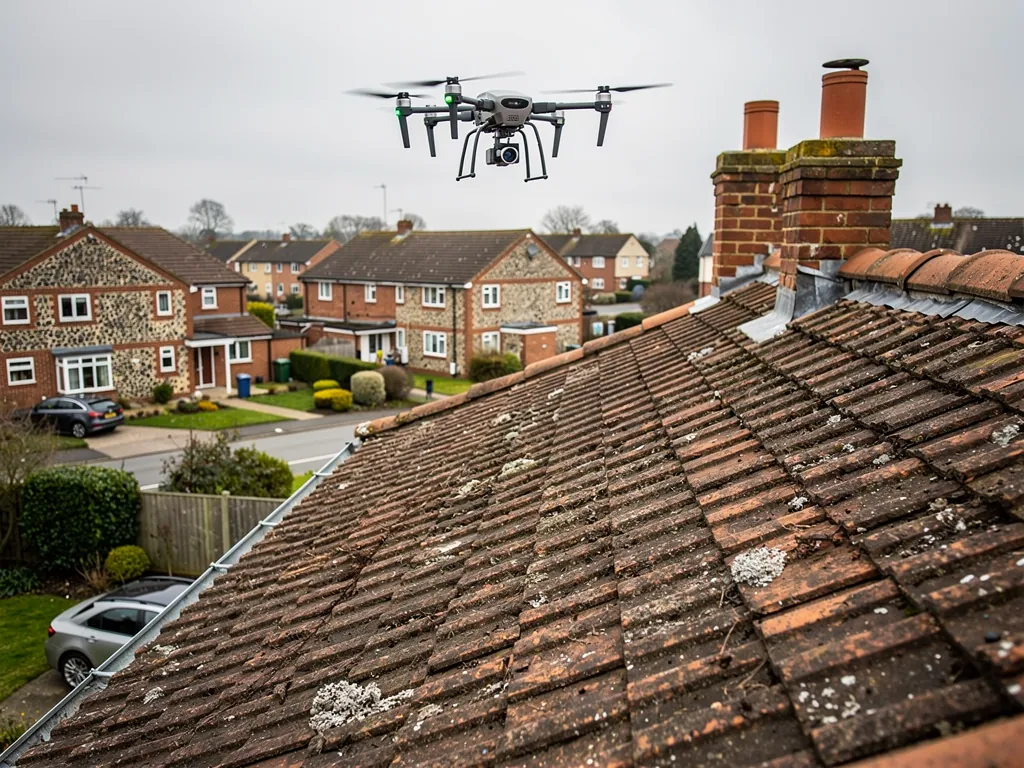
Drone hovering above a tiled roof during a roof survey

The short answer

Wiltshire Council's building control team, or a registered building control approver, covers notifiable roof work on a house. The church is a separate matter: being an Anglican church in regular use, All Saints is dealt with through the church's faculty system, not listed building consent.

All Saints is Grade II* listed, and a listed church can make people uneasy about the houses around it. In practice there are two separate questions: what your own house needs, and what the church needs.

What does my own re-roof need?

Most repairs need no approval. Building Regulations arrive when a re-roof is large. Per the Planning Portal, a building control application is not normally required while under 25 per cent of the total building envelope and under 50 per cent of the roof is touched. A new covering that weighs 15 per cent or more over the old one also needs approval, which matters when heavy tiles are going onto an old frame. During the survey we work out where your job sits against those limits, and we handle the notification when it applies, through Wiltshire Council's building control team or a registered building control approver.

How is All Saints itself handled?

An Anglican church in use is covered by the ecclesiastical exemption, so its works are authorised through the church's own faculty process rather than by the council. A house nearby does not enter that process, but it explains why the church roof is the parish and diocese's business and not yours or ours.

What if my cottage is listed?

If your own house is listed, the position shifts. Alterations affecting its character need listed building consent, and the roofing material forms part of what is protected. On a listed cottage we repair in matching material and settle the approach with you, plus the council where required, before any work begins.

Whichever applies, you receive the quote in writing once we have surveyed, and our workmanship guarantee runs for ten years, in writing.

Our view

Find out whether your house is listed before you price any roof work, because that one fact decides who has to be asked.

Roofing services in All Cannings

Questions from the Vale of Pewsey

Which roofs in All Cannings are thatched, and what do you do about them?

Several cottage groups in the village are thatched, and Rustic Farmhouse is a late sixteenth century thatched house. Thatch is for a specialist thatcher. We look after everything else on the property: tiled extensions, chimney stacks, lead flashings, gutters and flat roofs on outbuildings. If a leak runs from thatch into a newer roof, we trace where the water enters first.

Can you work on a roof close to the waterside here?

Yes. The waterway, which opened in 1810, crosses the parish a little north of the village, and our area takes in everywhere within thirty road miles of Swindon. Access is the first thing we check on any site, including narrow lanes, towpaths and farm tracks, so describe how the property is reached when you call or write, and the day gets planned around that.

What should I send for a flat roof on a village outbuilding?

A few photographs from the ground, the approximate size and what the building is used for, such as a garage, store or workshop. We then survey on site and photograph the roof itself. The written quote follows, and it states whether a patch or a whole new covering suits that particular roof.

Do old mortar ridge tiles in All Cannings need replacing?

Not necessarily. Since the 2014 revision of BS 5534, mortar on its own has stopped being the accepted way to hold ridge tiles, so a ridge we re-bed is also fixed mechanically. Where the existing ridge is firm and just the pointing has weathered, repointing may be enough, and the survey will show which case you have. Wind exposure on the open vale also plays a part in that choice.

Ask us about your roof

Tell us what’s happening and we’ll call you back.

  • Photos of what we find
  • A written quote
  • 10-year workmanship guarantee

Or call 01793 626096

Call Get a quote