New-build brick and render estate houses with grey tile roofs

Roofers in Urchfont

Leaks mended, coverings renewed, stacks rebuilt and flat roofs relaid for homes in Urchfont, from cottages under the tower of St Michael and All Angels out to the barns, yards and newer houses scattered through the Vale of Pewsey.

Urchfont's roofs, church tower to Plain edge

A village church tower above older rooftops
The church and the manor

St Michael and All Angels is a church of the late thirteenth and early fourteenth centuries, finished with a late fifteenth-century west tower, and was recorded as Grade I in 1962. Its aisles were re-roofed in 1631 and again in 1787, a useful reminder that even the grandest roofs get renewed every few generations. Urchfont Manor was built in the late seventeenth century by Sir William Pynsent, carries a Grade II* listing, and housed an adult education college from 1947 until 2012. Roofs on buildings of this rank are never ordinary jobs. Access, lead, timber and consent all call for thought before a contractor lifts a tile, and the cottages round about take their setting from them. Even a modest repair near the churchyard is planned with that in mind.

Roofs and chimneys in an open downland village
The old village below the Plain

Urchfont lies in the south-west of the Vale of Pewsey, north of Salisbury Plain and about six kilometres south-east of Devizes. The land to the south was bought by the War Department from 1897 and is now part of the Salisbury Plain Training Area, which leaves the village with a wide, open horizon and little to shelter it. Older houses and farm buildings in a place like this get steady weather on their roofs, so ridges, verges and flashings take the punishment first. Whatever the covering is, we look at how it is fixed before we look at how it looks.

Garage and extension roofs on newer houses
Later houses, extensions and outbuildings

Beyond the churchyard and the older lanes the village has more recent homes, garages, porches, conservatories and flat-roofed additions. Their trouble is the everyday kind: tired felt, valleys clogged with moss and leaves, tiles lifted by wind, cracked ridge beds and leaky joints where a new wing meets the old roof. A pitched garage may need little more than refixing and a fresh ridge, whereas a flat roof worn out after its working life is a replacement job. We explain which is which, and the survey photographs let you judge the evidence before you agree to anything.

Urchfont in the Vale of Pewsey

Map showing Urchfont and central Swindon. 24 road miles south-south-west of central Swindon.

Distance
24 road miles south-south-west of central Swindon
Council
Wiltshire Council
Conservation area
Urchfont, designated on 26 June 1968
Council
Wiltshire Council
Setting
Vale of Pewsey, at the foot of Salisbury Plain

Roof questions in the Vale of Pewsey

Is a house near Urchfont's church likely to be listed?

It may be. The church is Grade I and the manor Grade II*, and cottages nearby can be listed too. Wiltshire Council can confirm whether yours is before any roof work is planned.

Does Urchfont's conservation area affect new coverings?

Like-for-like re-covering rarely draws comment, but a change of material deserves a word with Wiltshire Council first. Wiltshire's records also list an Article 4 direction for Urchfont, so ask what it covers.

Do open downland roofs need stronger fixings?

Ridges, verges and hips take the most wind, so those are fixed mechanically and checked first. Nothing on the main slope is left to mortar alone.

Q1

What roofs stand around Urchfont's church and manor?

Lead-lined valley gutter between two slate roof slopes
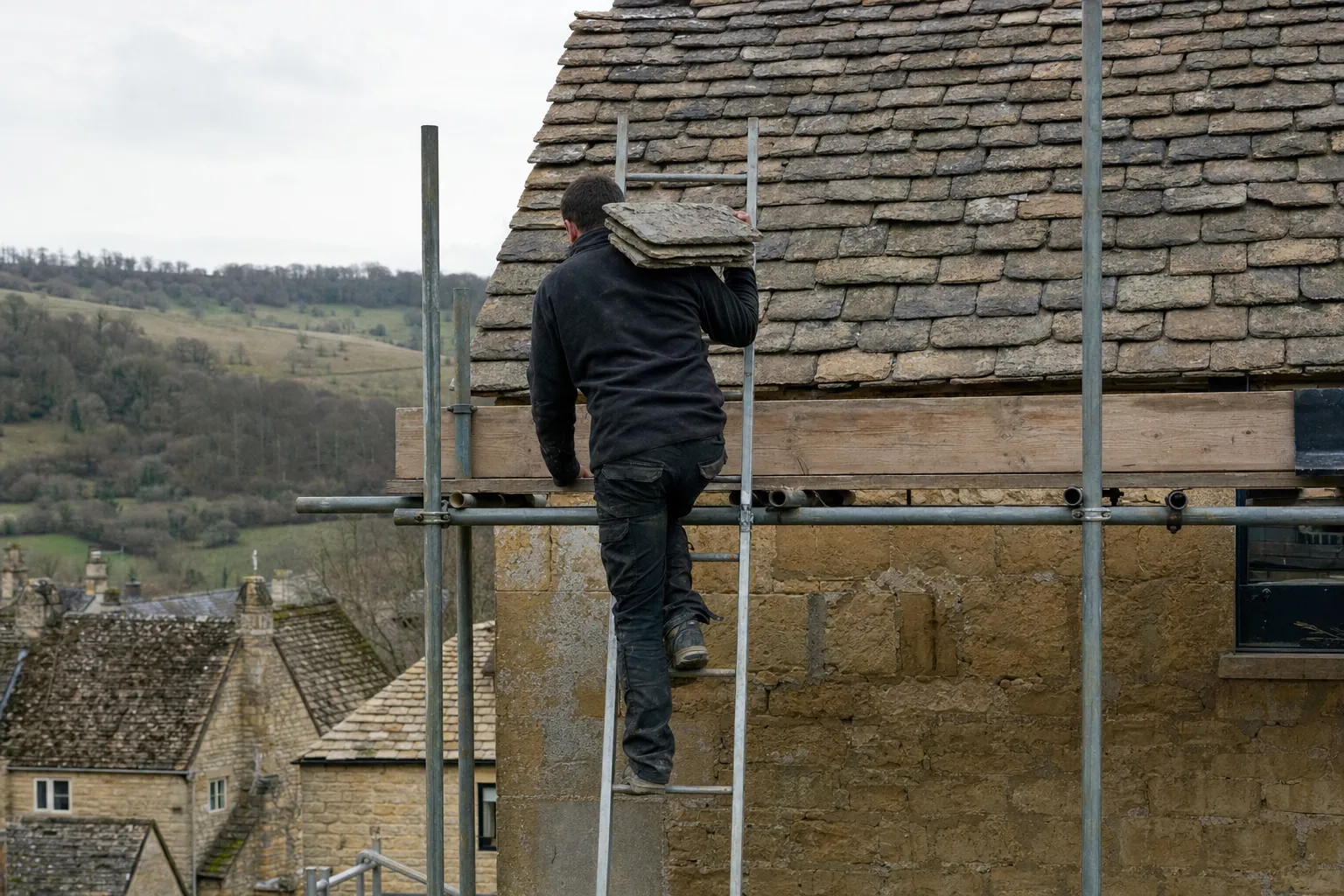
Roofer carrying stone slates up a ladder on scaffolding

The short answer

Roofs of very different weight and age. A Grade I church with aisle roofs renewed in 1631 and 1787, a Grade II* manor from the late seventeenth century, and cottages, farm buildings and newer houses beside them. Each needs its own approach, and the listed ones need consent routes checked first.

Stand beside St Michael and All Angels and a village roofline reveals how it was put together. The church's tower dates from the late fifteenth century, its aisles were re-roofed twice in the seventeenth and eighteenth centuries, and houses of every later period have been added around it.

Why do the biggest roofs fail where they do?

On big old roofs the broad slopes are rarely where a fault begins. Faults gather at the parapet gutters, the valleys between roof sections, the lead at the foot of a tower and the flashings round tall chimneys. Water finds those joints because they carry the most flow and are the hardest places to keep clear. Moss, leaves and a slipped sheet of lead can all turn a gutter into a dam, and then the water has nowhere to go but inwards. A leak that shows inside may be several metres from where the water enters, which is why we trace it rather than guess.

What is different about an ordinary village house?

Most homes here have nothing grand overhead, yet they share the same habits: a ridge that has lost a bed of mortar, a few slipped coverings, a cracked flaunching on the chimney and a gutter sagging at one end. Those are repairs, and the site is left tidy at the end, with the waste taken away. Our roof repairs page explains the usual faults.

How do you work beside listed neighbours?

Scaffolding near a listed building needs thought. Poles must not rest on fragile walls, boards have to leave paths clear, and anything fixed to a historic wall needs agreement. We plan access during the survey and discuss it with you, because a scaffold plan that suits a modern house may not suit one next to a medieval church.

If your property lies next to the churchyard, tell us when you ring, since that affects both the access plan and the order of work.

Q2

Does Urchfont's open setting change roof fixings?

The answer

It raises the stakes on the details the wind reaches first. Ridges, hips and verges on an exposed roof need mechanical fixing, not mortar alone, and slipped or lifted coverings are best dealt with before the next stormy spell. Where water is already coming in, stopping it comes before anything else.

Urchfont sits where the Vale of Pewsey meets the open land of Salisbury Plain, and a house with little between it and that horizon feels the weather more than a house sheltered in a dip of the land. The exposure is a matter of common sense rather than figures, and we allow for it when we plan the fixings.

Which parts of the roof take the brunt?

The edges and the high points. Verges at the gables, hips, ridges and the first row of tiles along the eaves are where the wind pulls hardest, and a chimney stack standing clear of the ridge takes its share too. If any of these has been bedded in mortar only, it may have loosened without anyone noticing. BS 5534:2014 ended the days of trusting mortar by itself, and a tested dry-fix system under BS 8612:2018 is one way to get the fixing right.

What should you look for from the ground?

Binoculars are enough for a first check. Look for tiles sitting proud of their neighbours, a ridge that has lost its straightness, mortar crumbs in the gutter and moss lines that suggest water is lying in one spot. A camera with a good zoom, pointed along the slope from the lane, helps too. If you see any of these, a visit is worth booking, and a photograph sent by WhatsApp lets us tell you what to expect before we arrive. Our chimney repairs page covers stacks, which are often the first thing that suffers.

What happens after a storm?

Storm damage and live leaks come first. A first visit is about stopping further water getting in, with a temporary cover where needed, and the lasting repair is quoted once the whole roof has been seen. The photographs from that visit are yours to keep whatever you decide next.

Our view

Where the wind arrives first, fix the edges properly and the rest of the roof looks after itself.

Q3

Who decides on roof work in Urchfont's conservation area?

Rolled lead roof covering over a bay above white windows
Long flat roof on a 1960s brick building being re-covered

The short answer

Wiltshire Council decides planning questions, including conservation area and listed building matters, and its building control team, or a registered building control approver, covers notifiable roof work. Most repairs need no application, but the Article 4 direction on record for Urchfont is worth checking before work begins.

Urchfont's conservation area was designated on 26 June 1968, according to Wiltshire Council's record on the national planning dataset. Most roof repairs in matching materials need no permission, but the area, and the listed buildings in it, bring extra questions.

What about the Article 4 direction?

Wiltshire's planning dataset lists an Article 4 direction for Urchfont, held under the name of the village itself. An Article 4 direction takes away some permitted development rights across a defined area, and the national planning guidance describes it in just those terms. Before any change of covering, roof window or chimney work is planned, ask Wiltshire Council exactly what this one restricts. That is a five-minute question that can save a costly mistake.

When does a listed house need consent?

A listed house needs consent before any work that changes its character, and what covers the roof is a large part of its character. The church is a different case: St Michael and All Angels is a Church of England parish church in use, so under the ecclesiastical exemption its roof work goes through the diocesan faculty system, led by the parochial church council, not through listed building consent.

Who handles a bigger re-roof?

A building control application is not usually needed if a job affects less than 25 per cent of the total building envelope and less than 50 per cent of the roof. Go further than that and Wiltshire Council's building control team, or a registered building control approver, takes over. We say which one suits your house and look after the notification.

A short note to the council, giving your address and a photograph of the slope, is often the quickest route to a clear answer, and we can help you put it together.


Questions from the foot of the Plain

Why do Urchfont roofs near the downland edge lose ridge tiles?

Wind lifts them wherever the bedding has weakened. Ridge mortar cracks over the years, and once one section loosens each gust works it further. Bedding the ridge afresh with clips or screws, or fitting a dry-fix ridge, ends the cycle. A ridge that has moved is a prompt to look at the verges and hips as well.

Can you reach a roof right beside the churchyard wall?

Usually yes, with a scaffold plan that suits the space. Before we start we study the ground, the wall and the neighbours, then agree the arrangement with you, including where the boards and poles will stand. Our 10-year workmanship guarantee is in writing with the quote.

Will you travel from Swindon to Urchfont and the Devizes side?

We do. Urchfont falls inside our 30 road mile reach from Swindon, and towns nearby such as Devizes are within it as well. Our areas page names each place, should you want to check one address.

Is a leaking lead valley on an old house a repair or a replacement?

Often a repair. If the lead is sound but a joint has opened or a section has lifted, a localised fix may do. If the sheet is split along its length or worn thin, it has to be replaced. Where a valley collects water from two slopes, the gutter lining is the first thing to wear. The survey photographs show which of the two you have, and our written quote comes after.

Ask us about your roof

Tell us what’s happening and we’ll call you back.

  • Photos of what we find
  • A written quote
  • 10-year workmanship guarantee

Or call 01793 626096

Call Get a quote