
A damp patch on a garage ceiling, a drip onto the car, a tide mark down the inside of a block wall: the symptoms are easy to see and the cause is not. Garages are simple buildings with a simple roof, but they get very little attention. Nobody goes up to look at them, the gutter is often the last thing cleaned, and the covering may have been laid by whoever built the garage decades ago.
That neglect is useful to know about, because it narrows the list of suspects. Nearly every garage leak starts in one of four places: the covering itself, the overlaps between pieces of covering, the joint where the roof meets a wall, or the rainwater system. This guide works through each, with what the leak looks like and what usually puts it right. Should the roof need more than a repair, our garage roof replacement page sets out the options.
Felt that has split, blistered or let water sit
Most flat garage roofs are covered in bitumen felt, laid in layers and sealed with a torch or with bitumen. Felt is flexible when new and gradually stiffens as the sun and frost work on it. After enough winters it cracks along the folds, lifts at the edges and forms blisters where moisture trapped underneath has expanded in warm weather. A blister that has burst becomes a hole.
Where the water goes next depends on the deck beneath. Boards of old chipboard swell and crumble. Plywood lasts longer but stains and delaminates. A leak that has run for a few seasons often leaves a soft, dark patch in the boards, which is why a roofer presses on the deck during a survey and not just on the felt.
Ponding
Puddles that remain on a flat garage roof a day or two after rain are a cause in their own right. Flat roof guidance based on BS 6229 sets a design fall of 1:40 so that 1:80 survives as a minimum after tolerances and deflection. A garage built nearly level, or one whose deck has sagged between the walls, never reaches that. Standing water works into every tiny flaw, and in winter it freezes and prises the surface apart.
When a patch is enough
A single split or blister on an otherwise sound roof can be cut out and patched. If the felt is crazed all over, patching is a short pause and not a cure. Our page on felt garage roof repair goes through where each approach holds.
Sheets that crack, slip or lose their fixings
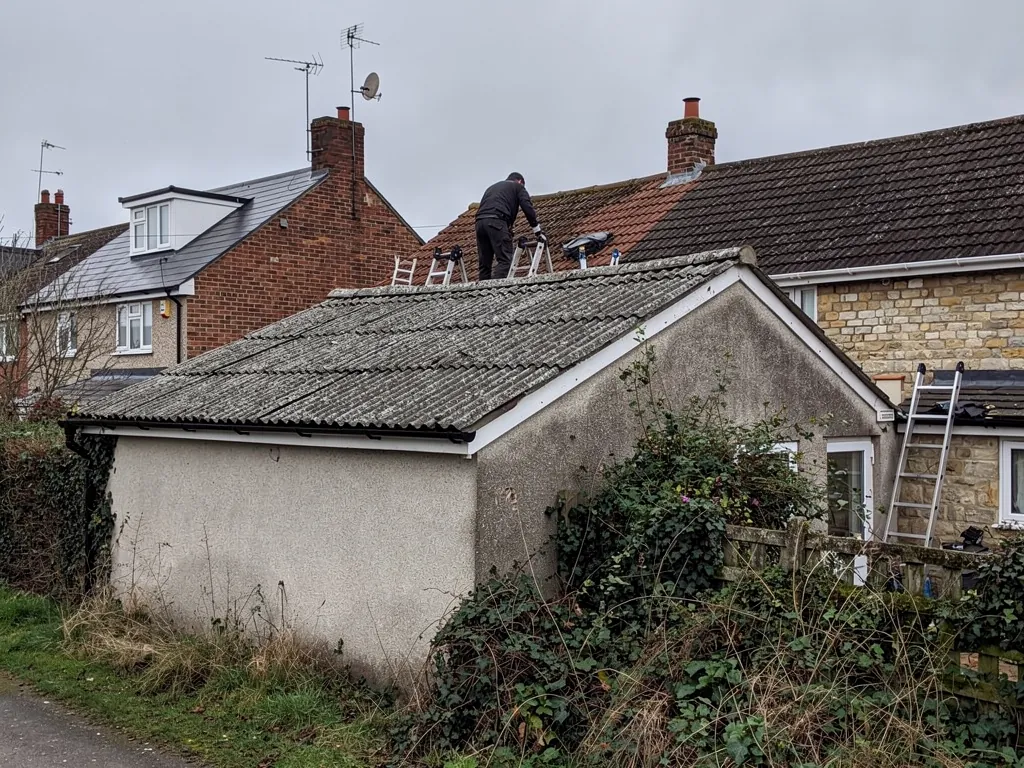
Pitched and low-pitched garages are often covered in large corrugated sheets, either fibre-cement, concrete-fibre or metal. Sheets keep rain out through their overlaps, and they are held down with bolts or screws that pass through the high ridges of the profile. Each of those fixings is a hole, sealed with a washer, and each can fail.
Fibre-cement sheets become brittle with age. They crack across the ridges, particularly where a ladder, a branch or a careless boot has leant on them, and moss can lift the lower edges. Washers perish, bolts loosen, and a sheet that rattles in the wind is also letting rain run underneath. Metal sheets rust at cut edges and at fixings, and sheets laid with too little overlap can leak in wind-driven rain even when nothing has broken.
One caution matters before anything else. Garages built before 2000 may have cement sheets containing asbestos, and drilling, scrubbing or breaking them releases fibres. Please do not pressure-wash, drill, cut or climb on them to trace a leak. Our page on checking whether a roof is asbestos explains how it is identified, and fragile-roof safety is covered in the guide to fragile roofs.
Where a sheet is sound but the fixings have failed, new fixings and washers can end the leak. Where several sheets have cracked, the cost of piecemeal repairs soon passes the cost of a proper solution, which is the subject of the page on overlaying asbestos sheets.
Laps, edges and the places pieces meet
A garage roof is rarely one unbroken surface. Felt is laid in strips with overlaps, sheets overlap each other along their sides and ends, and every edge of the roof has a trim, a verge or a drip. These junctions are where water is stopped by geometry as much as by material, and they lose out when the geometry shifts.
On felt, the lap along a strip can open when the adhesive weakens or when the roof moves. Wind then lifts the edge, and rain runs into the gap. At a verge or edge trim, the felt should finish over a drip bead that throws water clear of the wall. When that has been left out, water curls back under the edge and soaks the wall plate, a stain easily blamed on the covering.
On sheets, the side lap needs enough corrugations of overlap to stay watertight in driven rain, and the end lap needs enough length. Old garages are often short on both, because the sheets were cut to save money. Sealing strips between laps perish with time.
Single-pitch roofs
Many garages have a mono-pitch roof running from a high wall down to the front or back. The top edge is the vulnerable part, where the covering turns up the wall. The next section looks at that joint, where leaks along the top of a garage ceiling often begin.
Where the garage roof meets a wall
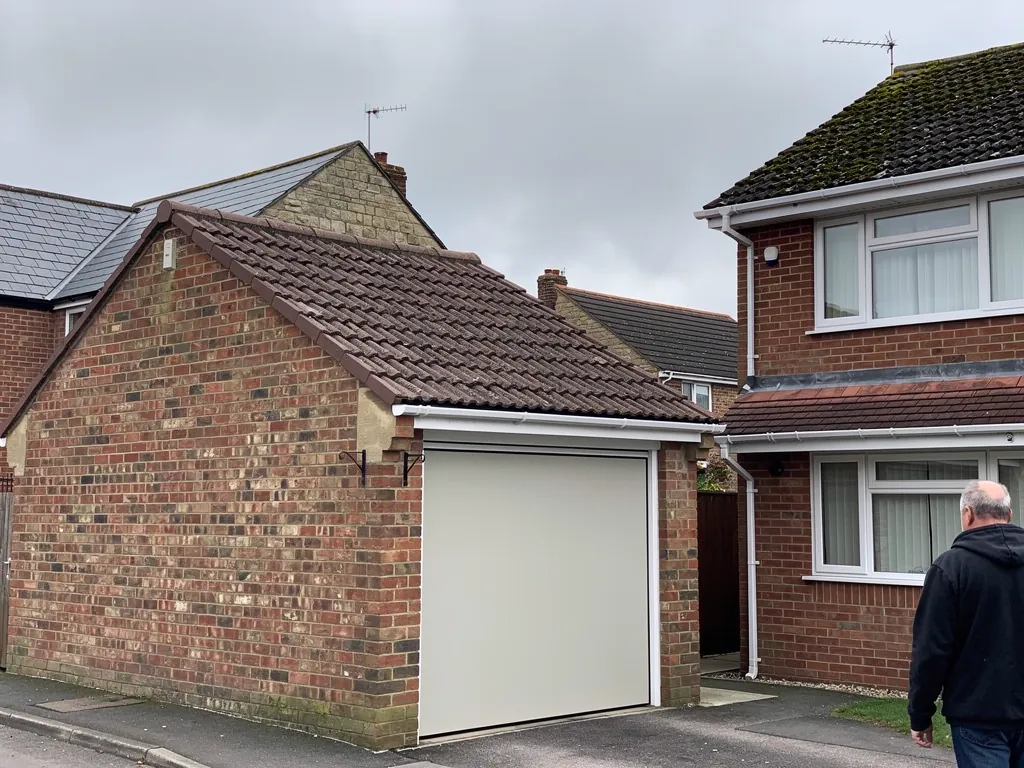
If the garage is attached to the house, or backs onto a boundary wall, the roof stops at a vertical face. The junction has to be waterproof, and on a flat roof that means the covering turns up the wall as an upstand and is finished with a flashing or a sealed cover strip tucked into the brickwork. This is a classic weak spot on an attached garage.
Several things can go wrong. Mortar fillets crack as the building moves. Lead flashing, if it was used, can lift at its top edge or split along a bend. Cover strips of mastic dry out and shrink. Felt upstands that were not turned up high enough let splashing rain over the top. The result is damp on the inner face of the wall just below the ceiling line, often following one side of the roof more than the other.
Why the wall is the first place to check
A tide mark close to the wall almost always points to the abutment and not to the middle of the roof. A roofer will look at the upstand height, the flashing, and the condition of the brickwork above, because water running down an old wall can also arrive at the junction from higher up.
The repair is usually a new upstand and a properly dressed flashing, set into a cut mortar joint and pointed. That is a modest job, and it is the sort of fault where a repair is clearly the right call and a new roof would be a waste. Where the garage is being turned into a room, the junction detail changes again, as covered under garage conversion roofs.
Gutters, downpipes and the rainwater edge
Garage gutters have a hard life. They sit low under overhanging trees, collect leaves from the neighbours' hedge, and are rarely cleaned because getting to them means setting up a ladder on a drive. When one blocks, rain spills over the front edge, runs back behind the fascia and into the timber plate and the upper brickwork, or drips down the face of the door.
Sagging is the other fault. Gutters need to fall gently towards the outlet, roughly 1:600 to 1:350 depending on the system, and brackets need to be spaced closely enough to carry water and debris. A bracket that has pulled out of a rotten fascia leaves a low spot where water pools and overflows. Joints between lengths perish too, and a dripping joint is easy to mistake for a leaking roof when you see it from inside.
A mono-pitch garage roof often drains to a single gutter along the low edge, so one blockage affects the whole roof. Where the gutter is plastic and thirty years old, replacing it can be cheaper than repairing it. The page on garage roof guttering explains the choices.
If the leak only appears during heavy rain and is concentrated near the front wall, look at the gutter before you blame the roof.
Nearby trees matter. Leaves and seeds that land on a flat roof do not only block the gutter, they sit in the ponded areas and feed moss, which holds moisture against the covering and lifts the edges of laps. A yearly clear-out is a simple preventative measure.
Garage conversions, rooflights and other later changes
A leak that began soon after a change to the garage has an obvious first suspect. When a garage is converted into a room the roof is often insulated, ceilings are boarded, and the junctions are altered. If the insulation goes in without a path for air, moisture from the room collects against the cold side of the roof. That produces wet insulation and damp ceilings in dry weather, which no amount of patching on top will cure. Our page on garage conversion roofs covers how the build-up should work.
Rooflights and vents added later are another source. A rooflight kerb that was built on site needs a sound upstand all the way round, and a plastic dome sealed with mastic alone will eventually open. Pipes and flues through the roof need collars, not smears of sealant.
Sheds and outbuildings
Everything above applies to a lean-to store or a timber shed. Their roofs are felt, sheets or boards, and they leak at the same places, usually at the edges and fixings. Our page on shed roofs looks at the smaller versions.
Condensation that looks like a leak
On a metal-sheet garage in particular, drips from the underside in cold, still weather are usually condensation from warm, damp air meeting cold metal. A dry roof surface and wet drips are the giveaway.
Tracing the leak and getting it made safe
The ground tells you plenty. Look at the stains inside the garage and note where they are in relation to the walls, the joints between sheets, the gutter and the front edge. Note the weather when they appear, because rain driven from the south-west finds different gaps from rain falling straight down. Take photographs in good light. A video clip of a drip during rain is worth more than a paragraph of description.
Resist going up yourself. Garage roofs are low enough to tempt people, but wet felt is slippery and old sheets can break under a person's weight. If water is coming in now, move belongings away, put a bucket under the drip and a sheet of heavy polythene over anything that cannot move. We put leaks and storm damage first when booking, and the water is stopped from doing more harm before we trace the cause.
A survey then follows the water to the source. For a garage that is usually a short job: a look at the covering, the laps, the wall junction, the gutter and the deck from underneath if there is a loft void or exposed boards. The written quote includes pictures of the roof itself and sets out the lightest job that will deal with the leak. Timing depends on the covering and the weather; the page on how long a garage roof takes gives a realistic picture.