
Industrial units, barns, garages and older workshops often have roofs that will not take a person's weight. Cement sheets that have aged for decades, plastic rooflights set into steel sheeting, and thin liner panels can all give way without warning, and the person underneath may be a worker in the building, not the one on the roof.
This guide is for owners, landlords and managers who commission roof work, and for contractors who walk onto it. It explains what fragile means in practice, how fragile surfaces are hidden, what protection goes in before anyone steps onto the roof, and where asbestos changes the plan. It does not replace a risk assessment for your building, which depends on the roof in front of you. For regular inspection routines that keep people off the roof between visits, see our guide to a planned roof maintenance programme.
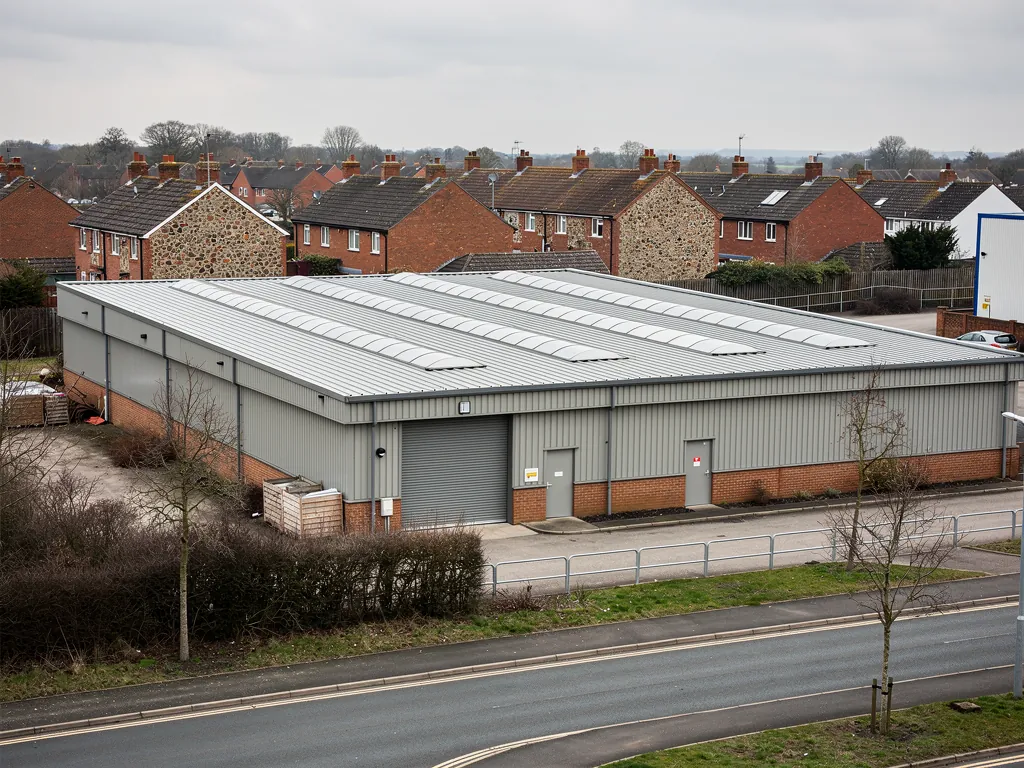
What makes a roof fragile
A fragile roof is one that cannot be relied on to carry the weight of a person and whatever they have with them, such as tools, a ladder or a bucket of sealant. It does not have to be old or visibly damaged. Some roofs are fragile from the day they were built, because the sheeting was never designed to be walked on.
Roofs in this category include asbestos cement sheeting, plain fibre cement sheets, single-skin metal sheeting that has corroded, glass and wired glass, and the plastic panels used as rooflights. Many composite panels and lined sheets are strong enough in the right places and fragile elsewhere, so what lies underneath counts for as much as the sheet on top.
Does a sound-looking sheet mean a safe roof?
No. A sheet can look intact from above and be brittle in the middle of its span, where there is nothing underneath it except air. Fixings that have corroded away leave the sheet held on by habit. Lichen, moss and dirt hide cracks, and a weathered cement sheet can crack under a load that would have been trivial when new.
The safest assumption on any roof of unknown construction is that it is fragile until a competent person has shown otherwise. Treating it that way costs little; assuming the opposite can cost a life.
Rooflights: where a fragile roof most often gives way
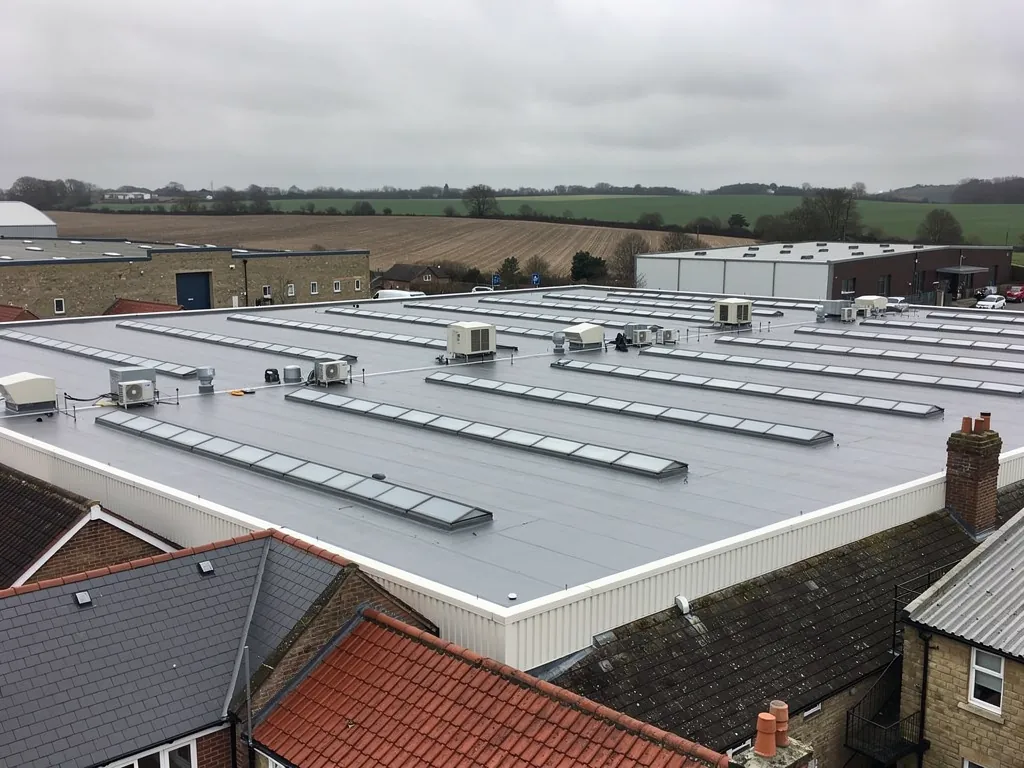
Rooflights are built into profiled sheeting to let daylight into the building, and in an industrial roof there can be dozens. Most are made of glass-reinforced plastic or polycarbonate. In sheet form they are far weaker than the steel or cement around them, and they weaken further with age, because sunlight makes the plastic brittle and discoloured.
The danger is that a rooflight can be almost invisible from above. Moss grows across it, paint is rolled across it by an earlier contractor, or the roof is covered in a layer of coating that makes it look like the neighbouring sheets. A person stepping from one sheet to the next in the middle of the roof, in a hurry, can put a foot straight through.
How do owners find every rooflight?
From inside, daylight shows each one. From outside, a survey marks them with a plan and photographs. Where rooflights are close to the walkway, the edge of each is protected with covers or guardrails before anybody uses the route. Our guide to replacing rooflights on an industrial unit explains what a replacement involves.
Controls that go in before anyone steps on the roof
Work at height is controlled in a sequence. The first question is whether the job can be done without going onto the fragile surface at all, for example from a mobile elevated platform, a tower or a cherry picker working from the ground. Where that is not practical, the second step is to protect people collectively, with measures that work whether or not anyone is paying attention. The last resort is protection that depends on each person doing the right thing, such as a harness on a line.
Collective protection on a fragile roof includes edge protection round the perimeter, covers or guardrails over every rooflight, and nets or soft-landing systems fixed under the sheets. For access, crawling boards or staging spread a load across several supports, so a person is never standing on the sheet itself.
Is a harness enough?
A harness is a legitimate part of a plan. It is not a replacement for a plan, and it depends on a sound anchor point, correct fitting and a rescue arrangement if someone falls. A person suspended in a harness needs to be brought down quickly, which is the reason for a rescue plan, not just a purchase order for equipment.
Ask any contractor to describe, before work starts, how people will get onto the roof, what stops them stepping onto a fragile area, and what happens if someone falls. A clear answer to all three is a good sign.
Asbestos cement sheets: fragile and hazardous together
Many industrial and farm roofs built before 2000 are covered with asbestos cement sheeting. For any building put up or refurbished before 2000, HSE tells owners to work on the footing that asbestos is there until a survey shows it is not. Old cement sheets are not only brittle underfoot; the material releases fibres if it is broken, drilled or abraded, so a fall through one is two hazards at the same moment.
HSE guidance treats careful removal of asbestos cement roofing as non-licensed, non-notifiable work, so long as the sheets come off whole, and that covers weathered sheets with no serious damage. If sheets are already badly damaged or broken up, or the method of removal would crack them, the job becomes notifiable. Notifying the enforcing authority, medical examinations for the workers and health records then apply.
What about asbestos insulating board?
Asbestos insulating board is a different product, found in some soffits and linings, and taking most of it out is higher-risk work for a specialist asbestos contractor. Looking at a board will not tell you what it is, so a sample or a survey is the right first step. Where a survey identifies board, we tell you that it needs a specialist and stop there.
Our answer on asbestos cement roof sheets goes into the commercial side.
What an owner should have in place
Owners and managers of commercial premises are usually the people who control access to the roof, and that comes with responsibilities even when the work itself is carried out by a contractor. The practical measures are straightforward.
Keep the roof access point secured, with a ladder hatch, locked door or removable access, so that casual visitors cannot reach it. Display clear signs at the access point warning that the roof is fragile. Keep a roof plan that marks every rooflight and any known fragile area, and give it to every contractor who is going up. A short permit or sign-in arrangement, recording who is on the roof and why, takes minutes and shows who knows what.
Who is responsible when a tenant's contractor goes up?
It depends on the lease and on who controls the roof, which is why the question is worth settling in writing before problems arise. Where the landlord keeps responsibility for the structure, the landlord's access rules should reach any tenant's contractor too. Our guide to landlord roof repair responsibility looks at how responsibilities are normally divided.
A short rule helps here: if a task needs a person on the roof more than once or twice a year, the building should have a safe route for it, whether that is a fixed ladder with a cage, a guarded walkway or a full-length guardrail round the plant. Planning those at design stage costs far less than retrofitting them around a live roof.
Plant on the roof, such as extract fans, solar panels and air handlers, brings engineers back to the roof again and again. Every one of those visits is a risk, so a protected walkway between the access point and the plant is one of the best investments an owner can make.
Safe design when a fragile roof is repaired or replaced
Repair and replacement are the points at which the risk is highest, because people spend longer on the roof and move materials across it. A plan for the work should be agreed before the first sheet is lifted.
The usual approach is to put protection in place from the edge, working inwards. Perimeter edge protection goes up first, usually with a scaffold or a proprietary system. Rooflight covers and nets follow. Only then do people go onto the roof, along defined routes. Materials are lifted onto the roof by a telehandler or hoist, and stacked over the supporting structure instead of the middle of a span.
Can over-cladding make a roof safer?
It can change the risk. Fitting a new sheet over an old fragile roof means the new sheets are the working surface, once they are fixed, but the fixing of the first sheets still happens from a position that must be protected. The over-cladding approach works differently from a full strip, and our guide to over-cladding industrial roofs sets out how it suits an ageing building.
Every new roof should leave the building less hazardous than the old one. The roof you commission today is the roof somebody else will be sent up in several years from now, and the people who maintain it are rarely the people who designed it.
New roofs should not stay fragile. Specify rooflights with a load-bearing rating, fit permanent edge protection and walkways where the roof will be visited, and keep a record of what was used, so the next generation of maintenance staff or contractors know what they are walking on.
Winter, wet weather and other conditions
Conditions change the risk on every roof. Wet moss, frost and ice make profiled sheets slippery and can hide the line between a rooflight and the sheet beside it. High winds make it harder to carry sheets, handle ladders and keep nets and covers where they belong. Our guide to winter checks for commercial roofs covers outlets, snow and ice.
The rule on any roof is simple: if the conditions mean people cannot work safely, the job waits. A delay costs less than an injury, and a sensible schedule allows for it.
Should the roof be inspected from the ground first?
Yes, wherever possible. A drone or a platform survey can show cracked rooflights, missing fixings and ponding without anyone stepping onto the surface. Where someone does need to go up, the survey photographs the roof from above and records the findings in writing, so the next person knows which areas are fragile.
For work on a roof that may be fragile, we start with the survey, send written findings and a written quote, and agree the access method with you before work begins. Workmanship carries a written 10-year guarantee, and once the work is complete the site is clear and the waste gone. Our commercial roofing page explains the wider range of work we do. If your insulation is being upgraded at the same time, the guide to adding insulation to a commercial roof shows what changes.