
Most commercial roofs fail slowly and then all at once. A blocked outlet, a lifted lap or a patch of surface rust is a ten minute job in March and a stock-damage claim in November. A planned maintenance programme exists to catch the March version. It is not a service contract in the sense of a boiler; it is a set of dated visits, a fixed list of things to look at, and a written record of what was found.
This guide explains how the cycle is usually built, which parts of the roof earn the most attention, and how the paperwork helps with leases, landlords and the building's insurers. If you are weighing a plan against a one-off fix, the sections on cost and records should help. Our wider commercial roofing page sets out the other services these visits tend to lead into.
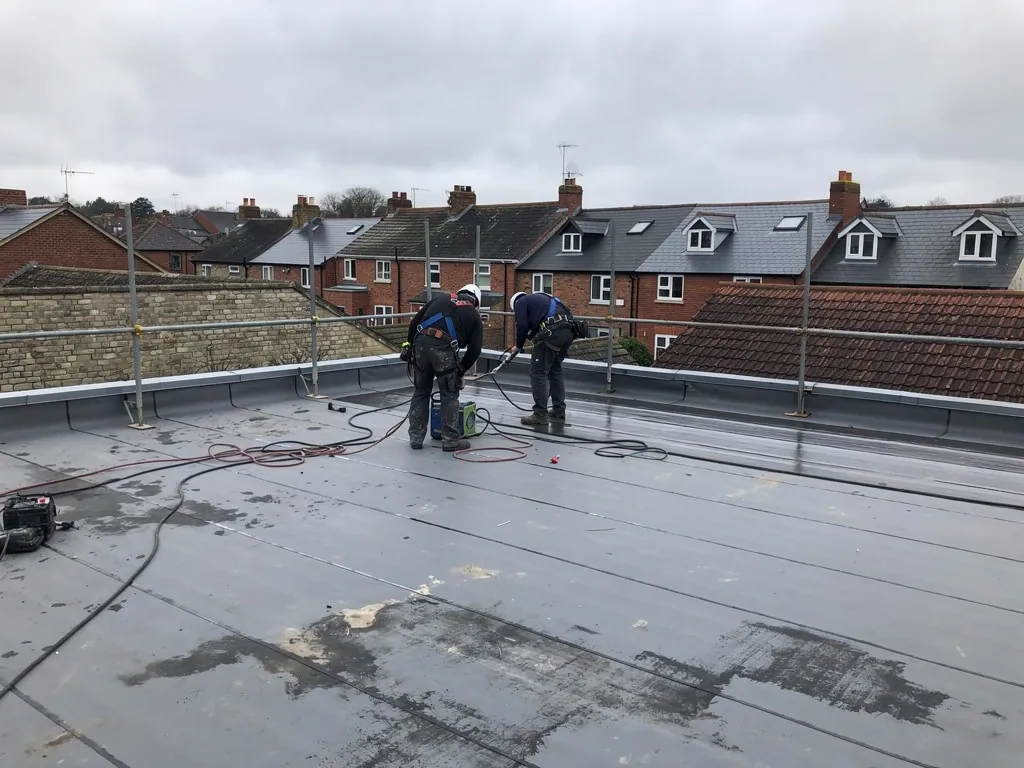
What a planned programme actually contains
A programme has three working parts. The first is a baseline survey: a full walk of the roof, with photographs, that records the covering, the age and condition of every detail, the position of outlets, rooflights, plant and access routes, and anything already patched. Everything after that is measured against it.
The second part is the visit schedule. Each visit follows the same checklist so that a change from one visit to the next shows up clearly. The third part is the report: dated photographs, a plain list of defects ranked by urgency, and a recommendation for each. Minor items found on the day, such as a handful of loose fixings or a choked outlet, can be dealt with during the visit. Anything bigger goes into a written quote.
What a programme does not do is promise that the roof will never leak. A tired covering with a worn-out fixing pattern will still reach the end of its life. What the visits give you is notice. You find out a year or two before the roof is a problem rather than the morning after a storm, which lets you budget for a recover or replacement on your own timetable.
Who should hold the plan?
The building owner or the managing agent, in most cases, with the occupier holding a copy. On multi-let estates the cycle is often run by the landlord and recharged through the service charge, so it pays to check what your lease says before arranging your own visits.
Setting the inspection cycle
There is no single correct interval. Many owners settle on two visits a year, one in spring after the winter has done its worst and one in autumn before the leaves and the weather arrive. Others add a visit after any severe storm. A simple, well-drained roof in good order may be fine with one planned visit and a storm check, while an older roof with tight gutters and plenty of plant on it justifies more attention.
The things that push the interval shorter are easy to list. An older covering, a history of leaks, roofs that sit under trees, roofs that collect debris from a neighbouring yard or unit, and roofs with a lot of foot traffic from plant engineers. A roof that is walked on for servicing needs checking more often than one nobody visits, because the damage is usually done by the visitors.
Do I need a visit after a storm?
It is sensible to look, particularly at flashings, ridge and verge details, and sheet laps on the side facing the weather. Wind lifts edges first. A quick photographic check after a bad night takes far less time than the leak it prevents, and if you do need to deal with your building's insurer, dated evidence of the roof's condition before and after is useful. We do not handle claims, but the paperwork we produce is yours to use.
What gets checked on each type of roof
The checklist changes with the covering. A profiled steel roof, a built-up felt roof and a single-ply membrane roof all need drainage cleared and the perimeter walked, but the rest of the list is different.
| Roof type | Main items on the visit |
|---|---|
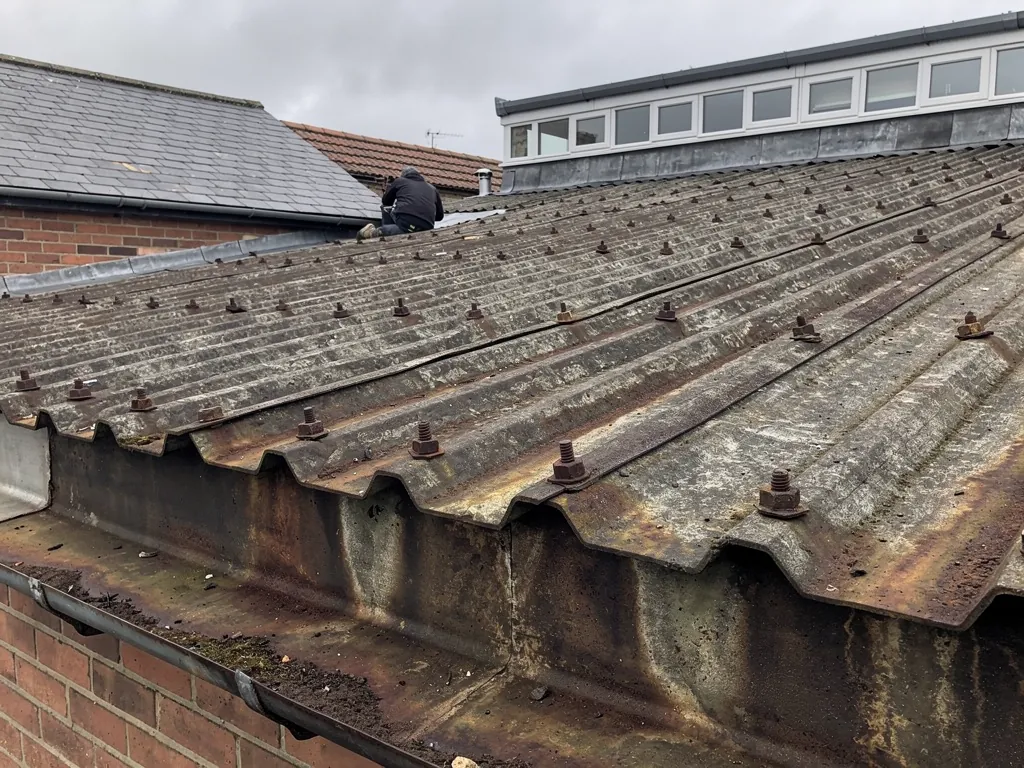
| Profiled metal sheets | Fixings and sealing washers, side and end laps, cut edges and scratched coating, rooflight surrounds, condensation staining on the underside |
| Built-up felt | Blisters, splits at upstands, ponding, surface chippings or reflective finish, outlets and trims |
| Single-ply membrane | Seam condition, penetrations and pipe collars, perimeter terminations, any punctures from traffic |
| Fibre-cement and composite panels | Cracks, slipped sheets, brittle rooflights, sealant at ridge and verge, any suspect asbestos-containing material |
Where a roof has older cement sheets, we treat them as suspect until a survey says otherwise. Our guidance on asbestos on commercial roofs explains why that matters before any work, even a visual inspection involving contact with the sheets.
What do you look for on the underside?
Where the building allows access, we check from inside as well: daylight through laps, rust bloom on fixings, dripping from the liner and wet insulation. Interior signs often show a fault before the outside does.
Drainage: the simplest and most valuable job
If a plan did only one thing, it should be keeping the water moving. Roof outlets, box gutters, parapet gutters and downpipes block with leaves, windblown packaging, bird nesting and moss. A blocked outlet on a flat or low-pitch roof turns the roof into a shallow pond. The added weight is rarely the first problem; the first problem is that standing water finds every pinhole and open lap.
Box and valley gutters behind parapets are the classic hidden failure. They sit out of sight, collect debris for years and overflow into the wall or the building below. Clearing them is a routine task on every visit, followed by a flush with water to confirm that the outlet runs freely. Where a lining has simply run out of service, our answer on industrial gutter lining covers the repair options.
Flat roofs are designed with a fall so that water leaves. British Standard guidance sets a finished minimum of 1:80, designed at 1:40 to allow for tolerances. Where a deck has since dipped, water collects regardless of how clear the outlets are, and the plan should flag it so that repairs allow for it.
Photograph each outlet before and after clearing. Two images on file show a landlord or surveyor exactly what the visit achieved.
Records, leases and the roof file
The written side of a plan is where most of its value hides. A roof file holds the baseline survey, each visit report, photographs, invoices for repairs, any manufacturer data sheets and warranty documents, and the details of anyone who has walked the roof. It should be kept somewhere a successor can find it.
A well-kept file helps in several situations. When a lease ends, a landlord's surveyor may claim that the roof has been neglected; dated records of regular inspection and prompt repair answer the claim. When a manufacturer is asked to honour a warranty, they will usually ask whether the roof has been maintained as required. When a building is sold, a buyer's surveyor looks at the roof first and at the paperwork second, and good paperwork can shorten the questions. Our answer on roofs and dilapidations goes further on the lease side.
How much detail should a report carry?
Enough that someone who has never seen the roof could find each defect again: a location on a simple plan, a photograph, a description in plain words and the action taken or recommended. We write ours so that a managing agent can forward it without translation.
Each programme report is written, dated and handed over as part of the visit. When a defect needs more than a quick fix, the price arrives afterwards as a written quote, built on the images taken up on your roof rather than on a guess from the yard.
It also helps to agree who receives the reports. On a shared estate, a copy to the managing agent and a copy to the occupier avoids the familiar argument about who knew what, and when. We are happy to send reports to more than one address.
Planned visits against reactive repairs
The honest comparison is between a modest, predictable cost and an unpredictable one. A planned visit has a known price and catches small faults while they are cheap. A reactive repair is priced whenever something fails, usually at a bad time, with the added cost of disruption, protective sheeting, damaged stock and a rushed access arrangement.
It does not follow that a plan always saves money. A roof in excellent condition may need little more than a clear-out and a report, and paying for visits twice a year can feel like paying for nothing. That is the point at which the cycle should be reviewed. We would rather shorten or lengthen a schedule than keep billing for visits that find nothing.
When does maintenance stop being enough?
When repairs are being made to the same areas repeatedly, when fixings are failing across whole slopes, or when the covering has lost its protective layer. At that stage the plan has done its job: it has shown you that the roof needs a bigger decision. The options are usually a coating, an over-clad or a full replacement, and our pages on commercial roof coatings and roof over-cladding describe when each one makes sense. Insulation upgrades are a related decision, covered in the guide to commercial roof insulation.
Safe access and who goes on the roof
Any programme depends on getting people on and off the roof safely. That means a permanent or temporary access route, edge protection or a fall-arrest arrangement where the edge or a fragile area is within reach, and a clear idea of which parts of the roof will take weight. Old cement sheets and ageing rooflights are the usual hazards, and a fragile surface can look perfectly solid from above. Our guide to fragile roofs and safety deals with the detail.
Your own staff and other contractors need to be kept off the roof unless they have a reason to be there. Plant engineers, solar installers and satellite fitters are the most common visitors who cause damage, and a simple sign-in log kept with the roof file gives you a record of who went up and when.
Our own visits follow the same rules. We plan the access route before we arrive, tell you where we will be working, and leave the site clear. Where the roof allows it, a drone or a camera on a pole does the first look without anyone stepping on the covering at all.
Repair work that follows a visit carries our written 10-year workmanship guarantee. The photographs stay yours, whether or not you go ahead with anything.