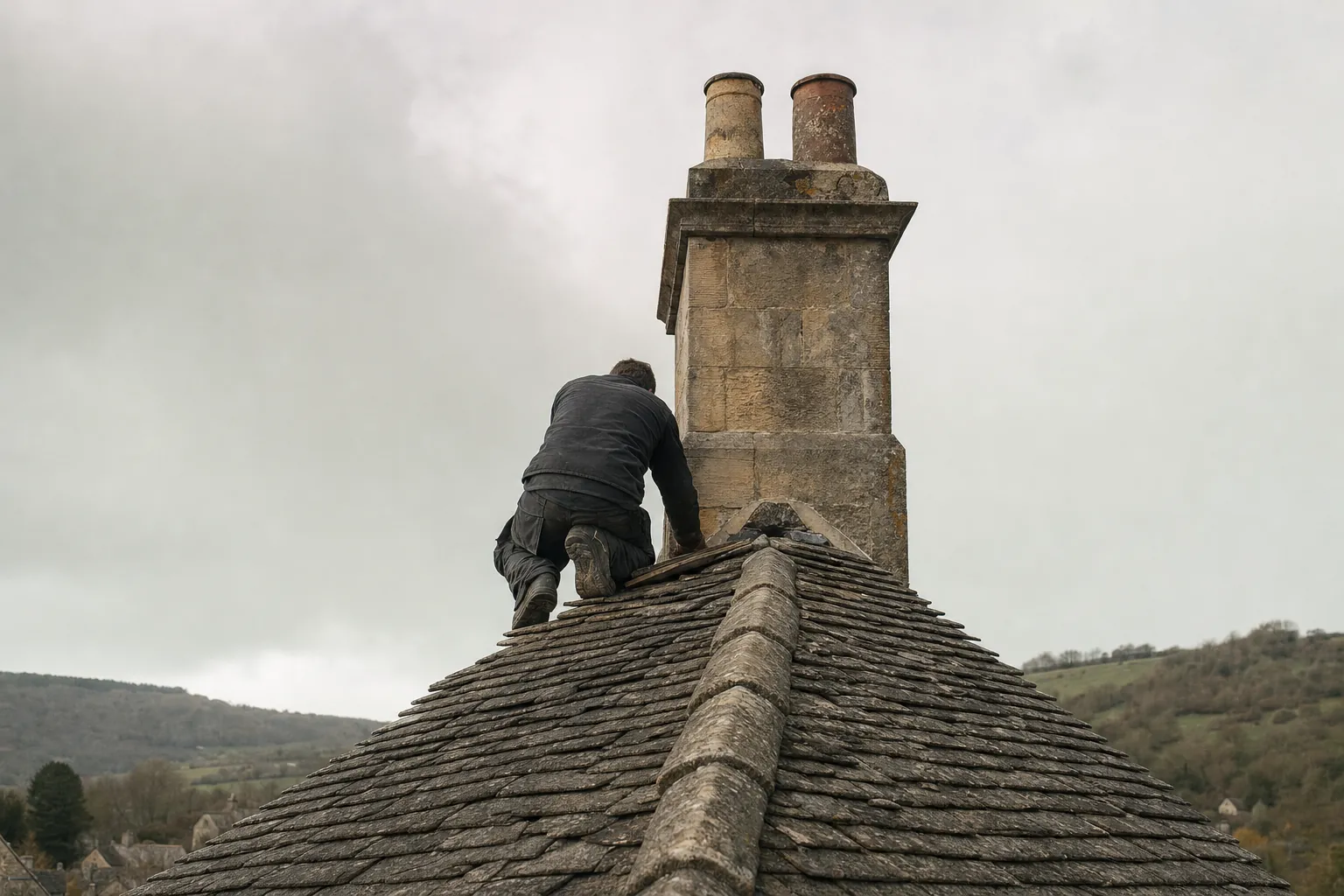
Wet slate and clay tile rooftops with chimney stacks after rain

Roofers in Hilmarton

Roof repairs, re-covering, lead flashings and farm and flat roofs in Hilmarton and its hamlets, from the Poynder-era school and almshouses near St Laurence church to farmhouses, barns and newer homes along the A3102.

Hilmarton's roofs, from almshouses to farmyards

Row of Victorian almshouses with chimneys
The Poynder-era village

William Poynder paid for a general restoration of St Laurence church in 1879 to 1881, and the buildings of the same estate era include Hilmarton Manor, the village school of about 1860 and five almshouses of 1877, all now Grade II listed. Buildings of this kind were designed as a group, with matching pitches, chimneys and eaves details, so one badly matched repair shows up across a whole row. Chimney stacks, valley gutters and the lead flashings round them are where leaks usually begin on Victorian estate buildings, and we trace the water path before suggesting a covering repair.

Old farm barn with a patched roof
Farmhouses and farm buildings

Thomas Poynder bought the manor in 1813, and when Dickson-Poynder sold the estate in 1914 several farms were bought by their tenants. Manor Farmhouse is timber-framed, and the farmsteads around the village have the barns, stables and cart sheds that come with working land. Older farm buildings carry roofs of tile, slate, corrugated sheet or a mixture patched over generations. Fixings that have corroded, sheets that have cracked and gutters that have let go of the wall are all common. If sheets are thought to be asbestos cement, they should not be broken, drilled or pressure-washed, and the material should be identified before any work starts.

Brick bungalow with a concrete tile roof
Hamlets and newer homes

The parish takes in Goatacre and the hamlets of Catcomb, Clevancy, Highway and New Zealand, so a call can mean a cottage down a lane as readily as a house on the main road. Newer homes, garages and extensions in the parish are commonly roofed in concrete or clay tile, with flat sections over porches and rear additions. These roofs are younger, so the faults are younger too: ridge tiles loosened as bedding fails, felt that has torn under the tiles, and flat roofs that pond. Most can be mended in a single visit once the cause is clear, and where they cannot, the quote says what a second stage involves and why it is needed.

From Swindon to the A3102

Map showing Hilmarton and central Swindon. 14 road miles south-west of central Swindon.

Distance
14 road miles south-west of central Swindon
Council
Wiltshire Council
Conservation area
Hilmarton, designated by Wiltshire Council
Setting
North Wiltshire village on the A3102 between Calne and Wootton Bassett
Council
Wiltshire Council

Hilmarton roof questions

Can the Poynder almshouse and school roofs be mended without consent?

Often, if the repair uses matching materials laid as they were. Where work would alter a listed building's character, listed building consent is needed from Wiltshire Council first.

How do I know whether a farm roof sheet contains asbestos?

You cannot tell by looking. Treat old fibre-cement sheets as suspect, leave them whole and have the material identified before anyone cuts, drills or washes them.

Will my Hilmarton conservation area house need a planning application for a new roof?

Not for a matching re-roof, which seldom does. Changing materials, or adding roof windows or dormers, is different, so ask Wiltshire Council first.

Q1

Who decides on roof work to Hilmarton's listed buildings?

Roofer repointing a stone chimney stack above lead flashing
Roofer on a stone slate ridge beside a stone chimney

The short answer

Wiltshire Council is the planning authority, and it decides listed building consent. St Laurence church, Hilmarton Manor, the school and the almshouses are all listed, so changes to their roofs that affect character need consent. Like-for-like repairs are the usual starting point, and the council can say what counts.

Hilmarton's church of St Laurence, still in use as a Church of England parish church, was listed Grade I in 1960. It was first mentioned in 1291 and has a north arcade from the late 12th century. Hilmarton Manor, the village school from about 1860 and five almshouses of 1877 are Grade II. The village also has a conservation area designated by Wiltshire Council.

What needs listed building consent?

Listed building consent applies to works that would affect a building's character as a building of special interest. A new covering, a different ridge detail or a change to chimneys can all count. Putting back what was there, with the same materials and the same method, normally does not alter the character, though the council has the last word and it is sensible to ask.

What counts as like for like?

Same material means the same type, size and colour, not merely the same family. Welsh slate is replaced with Welsh slate of matching size, and clay tile with clay tile of a similar tone. Lead stays lead, and old nails and clips are renewed behind it. Our slate roofing page sets out how slates are matched and re-laid.

Does the church follow the same rules as its neighbours?

For St Laurence, changes follow the diocese's faculty system while the church is in use, and the parish's architect guides that process. The same does not apply to the school, almshouses or manor, which go through the council in the usual way. Where a building has been converted to a house, the council's rules apply to the house.

Whichever route applies, the written quote describes the work and comes with photographs of the existing roof. That gives the council, or your architect, something concrete to consider before anything is decided, and it avoids a misunderstanding about what is being changed.

When you contact us, say if the building is listed. It changes how we plan the work, what we photograph and which questions go to the council first.


Who handles what on Hilmarton's historic buildings
BuildingListing notedRoute for roof changes
St Laurence churchGrade I, 1960Church of England faculty system while in use
Hilmarton ManorGrade IIWiltshire Council, listed building consent
Village schoolGrade IIWiltshire Council, listed building consent
AlmshousesGrade IIWiltshire Council, listed building consent
Q2

How are Hilmarton's farm and barn roofs repaired?

The answer

Start with the cause, which on farm buildings is usually corroded fixings, cracked sheets, failed gutters or a purlin that has dropped. Small areas are repaired in place with matching sheets or tiles. Where the covering has aged right across the roof, a full re-cover is better value than another patch.

The farms around Hilmarton date from before the 1914 estate sale, when several were bought by their tenants, and their buildings have been repaired and adapted ever since. A roof that has had five or six sets of hands on it needs reading carefully before anyone prices it, because the earlier repairs often hide the original fault, and the patch that looks simplest may be the one that failed.

Where does a farm roof survey start?

On a pitched farm building the underside is the first thing we inspect, from inside. Daylight through the covering, rust on fixings, and stained or soft timber show where water has been getting in. A roof that looks sound from the yard can still have rafters that have been wet for years.

How are mixed sheets, tiles and slates handled?

Mixed coverings are common on farmsteads, with clay tile on the house, slate on a stable and sheet on the Dutch barn. We match repairs to what is there. Where a sheet roof may be asbestos cement, we stop and have the material identified before anything is touched. Taking asbestos cement away carefully is non-licensed work, yet heavy breakage makes it notifiable, and the waste from a house needs a consignment note, so none of it is a quick weekend job.

What changes when a barn is converted?

When an old building becomes a home, the roof has to meet current expectations. Re-covering may bring a thermal upgrade under Part L when enough of the roof is affected, and we explain when that applies and handle the Building Regulations notification when it is needed. Our roof replacement page describes how a re-cover is planned, from stripping to final clean-up.

On every farm job, we take photographs before and after, and leave the yard clear of offcuts, fixings and broken sheet, because a stray screw in a gateway is a problem for tyres and hooves alike.

Q3

Is Hilmarton's stone-slate Well House a model for other roofs?

Brick and limestone cottages around a small village green
Roofers on a slate roof along a limestone village street

The short answer

Only for the Well House itself, which dates from about 1900 and has a stone-slate roof on timber posts. Other roofs in the village differ. If yours is stone slate, it needs a roofer who understands diminishing courses, pegs and the weight of the covering.

The Well House, dated to about 1900, has a stone-slate roof carried on timber posts. It is a good reminder of how a small roof can carry great character, and why the right repair for it differs from the right repair for a tile roof a few doors along.

Why are the courses laid in diminishing sizes?

Stone slate goes on in courses that shrink as they climb, the heaviest stones at the bottom edge and the smallest beneath the ridge. Because the stone splits naturally into far more small pieces than big ones, the pattern is partly dictated by the material. A roofer replacing a few slates needs to keep that pattern, or the repair will show from the road.

What holds the stones, and how heavy are they?

Stone slates were traditionally slung over a batten by a wooden peg, usually oak, driven through a hole in the slate's upper end. Pegs and battens fail before the stone does, so a leaking stone roof often needs refixing, not new stone. The covering is also heavy, so any change of material needs the rafters checked. The Planning Portal says a covering 15 per cent or more heavier than what it replaces needs Building Regulations approval. Our Cotswold stone roofing page explains these methods in detail.

Do small structures need the same care?

Garden buildings, porches and well covers tend to be roofed in the same material as the main house, and they are often the first part to be neglected. Timber posts rot at their feet, and a roof that drops by a few millimetres loosens every slate. Check posts and plates as well as the covering, because a sound roof on a failing frame is a short-lived repair, and a short look from underneath tells you which you have.

If you have a stone-slate roof of your own, send us a photograph. We can tell you quickly whether it needs refixing, partial replacement or a full strip and re-lay.

Our view

On a stone-slate roof, the pegs and battens usually fail long before the stone does.

Roofing services in Hilmarton

Questions from the A3102 and the hamlets

Do you cover Goatacre, Catcomb and the other Hilmarton hamlets?

Yes. Goatacre, Catcomb, Clevancy, Highway and New Zealand all sit within the parish, and we work across all of them. Tell us which lane and we will plan the visit around it.

Why do the Hilmarton almshouse roofs need careful matching?

They were built together in 1877 as a row, so their pitches, ridges and chimneys are meant to read as one. A mismatched repair stands out across the whole terrace, so we match the slate or tile by size and colour, and agree the choice with you in writing.

Can a barn roof be re-covered when the building is turned into a house?

Yes, but the work becomes a conversion. Re-covering can trigger insulation upgrades and a Building Regulations notification, and a larger covering weight needs the structure checked. We explain which apply to your barn and manage the notification where one is required.

My farm shed roof sheets look old. Should I worry about asbestos?

Treat any old fibre-cement sheet as suspect until it has been identified. Do not break, drill or wash it. Careful removal is non-licensed work, and substantial breakage makes it notifiable. Household asbestos waste needs a consignment note. Contact us and we will arrange for the material to be checked first.

Ask us about your roof

Tell us what’s happening and we’ll call you back.

  • Photos of what we find
  • A written quote
  • 10-year workmanship guarantee

Or call 01793 626096

Call Get a quote