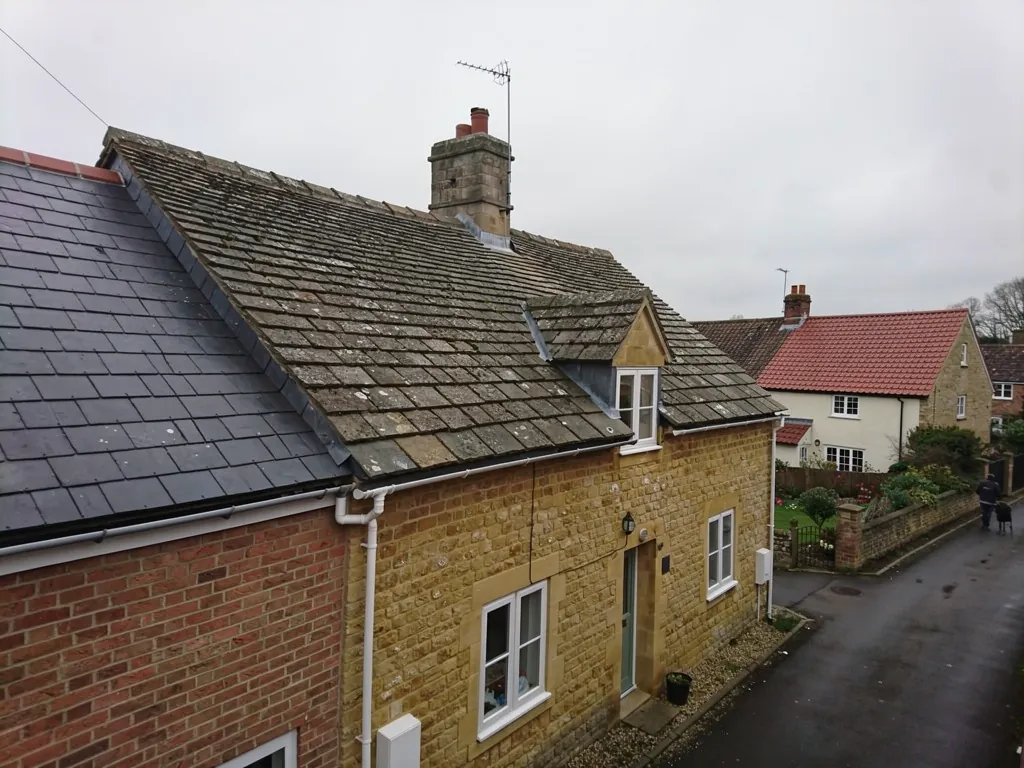
Rear tiled roof of a brick semi seen from the garden

Roofers in Cherhill, Wiltshire

Leaks, worn coverings, loose ridges and tired chimneys put right in Cherhill, whether the house is a low cottage off the Street, a farm building or a newer home under Cherhill Down and the White Horse.

Cherhill's roofs, from the Street to the scarp

Low cottages with steep roofs on a village lane
Cottages off the Street

The Victoria County History records several small houses dating from around 1700, give or take, in and off the Street and in Maiden Lane and Middle Lane, typically of chalk and thatch and of one storey and a half. A storey and a half means the upper rooms sit inside the roof, so the covering, the rafters and the bedroom ceilings are all one structure. Thatch is its own trade and the owner of a thatched roof should use a thatcher. Our work on these streets is the tiled and slated parts: later extensions, dormer cheeks, porches, chimneys and the metalwork round a stack. The chalk walls beneath need roofs that shed water well clear of the wall.

An old timber-framed house beside a stone barn
Tudor Cottage and the older farm buildings

Tudor Cottage in Park Lane was built in the fifteenth century as a timber-framed hall with a cruck truss, and was apparently the oldest house in the village in 1999. A frame of that age moves, so any covering on it has to tolerate movement. The same history records a stone-slated gambrel roof on a former barn at the Manor House and a brick-and-mansard roof at Upper Farm. A gambrel has two pitches on each side, steeper below, and a mansard is similar; both put the joins where a roof changes angle, and those joins are where leaks start. Barn roofs also tend to be long and open, which makes ridge and verge fixings important.

Modern tiled houses on a village road
Newer houses along the A4

Cherhill is a downland-edge village on the A4, and away from the old lanes there are newer houses too, built to a modern pattern. Their roofs are simpler, but they have their own habits. Concrete or clay tiles lose ridge mortar, dry-fix systems need an occasional check, and flat-roofed garages and rear extensions are usually the first parts to fail. Garden sheds and outbuildings with felt or sheet roofs were never meant to last a lifetime either. Houses facing the downs take wind off the scarp, so gable ends and verges are worth checking after a rough winter. Soffits, fascias and guttering on these houses age together, and a leaning gutter often has a rotted fascia board behind it.

From Swindon to Cherhill Down

Map showing Cherhill and central Swindon. 16 road miles south-west of central Swindon.

Distance
16 road miles south-west of central Swindon
Council
Wiltshire Council
Council
Wiltshire Council
Conservation area
Cherhill, on Wiltshire Council's register
Landscape
North Wessex Downs National Landscape (AONB)

Cherhill roof questions

Does the North Wessex Downs designation stop a re-roof?

No. Putting the same covering back is not made harder by the National Landscape. Wiltshire Council decides planning questions; the National Landscape body only advises.

Can you work on a house with a thatched main roof?

We cover the tiled and slated parts, such as porches, extensions, chimney flashings and outbuildings. The thatch itself needs a thatcher, and the survey will point you to the right trade.

Why do roofs under Cherhill Down feel more exposed?

The downs rise above the village, and wind coming off a scarp meets the first roofs it finds. Verges, ridges and gable ends take the force, so their fixings matter most.

Q1

What are Cherhill's old cottage roofs made of?

Brick and limestone cottages around a small village green
Cotswold stone cottage with a steep stone slate roof

The short answer

The earliest small houses recorded here were chalk-walled and thatched, though the county history counted only several of them on the Street and its lanes in 1999. Barns and farm buildings add stone-slated and mansard roofs, and later houses have tile or slate. The repair differs for each covering, which is why a survey starts by identifying what is there.

The Victoria County History of Wiltshire gives a detailed account of Cherhill's buildings as they stood in 1999. It describes chalk and thatch cottages of one and a half storeys, a fifteenth-century timber-framed hall, a stone-rubble church that is partly rendered, and farm buildings with stone slate or brick and mansard roofs.

Why do chalk walls need careful roof detailing?

Chalk is a soft building stone and does not like water. A roof on a chalk wall needs a generous overhang, working gutters and downpipes that discharge clear of the foot of the wall. Where a later tiled extension meets an old chalk wall, the junction needs careful flashing, because a failure there soaks a material that cannot cope with it. Thatch is a trade of its own; we leave it to a thatcher.

Is stone slate on a farm building worth keeping?

A stone-slated barn roof is heavy and lasts a long time, but its pegs, battens and ridge fail first. The slates are worth keeping if the structure underneath still holds. Our Cotswold stone roofing page describes the technique, which suits stone slate in general.

Where does a mansard roof leak?

A mansard roof has a steep lower slope and a shallow upper one. The break between them, and the junctions with any dormers, are the weak points. A survey checks the lead and the valley gutters at those breaks before it checks anything else.

If you are unsure what covers your own roof, send us a photograph from the road and you will get a plain description of what shows. A photograph from the lane is not a survey, and it cannot show the battens, the underlay or the state of the timbers, but it is often enough to say which kind of visit makes sense and whether a thatcher, a stone-slate specialist or an ordinary tiling repair is the right person for the job.

Q2

How should a roof under the White Horse cope with wind?

The answer

By having sound fixings at the edges. Wind pulls hardest at ridges, hips, verges and eaves, so those are the details that matter on an exposed slope. Mechanically fixed ridge tiles, bedded and clipped verges and tight, well-lapped courses do far more than any change of covering.

Cherhill sits below the western scarp of the Marlborough Downs, which rise to 262 metres on the southern boundary of the parish, and the White Horse was cut into that slope around 1780. Houses under that scarp are exposed in a way the valley below is not, and the roof details that matter most are the ones at the edges.

Are the ridges and hips fixed well enough?

Along the crest of a roof run the ridge tiles, and on a hipped roof more of them slope down the outside corners. For generations they sat on a bed of mortar and nothing else. BS 5534:2014 changed that, so a bed of mortar is no longer treated as enough and each tile also gets a mechanical fixing. An old ridge on an exposed slope with nothing but mortar under it ranks high on any list of upgrades we would suggest, and the work is small compared with a re-roof.

Why do verges and gables need checking?

Verge is the word for the sloping end of a roof at a gable. Wind gets under a loose verge and lifts the tiles beside it, so we check the bedding, the cloaking and the fixings. Dry-fix verge systems, tested to BS 8612, are quick to fit and cope well with wind. Our ridge, verge and dry-fix page describes them.

What happens after a storm?

If wind has already lifted tiles, we make the roof safe first and then explain what a repair involves. A storm often reveals old weaknesses and not new ones, so we use the visit to inspect the whole slope, the neighbouring slope and the loft side as well. Debris, a fallen branch or a loosened aerial bracket can each do hidden damage, and it is better to find it now than after the next downpour.

What matters most

On an exposed slope, fix the edges properly before worrying about the field of the roof.

Q3

Do conservation area and downland rules affect re-roofing in Cherhill?

Brick end-of-terrace gable beside a limestone house, slate roofs
Warehouse flat roof with single-ply membrane and rooflights

The short answer

Seldom, provided the covering stays the same. Cherhill has a conservation area on Wiltshire Council's register and sits within the North Wessex Downs National Landscape, but neither stops like-for-like repairs. Changes to appearance, and any listed building, are worth raising with the council before work is priced.

Two designations apply to Cherhill, and people often assume they are more restrictive than they are. Here is what each does and does not do for a roof.

What does the Cherhill conservation area change for a roof?

Wiltshire Council lists a Cherhill conservation area on its register. A conservation area adds scrutiny to changes of appearance, which means a different covering, a new rooflight or a rebuilt chimney is worth a conversation with the council. It does not stop you repairing a roof in the same material. Boundary details are on the council's maps.

Does the National Landscape change the rules?

The North Wessex Downs became a National Landscape on 22 November 2023, while the legal label remains Area of Outstanding Natural Beauty. Its partnership gives advice on planning matters, but applications are decided by the council. For a roof repair, neither body changes the rules, and a matching re-cover goes ahead as it would anywhere else.

What about listed buildings and building control?

Any alteration that touches the character of a listed building requires listed building consent, and some of the oldest houses in the village may carry a listing, which a council search confirms. For other houses, the Planning Portal says a building control application is not normally needed when less than 25 per cent of the total building envelope and less than 50 per cent of the roof is affected. Wiltshire Council's building control team or a registered building control approver handles notifiable work, and we sort out the paperwork.

MythLiving in a National Landscape means every roof repair needs approval.

FactPlanning decisions belong to the council, and a repair in matching materials rarely calls for an application.

Questions from below the White Horse

Why do Cherhill's older cottages sit so low under such steep roofs?

Many of the earliest ones were built as one-and-a-half-storey houses, with the bedrooms tucked into the roof. The steep pitch suits thatch, which sheds water best when steep, and the low walls are chalk. When a thatched roof is replaced with tile or slate, the structure has to be checked, because rafters built for thatch may be lighter and set out differently.

Is a flat roof over a Cherhill kitchen extension a problem waiting to happen?

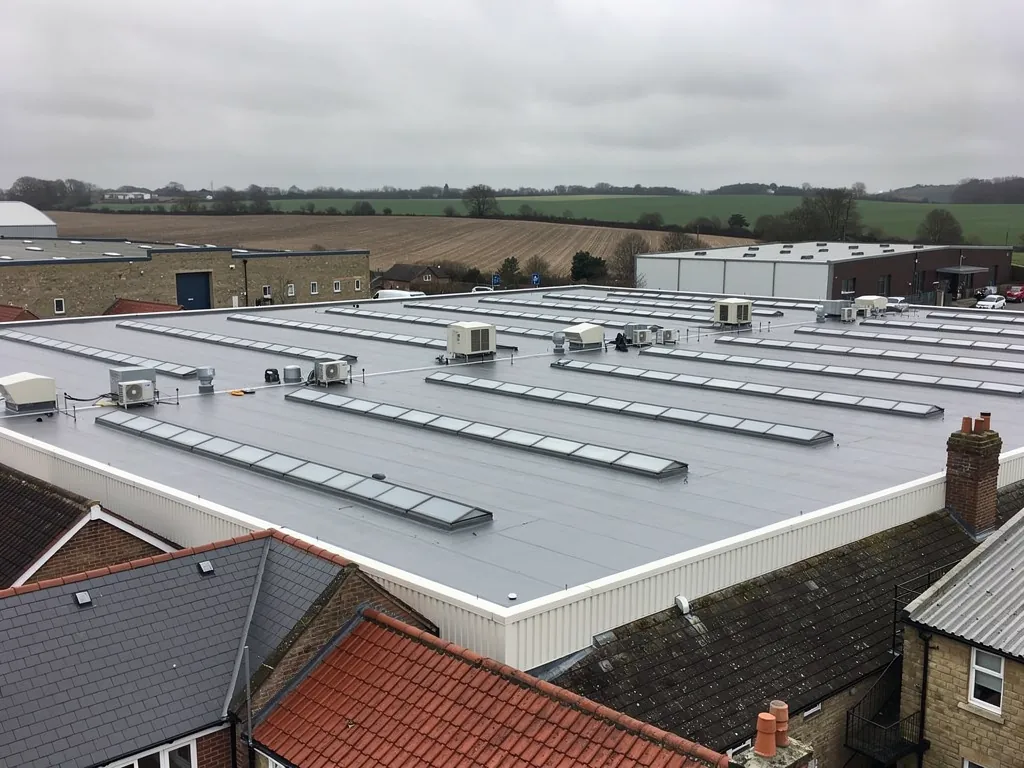
It can be, because flat roofs are often the first part of a house to fail. Falls, joints and the upstand where the roof meets the wall are the details that count. A properly laid single-ply or GRP roof lasts a long time, and a repair is often enough before a full replacement is needed.

Do you work on farm roofs near Cherhill?

Yes, on barns and outbuildings as well as houses. Sheet roofs, tiled roofs and stone-slated ones each need their own method, and large spans mean scaffolding or access platforms. We send photographs and a written quote once we have seen the building, and we explain if any part of the roof is fragile.

Could the cement sheets on an old barn contain asbestos?

Older cement sheet roofs can, which is why they should not be drilled, broken or pressure-washed. The HSE treats careful removal of asbestos cement as non-licensed work, and household asbestos waste needs a consignment note. If sheets have broken up substantially, the work becomes notifiable. We will tell you what we see and suggest a sample test before anyone touches the roof.

Ask us about your roof

Tell us what’s happening and we’ll call you back.

  • Photos of what we find
  • A written quote
  • 10-year workmanship guarantee

Or call 01793 626096

Call Get a quote