Clay tile and slate rooftops of brick market-town terraces

Roofers in Coates

Repairs, re-roofing, stone slate and chimney work for Coates, the Cotswold village beside Cirencester Park and close to the source of the Thames.

Coates's roofs, from Thames Head to the Fosse Way

Stone-roofed cottages beside a village church
The church and the old houses

St Matthew's dates to the 13th century and is listed grade II*, with a Perpendicular tower, a Norman font and a Norman doorway. Beside a church like that, the older houses of a Cotswold dip-slope village traditionally wore stone slate, cut from local limestone, and the district council's technical guidance on the subject is the standard reference. We do not assume any particular house has it. Where a Coates roof does carry stone, the work is slow and exact: slipped slates refixed, pegs and battens renewed, the courses kept true. Where stone has long since been replaced by something else, we describe what is actually there and repair that.

Old farm buildings with long roof slopes
Estate land and former farm buildings

Coates lies near Cirencester Park on the Bathurst Estate, and its eastern side once held the Royal Agricultural University's Rural Skills Centre, in the former Coates Farm buildings. Estate villages and old farmyards share a way of building: groups of related houses, barns and stores, often with big, plain roof slopes. Converted barns raise their own roofing questions, among them how insulation and ventilation sit together, how rooflights are detailed, and how a new covering matches the old buildings beside it. A long run of roof is unforgiving of small faults, so we trace every stain back along the timbers before anything is priced.

Tiled extension beside an older stone house
Newer houses and outbuildings

Not every Coates roof is old. Newer houses, garages, porches and extensions carry tiles over battens and underlay, or a flat membrane, and they fail in the ordinary ways: loosened ridges, split felt, blocked gutters and softened fascias. They are also easier to mend and quicker to re-cover than stone, but their appearance still matters in a village where the older roofs set the standard. A new covering should sit comfortably beside its neighbours in colour and texture, and a good survey notes what those neighbours look like before a tile is chosen. Inside the conservation area, or on a listed building, that is a planning question as much as a matter of taste.

From Swindon to the Thames source

Map showing Coates and central Swindon. 19 road miles north-west of central Swindon.

Distance
19 road miles north-west of central Swindon
Council
Cotswold District Council
Conservation area
Thames & Severn Canal (Coates Section), designated 1992
Landscape
Cotswolds National Landscape
Council
Cotswold District Council

Coates roof questions

Is my Coates house inside the canal conservation area?

The council's map of the Thames & Severn Canal (Coates Section) area shows the boundary, with St Matthew's church inside it. Check the map, or ask Cotswold District Council, before any work is priced, since the boundary decides which questions come next.

Can stone slates be matched on a Coates cottage?

Yes, by size, thickness and tone, graded so slates shrink as the roof climbs. Limestone and sandstone should not share a slope, and reclaimed slates are best kept for the building they came off.

Does the National Landscape change what roofing is allowed?

Like-for-like re-roofing is unaffected. Some permitted development rights are limited on this land, and the district council decides planning, with the National Landscape body only advising.

Q1

What makes a Cotswold stone slate roof different?

Reclaimed Cotswold stone slates sorted by length beside a limestone wall
Brick and limestone cottages around a small village green

The short answer

It is made from split limestone slates, sorted by size and hung on battens with large ones low and small ones high. Oak pegs hold each slate in place, and the covering is exceptionally heavy. That weight, and the skill needed to lay it, shapes every repair we plan.

In April 2000 Cotswold District Council published technical guidance for owners, and it describes a roof unlike anything in the clay and concrete tile family. We use it as a reference for how stone is graded, hung and weighed, and it explains why these roofs reward patience.

Why do stone slate courses shrink towards the ridge?

Limestone splits into plenty of little pieces and relatively few big ones, which is why a stone roof is sorted into sizes. The big slates, around 600 mm and occasionally 750 mm, go low down as a doubled eaves course; the tiniest go right up under the ridge. That gradation is the soft, tapering look people picture when they think of a Cotswold roof, and any repair has to respect it. Our Cotswold stone roofing hub covers the craft in more depth.

Why do stone slates hang from pegs?

Traditionally each slate hung from a batten on a wooden peg, usually oak, driven into a hole drilled near its upper edge. When a peg rots, the slate drops, so a slipped slate often signals a failing fixing and not a broken stone. A handful can be refixed as routine work, but a slope where many are shifting needs a longer look, which we give it from the loft as well as outside.

Can the timbers under a stone roof carry the weight?

The guidance puts the load at about 1000 kg for every 10 square metres. Rafters built for stone are sized to carry it, while rafters built for lighter slate or tile may not be. Before any covering changes, we look at the rafters, purlins and wall plates from the loft, and check what the structure was designed to hold, because a heavier covering is a Building Regulations matter as well as a structural one. For the everyday faults on the same roofs, our roof repairs hub is the place to start.

Q2

Should a Coates stone roof be mended or taken up?

The answer

Mend it when the fault is local: some slipped slates, a failed valley, a worn peg here and there. Take the slope up and lay it again when the whole thing is on the move, since the stones often outlast their fixings. A substitute for real stone seldom suits an old building.

Stone slate lasts a very long time. With upkeep, says the council's guidance, a Cotswold roof can comfortably pass a century and might run to two or three, and one cleared of growth every year could last twice as long again. Whether yours should be patched or taken apart depends on where the weakness sits.

When is a local repair enough?

A few slipped slates, a lifted ridge stone or a cracked valley can be put right without disturbing everything around them. We work from a ladder or crawling boards so the load is spread, and we do not walk on slates that are loose. Each refixed slate returns to its own course with its original overlap, so the slope keeps the same pattern of lap and lie, and rain still runs off it as the original builders intended.

When should a whole slope be re-laid?

Once battens have softened and pegs are failing across a slope, patching buys only a little time. The better route is to lift the covering, grade the stones, put in new battens and underlay, and then re-hang the same stones, topping up any shortfall with matching slates. That document reproduces an English Heritage policy favouring newly cut slates over second-hand ones. Salvaged slates, it says, belong on the building or group they were lifted from, since taking them from elsewhere strips somebody else's roof. Before a slope comes up we photograph it course by course, so the pattern of sizes can be matched when the stones go back, and the stones are stacked by size as they come off.

Why are substitutes a poor bargain for real stone?

The same policy calls fibre resin, concrete and reconstituted stone slates inappropriate for historic buildings. On a modern unlisted house they may suit a budget, but they weigh differently, weather differently and look different from limestone. We set out what each option does and let the written quote carry the figures, so the decision stays with you.


Our view

Mend the fixings, protect the stones, and lay them back course by course.

Q3

Who decides on roof work in Coates?

Roofer repointing a stone chimney stack above lead flashing
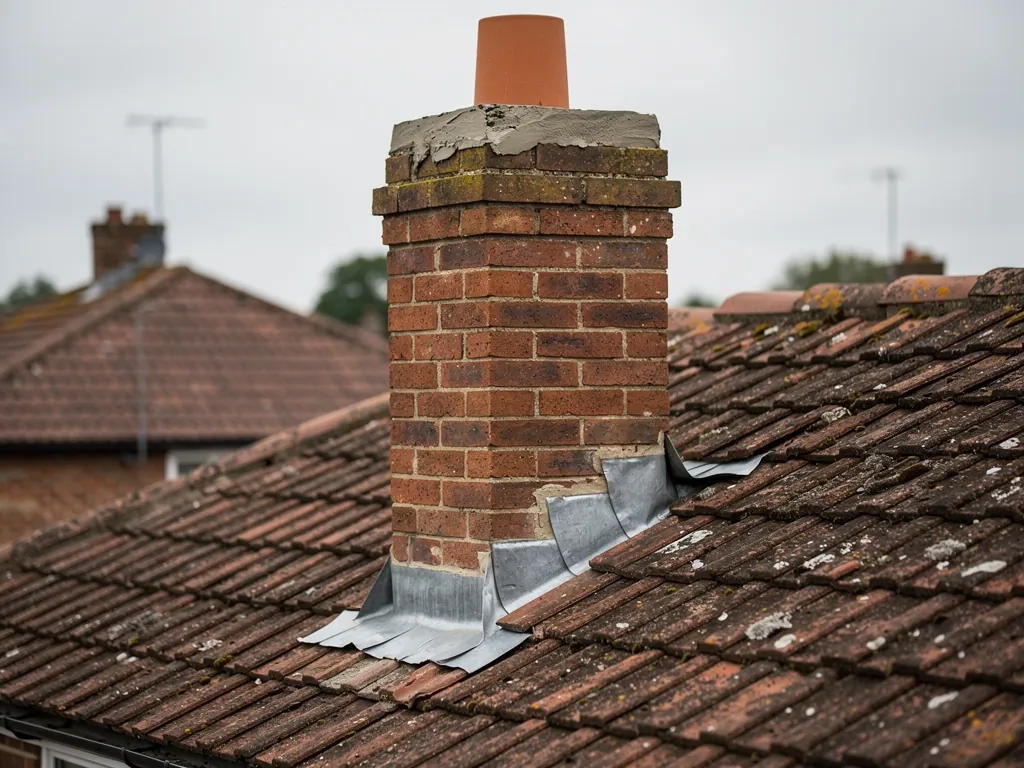
Brick chimney stack with new lead flashing on a clay tile roof

The short answer

Cotswold District Council decides planning and runs building control in Coates. The village has a conservation area along the canal and sits in the Cotswolds National Landscape, whose body advises the council but does not decide. Listed buildings, the church included, have their own consent requirements, and a house's own record settles whether it is one.

For most repairs nobody needs to be asked. Putting slipped slates back, replacing a worn flashing or laying a ridge afresh in like materials all count as upkeep. The questions arise with bigger or more visible changes, and it helps to know which door to knock on before you commission anything.

Where does building control come in at Coates?

Cotswold District Council has its own building control team in Cirencester. The Planning Portal puts the usual threshold at less than 25 per cent of the building envelope and less than 50 per cent of the roof, and it adds that a covering 15 per cent or more heavier needs approval. We tell you which side of those limits your roof falls on and take care of the paperwork if the job is notifiable. Chimney stacks that need rebuilding are a separate matter, and our chimney repairs hub explains the sequence.

What do the canal conservation area and National Landscape change?

The Thames & Severn Canal (Coates Section) Conservation Area was designated on 28 January 1992. A matching repair does not materially change a building's appearance, and so it does not usually need planning permission. The Cotswolds National Landscape bodies have no planning powers of their own; the council decides. If you are weighing an alteration to a visible slope, our guide to conservation rooflights sets out the planning position before you commit.

How do listed buildings change the rules?

Altering the features that make a listed home special calls for listed building consent first, and swapping stone for another material is exactly that kind of change. St Matthew's is grade II*, and any house on the national list is subject to the same rule. If you are unsure whether yours is listed, ask the council or check the national list before anything is ordered, and ask us to hold off until the answer comes back. A short delay at the start costs far less than work that has to be undone, and the council's own records will show whether a building is listed.

MythLiving in the Cotswolds National Landscape means you cannot re-roof your house.

FactA like-for-like re-roof goes ahead as normal; the council's say is needed for changes to appearance, or when the building is listed.

Questions from the Fosse Way to Thames Head

Why do stone slates slip on old Coates roofs?

Usually because the pegs or battens holding them have rotted, not because the stone has failed. Over decades the oak softens and the battens weaken, and a slate drops out of its course. We refix with fresh pegs or suitable fixings, check the neighbouring courses for the same weakness, and replace only the slates that have actually cracked or split.

Can the roof of a converted farm building in Coates be insulated safely?

Yes, but the insulation and the ventilation have to be designed together. Taking a roof back to its rafters brings Part L into play, and an insulated roof needs a clear route for moisture to escape. We check the timbers and the underlay first, then lay the build-up out in the written quote, layer by layer.

Do you work in the villages west of Cirencester?

Yes. Coates and the villages around it fall within the 30 road miles we cover from Swindon. Not certain about your address? The areas page names each place, or you can message us on WhatsApp with the postcode and a photograph of the roof.

How often should a stone slate roof be looked at?

Once a year is a sensible rhythm, and again after any major storm. A look from the garden and another from inside the loft will show slipped slates, moss build-up and daylight between courses. The council's guidance says scraping a stone roof clear every year may double its life.

Ask us about your roof

Tell us what’s happening and we’ll call you back.

  • Photos of what we find
  • A written quote
  • 10-year workmanship guarantee

Or call 01793 626096

Call Get a quote