Concrete tiled estate rooftops towards green hills

Roofers in Broad Hinton

Slate and clay tile roofing, repairs, chimneys and leadwork in Broad Hinton, the downland village on the chalk step beneath Hackpen Hill, inside the North Wessex Downs National Landscape.

Broad Hinton's roofs, from thatch to Welsh slate

Brick village houses with clay tiled roofs
The historic core around St Peter's

Broad Hinton's conservation area appraisal, adopted in September 2007, says many of the village's surviving historic buildings appear to date from the eighteenth century. They are of brick, with slate or plain clay tiled roofs, while straw thatch, timber framing and occasionally chalk stone are typical of the downland setting too. The Grade I listed church of St Peter ad Vincula stands at the heart of it, and Marlborough House is listed Grade II. A village this size has few roofs that match, so each house asks for a separate look: the pitch, the age of the battens, the state of the verges, and what an earlier repair did to the slope. Eighteenth century roofs have usually been re-covered at least once, and the timbers underneath may be older than the tiles on top, which is why our camera goes into the loft too.

Thatched cottage with a brick chimney stack
Thatch and the buildings beside it

The appraisal's management guidance lists the roof coverings of the area as wheat thatch, plain clay tiles and Welsh slates, and it calls thatched roofs an important characteristic of the conservation area. Thatching is a craft of its own, but a thatched roof is rarely alone. The brick chimneys that rise through it, the lead and slate on the neighbouring outbuildings and the rainwater goods around it all need their own care, and a leaking flashing beside straw is a problem worth catching early, because wet thatch rots from the inside. Chimneys that pass through thatch are another reason we inspect stacks closely before quoting: the brickwork, the pointing and the pot all have to be sound. A neighbouring slate or tile roof can be repaired without anyone going near the thatch itself.

Farm outbuildings with clay tile roofs
Farms, barns and later houses

A downland parish has barns and farm buildings as well as houses, and these often carry large roofs with long runs of gutter and plenty of exposed edge. Plain clay tiles are small and hung in overlapping courses, so a repair means fitting tiles of the right colour and camber to sit among their neighbours. A barn roof that has lost its gutter can soak the wall below it, and on chalk or soft brick that damage builds quietly for years. Later houses within the village use a wider mix of coverings, often with flat-roofed porches and extensions added to them. Whatever the age, wind off the open chalk finds the verges and ridge first, so the bedding and the fixings along those lines are where our survey starts.

Out to the chalk step at Broad Hinton

Map showing Broad Hinton and central Swindon. 7 road miles south-south-west of central Swindon.

Distance
7 road miles south-south-west of central Swindon
Council
Wiltshire Council
Council
Wiltshire Council
Conservation area
Broad Hinton, designated in 2007
National Landscape
North Wessex Downs

Roof answers for Broad Hinton homes

Is the southern part of Broad Hinton in the conservation area?

The 2007 appraisal was adopted for the southern part of the village. Wiltshire Council can confirm whether your house sits inside the boundary as it stands today.

Can you re-lay plain clay tiles on an eighteenth century brick house?

Yes. Plain clay tiles are sorted, the sound ones re-hung, and new tiles matched for colour and camber to fill the gaps, so the slope keeps its texture.

Does the North Wessex Downs designation affect a roof repair?

Not a matching repair. The National Landscape body only advises, and Wiltshire Council decides planning, so a new material or a new roof opening is what to ask about.

Q1

What roofs does the Broad Hinton appraisal record?

Reclaimed Cotswold stone slates sorted by length beside a limestone wall
Brick end-of-terrace gable beside a limestone house, slate roofs

The short answer

Wheat thatch, plain clay tiles and Welsh slates are the coverings the 2007 appraisal lists. Many surviving historic buildings appear to be eighteenth century brick with slate or clay-tiled roofs, with timber framing and occasionally chalk stone. Thatch is described as an important characteristic, so a repair here is judged against that mixed local palette, not against a standard modern roof.

A conservation area appraisal is a useful document for a roofer, because it says in plain terms what the council values in the village. Broad Hinton's was prepared by the former district council, adopted on 20 September 2007, and it treats the southern part of the village as the area to protect.

How do plain clay tiles and slate age here?

Plain clay tiles are small and overlap row upon row, each hung from a batten by a nib at its head and nailed at intervals. They age by flaking on the surface, laminating after frost, and slipping when the nails or battens rot. Individual tiles can be replaced without touching the rest, which is exactly why a survey matters: a handful of broken tiles may be all the roof needs. Welsh slate on later or re-roofed buildings behaves differently, with rusted nails the usual fault. Clay tiles also vary a great deal in colour from one batch to the next, so we sort the sound ones first and mix the replacements through the slope in a scatter instead of fitting them in a block that would show from the road.

Why do chalk walls need the roof edge kept in order?

The appraisal also records thatch, timber framing and occasional chalk stone. Chalk walls are soft and soak up water, so a roof edge that sheds rain onto the wall rather than clear of it does lasting damage. Keeping the verge and gutter working is therefore not a small matter on those buildings.

Why should a repair follow the appraisal's list?

If you are repairing a roof in the village, the three coverings the appraisal names are the safest guide to what suits the street. Moving from plain clay tile to a covering with a different colour, texture or thickness alters how the building sits beside its neighbours, and a switch of that kind deserves a conversation with the council before you commit. The church is the other reference point: St Peter ad Vincula is Grade I listed and is one of only 15 churches in England with that dedication, so the village has a landmark that sets a standard for care. Our slate roofing page covers the Welsh slate side in more detail.


Q2

Does Hackpen Hill make Broad Hinton roofs more exposed?

The answer

The village sits on the lower chalk step below the Marlborough Downs, with its south-eastern edge climbing the escarpment of Hackpen Hill. That open setting means wind and driven rain reach verges, ridges and chimney flashings, so those are the parts we inspect and fix with most care.

You do not need a weather record to see that a village beneath a chalk escarpment meets the wind differently from one in a sheltered valley. The useful question is where on a roof the wind does its damage, and on an open site like this one the answer is the edges, the top and anything that stands proud.

Why do verges fail first on an open site?

At a gable, the roof ends in a sloping edge called the verge. Wind gets under it first, so a cracked bedding or a loose tile there is the earliest sign of trouble. A downland barn with long gables has a great deal of verge to lose. We check how each verge tile is held and whether the edge is sealed against wind-driven rain, and where it is not, we re-bed it and add clips or screws, which also stops a loose tile from dropping into a yard or onto a vehicle below.

How should the ridge and hips be fixed?

The ridge is the line along the top of the roof, and hips run down the corners. Under BS 5534:2014 the tiles along both are no longer left to mortar alone and are fixed mechanically as well. On an open site those fixings earn their keep, and a dry-fix kit tested to BS 8612:2018 is one tidy way to provide them. Our ridge, verge and dry-fix page explains how that kind of system goes on.

Could the damp patch upstairs be the chimney?

Tall brick stacks stand proud of the roof and take the weather on all four faces. Pointing opens, the flaunching on the pot (the mortar collar that holds a chimney pot in place) cracks, and the lead flashing lifts. A stack can leak for a long time before anyone connects the damp patch upstairs with the chimney outside.

MythA roof in the open countryside only needs looking at after a storm.

FactWind and rain work on verges, ridges and flashings every season, and a yearly look from the ground catches most faults early.

Q3

What does the North Wessex Downs setting change?

Rolled lead roof covering over a bay above white windows
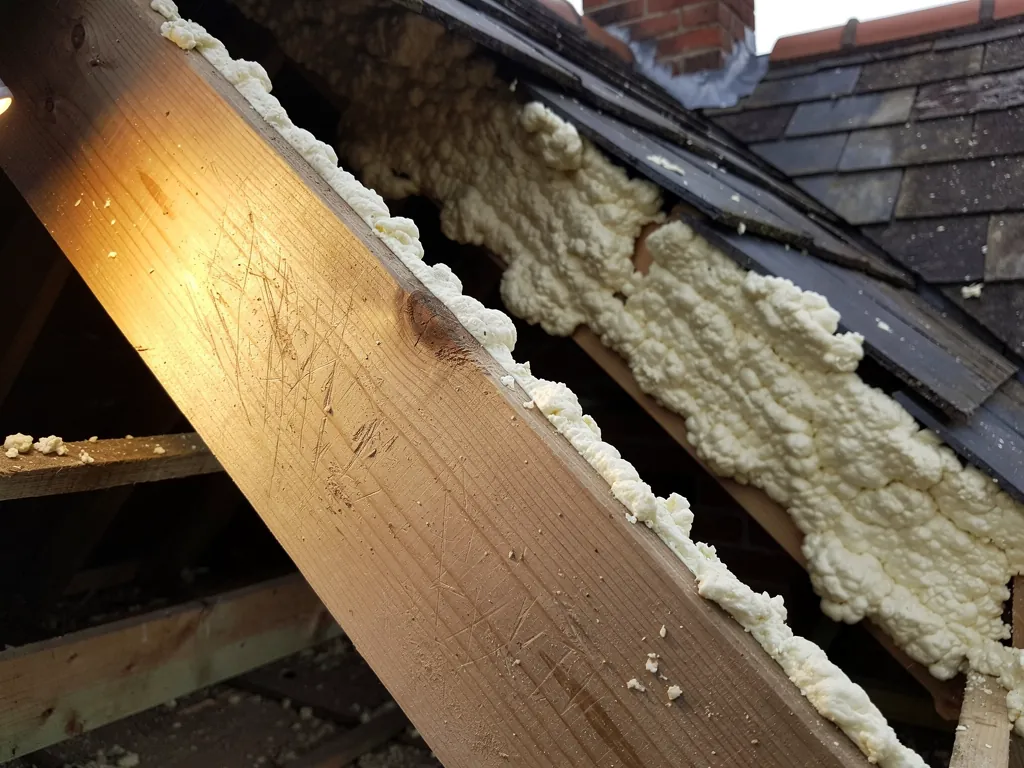
Scraped-back rafter beside thick spray foam under a slate roof

The short answer

Less than people expect. Broad Hinton lies within the North Wessex Downs National Landscape, but the council decides planning and the landscape body only advises. A repair in the same material rarely needs an application; what the council weighs up is any alteration to how a roof looks, which is the question to settle before work is priced.

On 22 November 2023 areas of outstanding natural beauty in England and Wales began to be called National Landscapes. The legal designation and its protections stayed the same. Broad Hinton sits within the North Wessex Downs, and it also has its own conservation area, so a house can be affected by both.

Who decides on planning in the National Landscape?

The North Wessex Downs partnership has a non-statutory, advisory role. The primary planning role stays with the local planning authority, which for Broad Hinton is Wiltshire Council. So if you are unsure whether a plan needs permission, Wiltshire Council's planning team is the one to ask, not the landscape body.

Can I re-cover in matching tiles without an application?

Putting back the same covering in the same pattern is upkeep, and it is not generally a matter for a planning application. The exceptions are a listed building, such as the church or Marlborough House, and any direction withdrawing permitted development rights. If you want something new in a roof, the planning side of a roof window in a protected area like this is explained on our roof window planning page.

When do Building Regulations come into it?

Planning permission is a separate question from the Building Regulations. The Planning Portal says you do not normally need a building control application while less than 25 per cent of the total building envelope and less than 50 per cent of the roof is affected, and a covering that weighs 15 per cent or more extra needs approval. In Broad Hinton, that means Wiltshire Council's building control team or a registered building control approver. The church, a Church of England building in use, comes under its own faculty process.

Where to ask

Ask Wiltshire Council about permission; the landscape body advises but does not decide.

Questions from beneath Hackpen Hill

Can plain clay tiles on a Broad Hinton brick house be repaired, or must the roof be replaced?

Usually repaired. Plain clay tiles are individual pieces, so a cracked or slipped tile can be swapped without disturbing the rest. If the battens beneath have rotted or the nails have failed across a whole slope, we take that slope off, fit new battens and underlay, and re-hang the sound tiles, topping up with matching new or reclaimed ones. The repair is chosen by what the survey photographs show, not by a fixed rule.

How do you work around a thatched roof next door?

With care for the chimney and the boundary. We keep ladders, scaffold and any hot work well clear of straw, and we tell you before work starts if a task, such as torch-on felt or lead dressing near a shared wall, needs a different method beside thatch. Where a neighbour's thatch sits close to your roof, we plan the access with that in mind.

Is Broad Hinton too far out for a survey?

No. It is inside the area we cover, which is every place within 30 road miles of Swindon, and the B4041 runs straight through the parish. The survey is the same as anywhere else: photographs of your own roof, then a written quote.

Does a Grade I church nearby limit what I can do to my own roof?

Not by itself. Listing applies to the building that is listed. A house beside St Peter's is caught only by its own listing, if it has one, or by the conservation area boundary, and Wiltshire Council can tell you which, with a boundary that may have changed since the 2007 appraisal.

Ask us about your roof

Tell us what’s happening and we’ll call you back.

  • Photos of what we find
  • A written quote
  • 10-year workmanship guarantee

Or call 01793 626096

Call Get a quote