
A slate stays on a roof for one of two reasons. Either a pair of nails passes through holes near its head into a batten, or a metal hook grips its lower edge and clips it to the batten. The first is the traditional method and still the default on most British work. The second appeared with machine-cut slate and suits certain roofs well, but it comes with a pitch limit that is easy to overlook.
This guide sets out how the two methods differ, why the fixing materials matter as much as the method, and how to decide which one a given roof should have. If you are weighing slate against other coverings first, our slate roof pros and cons page is the place to start, and the slate roofing hub covers the full range of work.
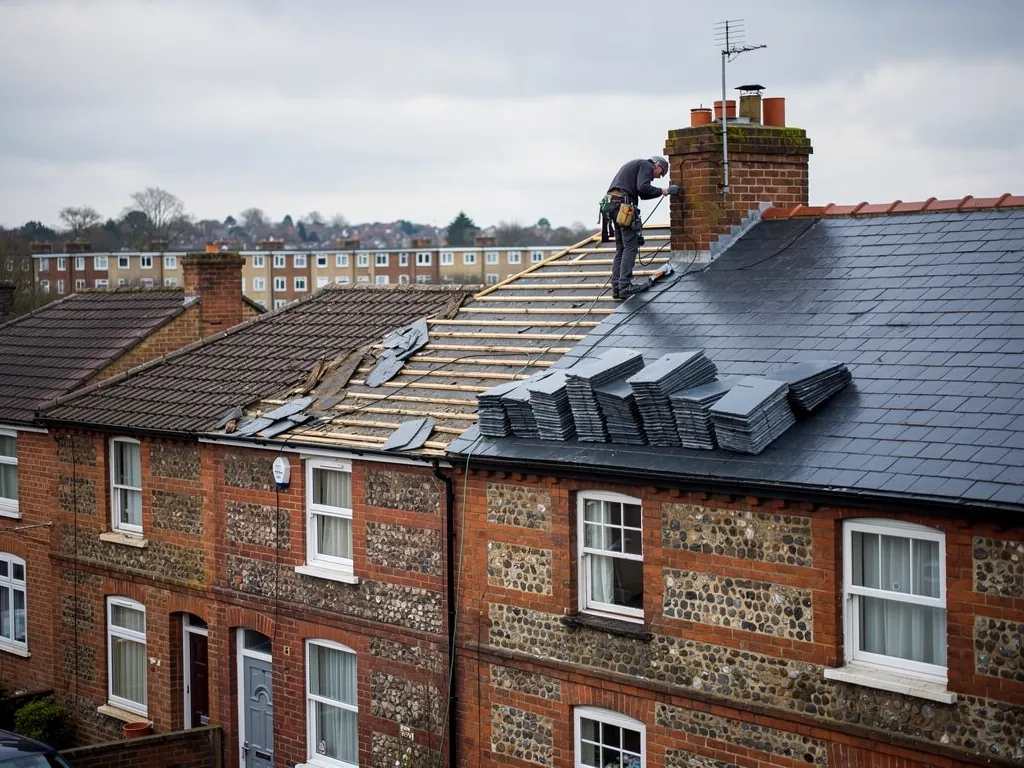
Head nailing: the traditional fixing
In head nailing, two holes are drilled or punched near the top of the slate, and a nail goes through each into the batten behind. The slate hangs from its nails, and the course above overlaps the nail heads so that no fixing is ever exposed to rain. The lap between courses, not the nails, is what keeps water out.
It sounds simple and it is, but the detail matters. The nail should be driven flush, not punched deep, because a nail driven too hard cracks the slate around the hole. A nail left proud lifts the slate above and leaves a gap. Two nails per slate is standard, set evenly either side of the centre line, and the slate must hang free enough to move slightly with the weather.
Head nailing is also the method that allows the greatest range of pitch. Provided the headlap is correct, it works on slopes down to the lower limit for natural slate. Cupa Pizarras, drawing on BS 5534, gives that limit as 20 degrees at moderate exposure, with the lap set out in the headlap table later in this guide.
The weakness of head nailing is not the method but the nail. When nails fail, the slate slides, and an entire course can go. That is a matter of what the nail is made of, which gets its own section below.
Centre nailing and why it is rare now
Some older roofs, particularly Welsh work, were nailed through the middle of the slate rather than the head. The nail sits at about half the slate's length and the slate hangs from it like a pendulum, with the covering relying on a deeper overlap and the weight of the slate itself to resist wind.
Centre nailing is still found on historic roofs and is sometimes retained on listed buildings, where matching the original method is part of the repair. It is rarely specified on new work. The nail sits further from the tail, so the slate is more likely to lift and chatter in strong wind, and the pitch and lap calculations that apply to modern head-nailed slate do not carry over.
Why does this matter when buying slates?
Because the holes are already in the slate. A slate re-used from a centre-nailed roof has holes in the wrong place for head nailing, and may have to be re-holed or kept for repairs to the same kind of roof. Our guide to reclaimed slate explains how second-hand stock is graded for this reason, among others.
It also matters when we repair a centre-nailed roof. A slate fixed in a different style from its neighbours behaves differently in wind, so we match the existing method wherever the repair is small, and raise the question of a full re-fix only when the roof as a whole is failing.
Hook fixing: how it works and where it stops
A slate hook, sometimes called a hook fixing or a tail hook, is a stainless steel or non-ferrous metal clip that curls over the bottom edge of a slate and attaches to the batten. It is used on machine-cut slate, where no holes are formed near the head, and some roofers use it for speed, because no nail has to be driven through each slate.
The slate sits on the hook rather than hanging from the nails. This has a real benefit in repair: a single slate can be lifted and replaced by sliding the hook, with no need to cut out nails. It also suits roofs where the slate has no pre-punched holes at all.
The limit is pitch. Cupa Pizarras rules hooks out below 25 degrees. On a shallow slope, water can be driven up under the slates and the hook offers less resistance to wind lift than a nail at the head. The 25 degree rule is not a rule of thumb; it comes from the manufacturer's reading of the standard.
Can hooks and nails be mixed on one roof?
Not within a course, as a rule, and not on a roof that crosses the limit. A roof with a 22 degree main slope and a steeper dormer cheek is nailed throughout. Our page on slate sizes and headlaps shows how the lap changes with pitch, and with it the number of courses a hook has to hold.
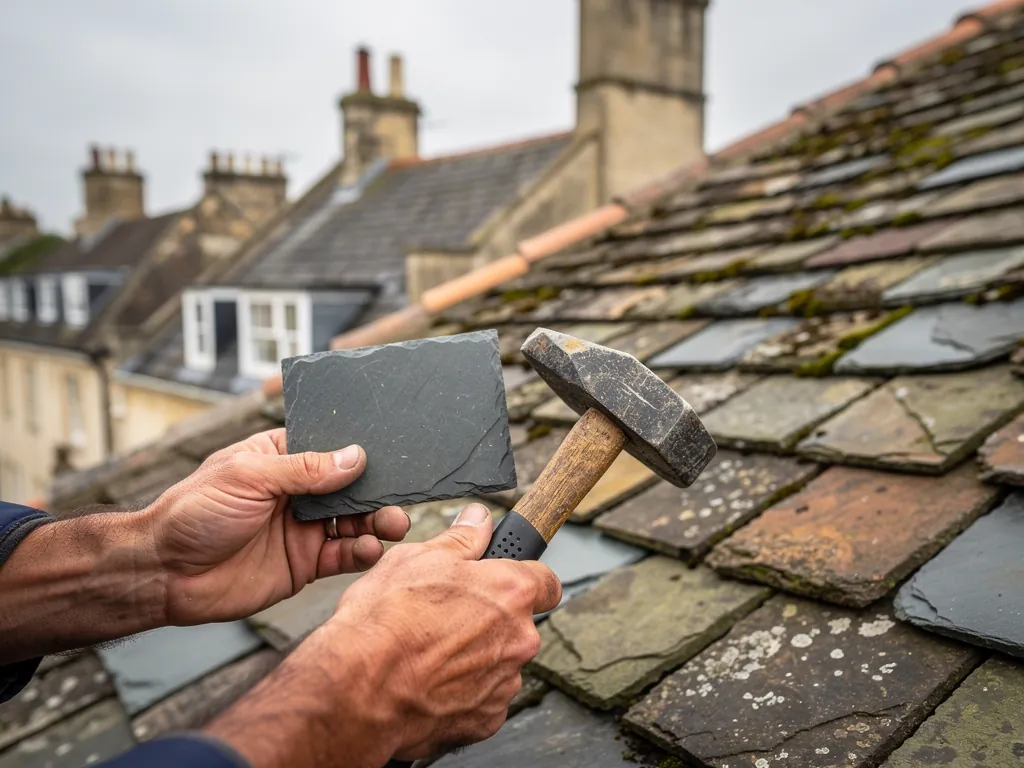
Nail and hook materials: why the metal matters
Many slate roofs fail because the nails rusted, not because the slates wore out. Mild steel and galvanised nails were common in the past. They corrode in damp lofts and where condensation collects, the nail shank thins, and eventually the slate slips out. This is called nail sickness. It tends to appear along a course first, then spread, and the roof is telling you that the fixings are failing everywhere. Our page on delaminating slates covers a different fault with a similar look, and we sort out which one you have before suggesting a cure.
Modern slate work uses copper nails or stainless steel nails. Copper is soft, easy to drive and compatible with lead, and stainless is stronger and suits exposed positions. Aluminium nails are sometimes suggested, but we stay with copper and stainless. Hooks are specified in stainless or in a coated non-ferrous alloy. Where lead sits beside copper or stainless, the roofer checks for any mixing of metals that could set up corrosion.
The nail length matters too. It must pass through the slate, the batten and into the timber with enough hold, and not so long that it comes out the back of the batten into the roof space. The right length depends on the slate thickness and the batten, and it is chosen on site.
If your roof has lost slates in a line along one course, suspect the nails before you suspect the wind.
Headlap and pitch: the numbers that decide the fixing
Headlap means the overlap of each slate on the one two courses below it. It is the main defence against water being driven up the slope, and it grows as the roof gets flatter. The figures below are Cupa Pizarras' for a 500 x 300 slate at moderate exposure, drawn from BS 5534.
| Roof pitch | Minimum headlap |
|---|---|
| 20 degrees | 115 mm |
| 25 degrees | 95 mm |
| 30 degrees | 80 mm |
| 35 degrees | 70 mm |
| 40 degrees | 60 mm |
Exposure moves the numbers. The same manufacturer treats anywhere within 30 miles of a west-facing coast as severe exposure, which calls for a larger lap, so we work from the manufacturer's tables for your slate and your site, not from a table in a leaflet.
The fixing follows the pitch. Between 20 and 25 degrees only nails are suitable, and a deep headlap is critical. From 25 degrees upwards, hooks become a choice, not a ban. Above that, the fixing is decided by the slate type, the roof's condition and what is already there.
What if my roof is below 20 degrees?
Natural slate then needs a different design or a different covering. We tell you at survey, with the reasons, rather than propose a slate roof that would leak. Our pros and cons page puts that in context.
Choosing between nails and hooks on your roof
For most houses the answer is nails. A head-nailed natural slate roof laid to the correct headlap on a pitch of 20 degrees or more is the form that has been used for generations, and it is easy to repair for the next owner. Hooks are an option where the slate is machine-cut, the pitch is 25 degrees or more, and the whole roof is being re-covered in one new slate.
Existing roofs often settle the question. If the roof was nailed, we nail. If a few slates have been replaced with hooked ones, that is usually a sign of someone doing a quick repair, and we look at whether the hooked slates are holding. Matching the original fixing also keeps the roof consistent in how it responds to wind.
The original nailing method can be protected together with the slate when the house has a listing or sits within a designated conservation area. Ask the council before changing it. Our page on slate roofs on listed buildings explains the consent position.
Does the fixing change what a repair costs?
Slightly. MyBuilder's slate guide, updated on 21/08/2026, gives £100 to £180 per m² for installed slate, and the fixing is a small share of that. Cost is driven by access, the slate and the state of what lies underneath. Whichever fixing we choose is named in the written quote.
Wind, storms and checking the fixings you already have
A roof loses slates in wind because the fixings fail, not because the wind is strong. Slates that are sound and properly nailed stay put through severe weather. The ones that go are the ones whose nails have rusted through, whose holes have worn into slots, or that were never nailed twice.
When a storm has passed, scan from the ground for slates sitting proud, gaps in a course, or fragments on the lawn. Do not climb onto a slate roof yourself; slate is brittle and slippery. Binoculars show more than you would expect. If slates have slipped, a few at a time, the likely cause is nail sickness, and our delaminating slates page helps you tell the two faults apart.
Fixings can also be checked during routine maintenance. A roofer lifts a few slates at a representative spot and looks at the nails. If they are bright, the roof is sound. If they are brown and flaking, the nails are on borrowed time, and a refix or reslate is closer than it looks.
Where a fix is needed, our proposal covers only what the fault demands, backed by photographs of your own roof. A written 10-year guarantee covers the workmanship, and afterwards we sweep up and carry the waste away.