
Reclaimed slate is natural slate that has been taken off one roof so it can be laid on another. The stone itself is the same material that has covered British roofs for generations, and a sound old slate has already proved how it behaves outdoors. That is the appeal. It is also the risk, because a slate that has spent a century or more in the weather may have a hidden weakness that only shows once it is nailed up again.
This guide explains how we think about grading, what a roofer checks on each slate, where the stock comes from, and when it makes sense to use it. It applies to a single repair patch on a Victorian terrace and to a whole re-roof on a larger house. For the wider picture, start with our slate roofing page, and for money matters see what a slate roof costs.
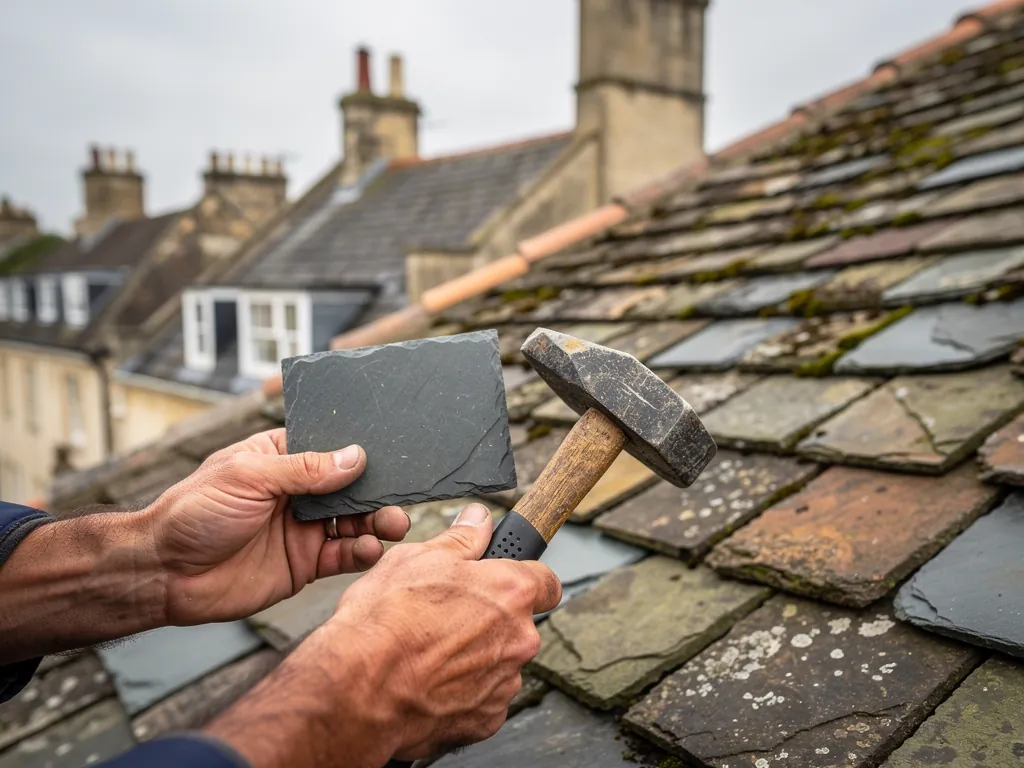
Why reclaimed slate is used at all
There are four reasons a roofer reaches for second-hand slate. The first is appearance. A slate that has weathered for decades has a softened edge, a slightly uneven surface and a colour that new stock only reaches after years in the open. Set beside original slates on an old roof, it blends in. New slate of a similar colour often sits like a bright patch for a long while.
The second is size. Older roofs were laid with slates cut to sizes that are no longer standard, and the thickness and proportions differ from today's catalogue. Reclaimed stock from a building of the same age is often the only way to get something that matches both the dimensions and the look.
The third is supply. Some slate sizes and shades are no longer cut in any volume, and a roofer who wants a close match for a Victorian or Edwardian slope may find the only matching stock is already on a roof somewhere. Taking it off one building to save another is the oldest form of recycling in the trade.
The fourth is cost, though this is the least reliable reason. MyBuilder's slate guide, updated on 21/08/2026, gives typical installed prices of £110 to £150 per m² for reclaimed slate, against £140 to £180 for Welsh and £100 to £130 for Spanish. Reclaimed lands mid-table, not at the bottom, because sorting and extra handling are paid for in labour.
How a slate is graded before it goes on a roof
Grading is a sorting job done by hand, one slate at a time. A good slate is hard, dense and flat. When you hold it by one edge and tap it with a knuckle or the back of a hammer, it gives a clear, ringing note. A dull thud or a flat clack usually means the slate has cracked through, or has begun to split into layers.
We look at each slate for the faults listed below. Any one of them can be enough to put a slate on the reject pile.
What counts as a fail?
A slate fails if it is cracked through, if the corners or tail have broken away, or if the nail holes have worn into slots. It also fails if the surface has started to flake or lift in layers, which is called delamination. Dark stains alone are not a fault, but a slate that is soft, powdery or gritty on its surface is losing its skin and will not last.
Does the nail hole matter?
It matters a great deal. A slate that was fixed through its head has two holes near the top. When it is re-laid it needs a sound top edge with room for new holes, so a slate with a damaged head or with holes that sit too close to the edge is of little use. Slates that were nailed through the middle, as on some old Welsh work, are best used on a repair where the same fixing style has to be matched.
Why sort by size as well?
Slate roofs are laid in courses, each lapping the one below. If the lengths in a course vary too much, the headlap changes along the row and the rain finds a path. Sorting reclaimed stock into matching lengths and widths before the first course goes on saves a lot of trouble later. Thickness gets sorted too, because a thick slate beside a thin one leaves a visible ridge across the course and a gap underneath the thin one.
Where reclaimed slate comes from
Most reclaimed slate is a by-product of other work. A roof is stripped for a re-slate, an outbuilding is demolished, or a terrace is renovated, and the best of the old slates are saved and sorted. Architectural salvage yards sell them by the thousand, usually sorted by size and sometimes by colour. Specialist slate merchants also hold second-hand stock alongside new.
The best source for a repair, though, is often the roof itself. On a re-slate we strip the sound slates from the main slopes, grade them, and put the best back on the front of the building where they are seen. Slates from the rear or from a lean-to can be used to patch the front, and the less perfect ones are used where they are hidden. That keeps the colour and size consistent, because every slate came from the same quarry and the same weathering.
When stock comes from a yard, it is worth asking where it was taken from and when. A slate from a house of the same era and region usually has a similar thickness and colour to your own. Stock of unknown origin may be perfectly sound, but it needs more careful grading, and it may not suit the look of the roof.
Delivery matters too. Slate is heavy and brittle at the edges, so it should arrive on pallets, stacked on edge and wrapped, not tipped from a lorry. A load that has been dumped will have lost a share of its best slates before the roof even sees them.
Always ask to see the slates before you pay or have them delivered. A pile that looks tidy from the top may be cracked and delaminated underneath.
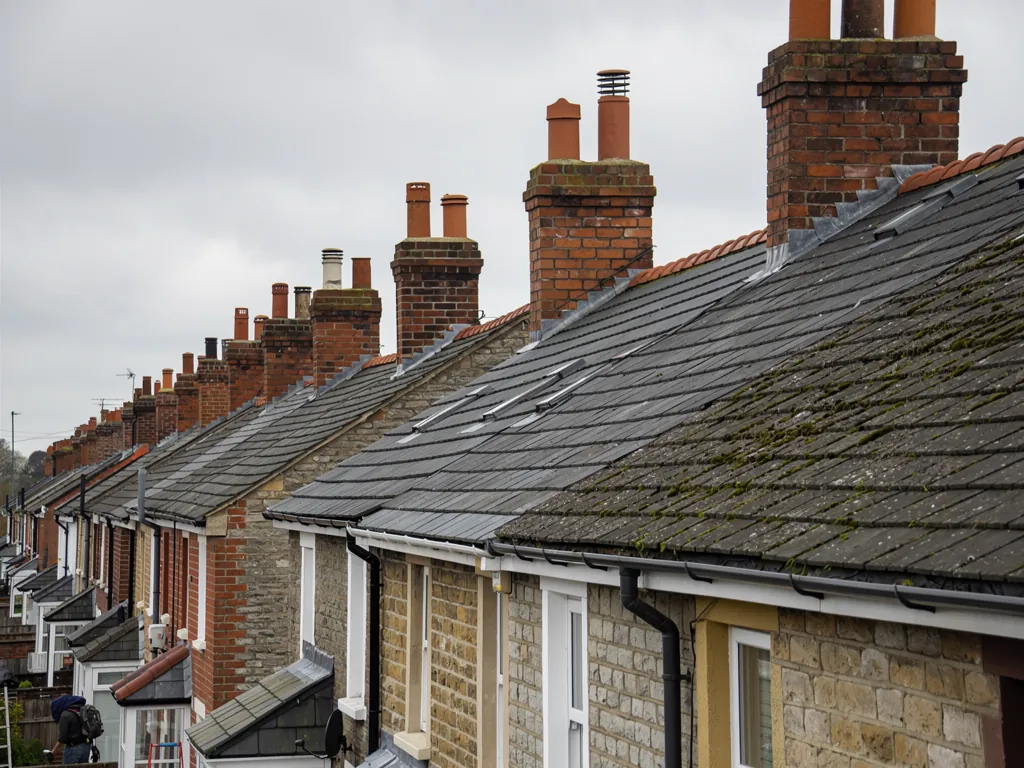
Reclaimed or new: how we decide
There is no rule that says one is better. Three things steer the choice: how old the building is, how much of the slope needs work, and how the slates look once they are off.
On a small repair to an older roof, reclaimed slate is usually the right answer. A handful of new slates on a weathered slope looks patchy, and matching size and thickness is easier from old stock. Where the roof is a mix of ages already, the difference is hardly noticeable.
On a full re-roof the question is more finely balanced. If the existing slates are mostly sound, we strip, grade and re-use them, topping up with reclaimed or new slate where gaps appear. If the slates are failing across the whole roof, because of nail sickness or delamination, putting them back is a false saving and new natural slate is the sounder option. Our guide to Welsh against Spanish slate covers the main new options.
What about the lifespan?
MyBuilder quotes a well-installed slate roof lasting 80 to 100 years or more. Reclaimed slate starts with part of that life already used, so we do not promise it will match a new slate. What we do say is that a slate that passes grading properly has a good chance of outlasting the fixings that hold it, and the fixings are what we renew.
Where the sums are close, we lean towards the option that leaves you with the fewest future visits. A cheaper re-use that needs patching again in three years is dearer than it looks on the day.
Fixing, headlap and pitch for second-hand slate
Old slate is laid to the same rules as new. The covering needs enough headlap, which is the amount each course overlaps the slate two courses down, to stop water being driven up and over. Under BS 5534, as Cupa Pizarras sets it out, a 500 x 300 slate needs at least 20 degrees of pitch at moderate exposure, and a 115 mm headlap when it is that shallow. Steeper roofs need less lap; at 30 degrees the same slate needs 80 mm.
Reclaimed slates are often thinner, shorter or uneven in length, so we measure and lay out the courses to suit the stock rather than the other way round. The slates are fixed with new nails, not the ones they were hung on. Re-using old iron nails, or hanging slates on rusted battens, undoes the whole point of the exercise.
Hooks are an option on some roofs, but hooks are ruled out by the same manufacturer on anything under 25 degrees. Our page on nails and hooks for slate explains when each is suitable.
Do the battens and underlay change?
Yes, whenever slates come off for re-use. New treated battens and a modern breathable underlay go down first. A roof that was laid without underlay will usually get one, so the covering has a second line of defence.
Reclaimed slate on listed and older buildings
On a listed house, or within a conservation area, the slate is counted as protected character. Replacing the original natural slate with a different material may need consent, and the council will usually prefer like-for-like repair. Reclaimed slate from the same building is often the most acceptable way to carry out that work. Raise it with the council's planners before you order a single slate. Our page on slate on listed buildings goes through the consent question.
With Cotswold stone slate the position is stricter. Cotswold District Council's technical guidance reproduces English Heritage policy: reclaimed stone slates are to be reused solely back at the property, or cluster of properties, that supplied them, and fresh-cut stone is preferred to second-hand. That guidance is from 2000, so treat it as traditional practice and confirm the current position with the council.
For ordinary natural slate on an unlisted house the rules are looser, but the same sense applies. Keep the slates that came from your roof, use them on your roof, and buy outside stock only to fill the gap.
What we check on a survey, and what you can check yourself
On a survey we look at the slates on the roof you have, not only at what could replace them. We note how many are cracked, slipped or delaminating, whether the nails have rusted through, and whether the slates are good enough to strip and re-use. You receive photographs of your own roof together with the written quote, and can judge the condition yourself.
If you are buying stock, there is plenty you can check without any special skill. Lay a few slates flat on the ground and look at the surface for flaking. Tap a sample and listen. Measure three or four for length and width. Check that the holes sit near the head and are clean, not worn into slots.
Ask whether the supplier will take back slates that fail on delivery, and how many spares come with the order. A roofer needs extra to cover breakages during stripping and cutting at hips and valleys, so a supplier who says the exact number will do is being optimistic.
Finally, ask who is grading. If the person selling the slates will not explain the grading, buy from someone else. Our workmanship guarantee runs for 10 years, in writing, and the grading of slates we re-use sits inside it.
The written quote that follows tells you which slates we expect to re-use, which parts need new stock, and leaves the site cleared and the waste taken away.