
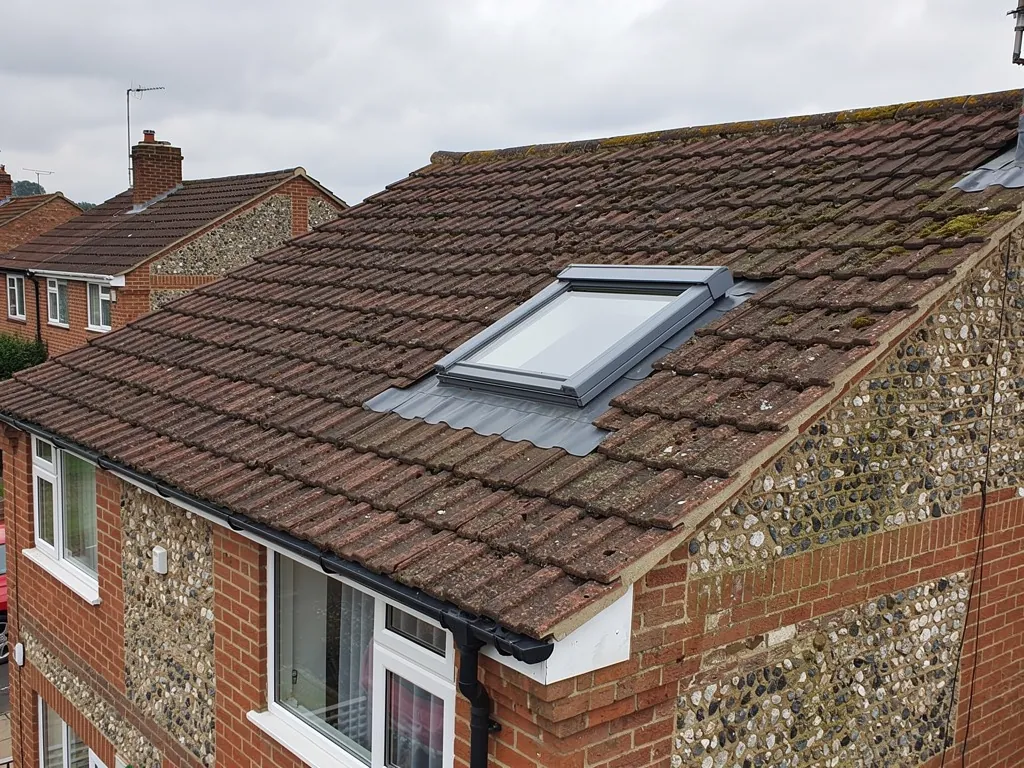
A roof window is set flush with the roof slope, and the tiles or slates around it are cut back to meet the frame. It belongs to our skylights and roof windows work, and this is the part of that work that decides whether it stays dry. The joint between the two is where water would run in, so every window is surrounded by a flashing: a strip of metal, shaped to lead rain over the edge of the frame and away down the slope. Without one, a perfectly good window leaks within a season.
Makers sell the flashing as a kit, a set of pre-formed pieces for one window size and one type of covering. Choosing the wrong kit, or reusing an old one on a new window, is one of the commonest reasons for a leak at the frame. Below you will find what a kit contains, how kits change between tile and slate, where lead beats a factory kit, and what to look for on a window you already own. For leaks that have already started, our guide to why a roof window leaks picks up from there.
What a flashing kit is made of
A typical kit has a handful of parts. An apron covers the bottom edge of the frame and sheds water onto the covering below. Side pieces run up either flank and tuck beneath the tiles or slates on each side. A top piece, or head flashing, catches water coming down the slope towards the head of the window and sends it round the edges. A soaker is a thin sheet of lead or aluminium that slips beneath successive courses of the covering and turns up against the frame, and the side pieces in most kits work on the same principle.
Around the frame sit two further pieces that rarely get a mention. An insulation collar fills the gap between the window and the surrounding rafters, which keeps the heat in. An underlay collar dresses the roofing membrane up to the frame so that rain driven under the tiles runs out at the eaves instead of dropping into the loft.
Is a kit the same as a flashing?
Not quite. The flashing is the visible metal. The kit is the whole set of pieces, fixings and seals, matched to the window size and the covering, and it is designed to be fitted in a set order. Leave out the underlay collar, or fit the side pieces before the apron, and the pieces no longer lap the way they were meant to.
Kits are normally supplied with, or specified for, the window itself, because the frame and the flashing are made to fit each other. A mismatch of even a few millimetres at a corner can create a path for water.
Plain tile, interlocking tile or slate: why the covering decides the kit
A roof window frame stands slightly proud of the roof underlay, and the covering has to be brought up to it neatly. How much the covering rises and falls decides the kit. Slates and plain tiles lie almost flat, with thin edges, so the flashing can be a flat apron with small upturns. Interlocking tiles such as double roman or pantile rise and fall in waves, so the kit needs a flexible or pre-profiled lower apron that follows the shape and a deeper side section to match the thickness of the tile.
The thickness of the covering matters too, and so does the batten gauge. If the gap between the frame and the covering is deeper than the kit was designed for, the side pieces cannot reach the roof underlay. Makers publish kit ranges by covering depth for this reason, and the choice should be made from the actual tile on your roof, not from a guess at it.
Does the pitch affect the kit?
It can. Makers specify a range of roof pitches for each window, and a low-pitch roof gives rain less run-off, so every joint is more critical. Covering pitches also vary by tile: Marley, for example, gives Lincoln clay pantile a minimum of 15 degrees, and its Ludlow Major concrete tile 22.5 degrees. A kit has to suit both the window range and the tile range on the same roof.
Always send us the tile or slate name, if you know it, and a photo of a loose tile. It saves a return visit to measure the profile.
Single, side-by-side and stacked windows
One window needs one kit. Two windows next to each other can be fitted with a combination kit that links the frames with a shared strip and avoids doubling up the flashing between them. Where two windows sit one above the other on the same slope, a connecting piece carries water from the upper window down past the lower one and onto the covering below.
There are limits. The gap between windows has to be wide enough for the connecting parts to sit properly and for the covering between them to lie correctly, so the spacing is set out before the openings are cut. If that gap is too narrow, the choice is either to move one window or to treat the pair as a single wide opening with a different frame.
Do combination kits suit loft conversions?
Often, yes. A loft conversion tends to need two or three windows in a row to light a bedroom or a landing, and combination kits keep the roofline neat. Placement of those windows also affects the escape rule, which we cover in our guide to roof windows for loft conversions.
A run of windows also concentrates water at the top of the lowest one, because rain from the upper section passes down onto its apron. For that reason, the lower apron needs to be correctly lapped over the covering and not just stuck down with mastic.
Slate roofs, soakers and when lead is the better choice
Factory kits are made for standard products, but old slate roofs seldom behave like standard products. Slates vary in thickness, the battens may have been laid at uneven gauges, and the underlay, if there is any, may not be a modern membrane. On those roofs a roofer can form the flashing from lead on site, bending it to the slates in front of them.
Lead is sold in codes that refer to its thickness. Code 3 is 1.32 mm thick and is recommended for soakers only. Code 4 at 1.80 mm has become the standard for everyday flashings, according to Leadworx, and Code 5 at 2.24 mm is heavier. On a slate roof a window is normally surrounded by soakers laid between the courses and a lead cover flashing dressed over them.
What does lead flashing cost compared with a kit?
Checkatrade's roof repair guide gives Code 5 flashing up to 150 mm wide at £50 to £70 per metre, and stepped flashing at £80 to £120 per metre, both excluding VAT. A window has several metres of edge, so the on-site route usually costs more than a factory kit. It is worth the difference on a roof where a kit would not fit well, such as a stone slate roof on a Cotswold-edge cottage, where the slates shrink in size up the slope and an off-the-shelf kit cannot follow the pattern.
Lead also lasts. MyJobQuote puts the life of well-installed lead flashing at over 80 years, which outlasts the window inside it.
Replacing the window: reuse the old flashing or not?
The general rule is that a new window gets a new kit. The old flashing was formed round the old frame, so its corners and side pieces seldom line up with a different unit, even from the same maker. Old aluminium kinks and splits when it is lifted, and old lead can crack where it was folded, so it fails at the first test.
Fitters sometimes want to keep a lead flashing that is in good condition, and that can be reasonable if the new frame is the same size and the lead is thick enough. The choice is made once the old window is out and the condition of the metal can be seen, which is why our quote does not assume either answer. Our page on roof window replacement covers the swap itself.
What happens to the underlay when a window is replaced?
It is one of the first parts to check, because it is the layer that guides any water that gets past the flashing. If the old underlay around the frame has torn, rotted or never been dressed up to the frame, it should be repaired as part of the swap and not just flattened and covered over again.
We would rather propose a modest fix than a big one. If the window is sound and only the flashing has failed, a new kit may be all the roof needs. After the survey you receive photographs of the roof around your frame and a written quote, and our 10-year guarantee on workmanship is given in writing.
Checking a window you already have
You can learn a fair amount from the ground, a landing or the loft hatch. Look for brown staining on the lining at the top corners of the reveal, which is where water collects when the head flashing has failed. Look for lifted or buckled metal at the sides, daylight at a corner of the frame, and cracked or missing mastic. Mastic is a seal, not a flashing, and a thick bead around a frame is often a sign that someone has tried to stop a leak without finding the cause.
Is moss at the frame a problem?
Moss collects in the angle where a flashing meets the covering and holds water against it. It does not make the flashing fail on its own, but it keeps the joint wet and it lifts the edges of slates and tiles. It is worth clearing when it is seen, as part of ordinary roof maintenance.
Can I fit the flashing myself?
Fitting kits is a skill, and the kit has to lap into the covering with the right sequence. A mistake at the head or the apron may not show for months. The guide to roof window blinds explains what goes on inside the frame, and the blind sits on the inner reveal where it does not touch the flashing.
If you want the whole frame reviewed, send us a photograph of the window from the outside and one from the loft. Related details such as sun tunnel sleeves and roof lantern kerbs have their own flashing, and their guides cover them.