
Roofs rarely fail overnight. They give notice, usually in small ways: a stain that comes back after being painted, a slate on the lawn after a gale, a loft that smells damp. Any one of those can be an isolated problem with a simple repair. The skill is in telling an isolated problem from a roof failing across every slope together, because patching the second kind wastes money.
This guide lists the signs we look for, starting inside the house and moving out to the roof itself. It deals with symptoms only. Why the roof got into that state is a separate question, answered in our guide to why roofs fail. Nothing here replaces a survey, and nobody should climb onto a roof to look for these signs. Binoculars from the garden, a torch at the loft hatch and the camera on your phone will gather what a roofer wants to see.
Stains, drips and damp inside the house
The most obvious sign is water where it should not be. Brown or yellowish rings on a bedroom ceiling, bubbling paint, a patch of wallpaper that peels from the top, or a drip into a bucket during heavy rain all point to water reaching the ceiling below the roof. A single stain after a storm may be a failed flashing or a slipped slate. A stain that spreads, comes back after redecorating, or turns up in more than one room is more worrying, because it means water is getting in at several points.
Look at the stain's position as well as its size. A stain near the chimney breast points to the stack and its flashing. One along the top of an outside wall may be an overflowing gutter. A stain in the middle of a ceiling under an open slope suggests the covering and underlay themselves have given up. Taking photographs on the same spot every few weeks lets a roofer see whether it is growing.
A dry stain with a defined edge is usually old damage that has stopped. A stain that feels cold or damp to the touch, or has a fresh darker edge, is active.
Is damp always a leak?
No. Condensation in a loft or bedroom can mimic a leak, particularly after extra insulation went in with nowhere for moist air to escape. Should the dampness turn up during a dry cold spell instead of following rain, get the ventilation checked before anyone talks about replacing the roof.
What the loft tells you
The loft shows the roof from beneath, and a torch plus a short spell at the hatch is enough for a first look. Stay on the hatch ladder instead of stepping across the ceiling joists, and sweep the beam over the rafters.
Is daylight showing through the roof?
Small points of light usually mean a slipped, cracked or missing slate or tile, or gaps at the ridge and verge. A few can be repaired. Many, spread across a slope, suggest the covering as a whole is spent. Daylight does not always mean water, as modern roofs have deliberate ventilation gaps, but light through the middle of a slope is not designed in.
What do the timbers look like?
Rafters, battens and the wall plate should be pale, dry and firm. Dark staining, soft or crumbling wood, white fungal growth, or lines of tiny holes with fine dust beneath point to long-term wet or woodworm. If you can press a screwdriver into a timber without effort, it is not sound. Rot around chimney stacks and valleys is common, because that is where water collects.
On older roofs with no underlay, you may see the back of the slates and nails directly. Rust on the nail tips and streaks beneath them show the fixings are corroding. Where there is an underlay, check for torn, sagging or damp sections, and for water marks on the insulation, which is often the first place a slow leak shows.
A smell of mould or mustiness when you open the hatch also counts. It means moisture has been present for some time, and it is worth noting even when you cannot see a stain.
Pay attention to the insulation too. Compressed, discoloured or sodden patches sitting under one part of the roof show where water has been arriving, and flattened insulation beside a chimney or valley is a common clue. Check around pipes, cables and any recessed light fittings that pass through the ceiling, since water can follow them down and show up in the room below, a long way from the real entry point.
Finally, look at the underside of the ridge and the point where rafters meet the wall plate. White powdery deposits on masonry or timber show that moisture has been moving through, and black spotting on the underside of the underlay suggests the loft has been damp for a long time, whether from a leak or poor ventilation.
Slipped, cracked and missing slates or tiles
From the garden, look along each slope with binoculars. Slates that have slipped part-way down their course leave a visible gap and a lighter stripe below. Missing slates show as dark holes. Cracked tiles may be harder to spot, but a line of chipped edges or fragments on the lawn gives them away.
A lone slipped slate does not justify a new roof. A row of them, or several scattered in a pattern, tells a different story. On old slate roofs the nails that hold each slate are often iron, and they rust through, so slates start sliding in the same course or across the same slope. This is called nail sickness. Refixing some slates with hooks or tingles, which are small strips of metal that hold a slate in place, is a repair, and we use them where they suit. When it is happening everywhere, repair after repair becomes a short-term fix that costs more in the end than a re-slate.
What about tiles that look crumbly or flaky?
Concrete tiles lose their surface slowly and gain a rougher face, which is normal. Tiles that crumble when touched, flake in layers, or show a deep orange or white bloom may be breaking down. The same goes for clay tiles that split along their thickness after frost. If a quarter of the surface looks like that, the covering is failing as a whole.
Sagging, bowing and moss
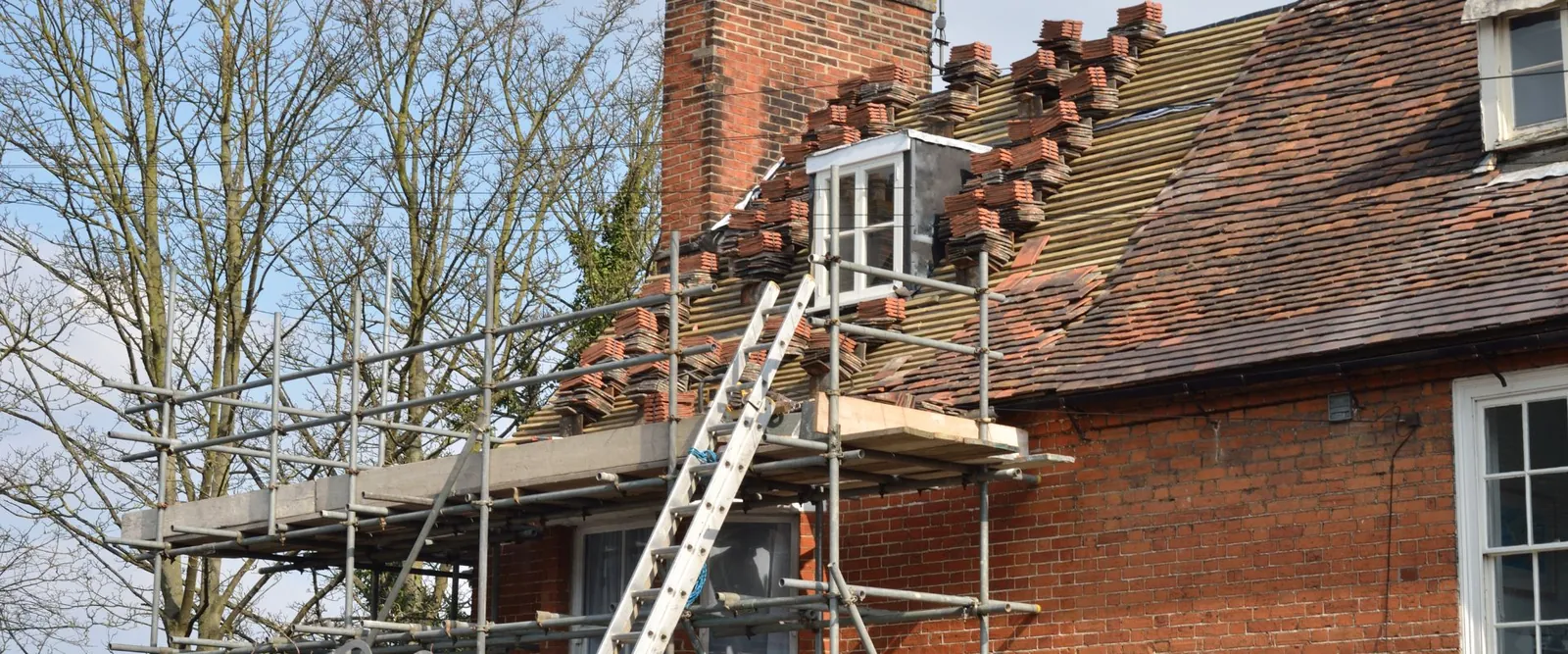
Stand back across the road and look at the roof line. The ridge should be straight and the slopes flat. A ridge that dips between supports, a slope that bows inwards or outwards, or tiles that sit on a visible wave can point to a structural problem such as rotted timbers, a failing purlin, or a covering too heavy for the frame beneath it. Sagging is one of the signs that should not wait. It can be the visible end of a hidden problem, and the longer it is left the more of the roof it affects.
Moss and lichen are different. They grow on shaded, north-facing slopes and damp roofs, and they are mostly a cosmetic issue on a sound roof. They turn into a concern once a deep mat of moss keeps water pressed against the covering, blocks the gutters, lifts tiles or hides defects. On slate, a heavy growth can hold moisture against the edges and speed up the deterioration of the nails. A clean is sometimes all a roof needs, and the survey says plainly when one is enough. MyBuilder's roof cleaning guide, updated 21/08/2026, gives pitched roof cleaning at around £450 to £850.
Where the growth is deep and the tiles under it feel soft or porous, cleaning may expose how much of the covering has gone, which is useful to know before spending on a clean.
Flashings, ridges and the details that keep failing
The details of a roof wear out before the broad slopes. Lead flashings against walls and chimneys crack, lift or pull away from the brickwork. Ridge tiles loosen as the mortar beneath them dries out and crumbles. Verge mortar falls out at the gable ends. A roof that needs one of these fixed is not necessarily a roof that needs replacing, and we separate the two in the survey.
The signal to watch for is repetition. If you have already paid for a chimney flashing, a ridge re-bed and a valley repair within a few years, the roof may be handing you a series of small bills that add up to a large one. Ask yourself whether each repair has held. If the same junction has been repaired twice, the structure behind it is probably moving or the surrounding materials are too tired to hold a new repair.
Does the age of the roof matter on its own?
Age is a hint, not a verdict. Published guides give wide ranges: MyBuilder says natural slate can last 80 to 100 years or more, clay tiles may need replacing after 40 to 60 years, and concrete tiles after 30 to 50. Marley, a tile maker, puts its concrete tiles at about 60 years but says that is no guarantee. A well-kept roof can outlast the range and a neglected one fall short. Our page on how old your roof is explains how to work out the age.
From warning signs to a decision
Put the signs together. A roof that needs replacing usually shows several of these at once: loft timbers that are damp or soft, covering that is flaking or slipping across a large area, repeated repairs at different points, and sometimes a visible sag. A roof that needs repair shows one or two isolated faults, sound timbers and a covering that is otherwise healthy. In between is a roof that needs a stripped and re-laid slope, which costs less than a full re-roof.
The survey decides it. We go up, photograph the roof and give you a written quote. It says what we found, and if a repair is enough, it says so. Where a modest repair will genuinely hold, that is the advice you get. Our guide to what is involved in a new roof shows what happens if replacement is the answer.
What should I do before a roofer visits?
Take dated photographs of any stains. Note which rooms and which weather they appear in. Note any recent work on the roof, including solar panels, aerials and chimney repairs, since they may explain a fault. Do not climb up yourself. Living in a conservation area adds a step, and our guide to re-roofing in a conservation area explains the consent that may apply, and if scaffold is likely, scaffolding for a re-roof sets out how it works.
If rain is getting in right now, say so when you call: an active leak jumps our queue, and before anything else we stop the water getting worse. Our roof replacement page covers the full job once the survey says that is what the roof needs.