
Garage roofs are a strange corner of the pricing world. They are small next to a house roof, so the totals look modest, yet the gap between a plain flat garage and a pitched one with old cement sheets is wide. National cost guides tend to split the work into three groups: flat roofs, pitched roofs, and roofs that need asbestos taken off before anything new goes on.
This guide sets out the typical UK ranges published by MyBuilder and Checkatrade, with the dates they were last updated, then explains what moves a garage from the bottom of a range to the top. None of these figures is a Skyline price. Ours is a written quote that follows a survey of your own building. If you are not sure which group your roof belongs to, start with our page on how to tell whether a garage roof is asbestos, because that single question changes the bill more than any other.
The three price groups for a garage roof
MyBuilder's garage roof replacement guide, updated on 21/08/2026, gives typical totals by roof type. They are national figures for a complete replacement, so treat them as a starting map rather than a prediction for a particular street in Swindon.
| Garage roof | Typical total (MyBuilder) |
|---|---|
| Single garage, flat roof | £700 to £1,000 |
| Double garage, flat roof | £900 to £1,400 |
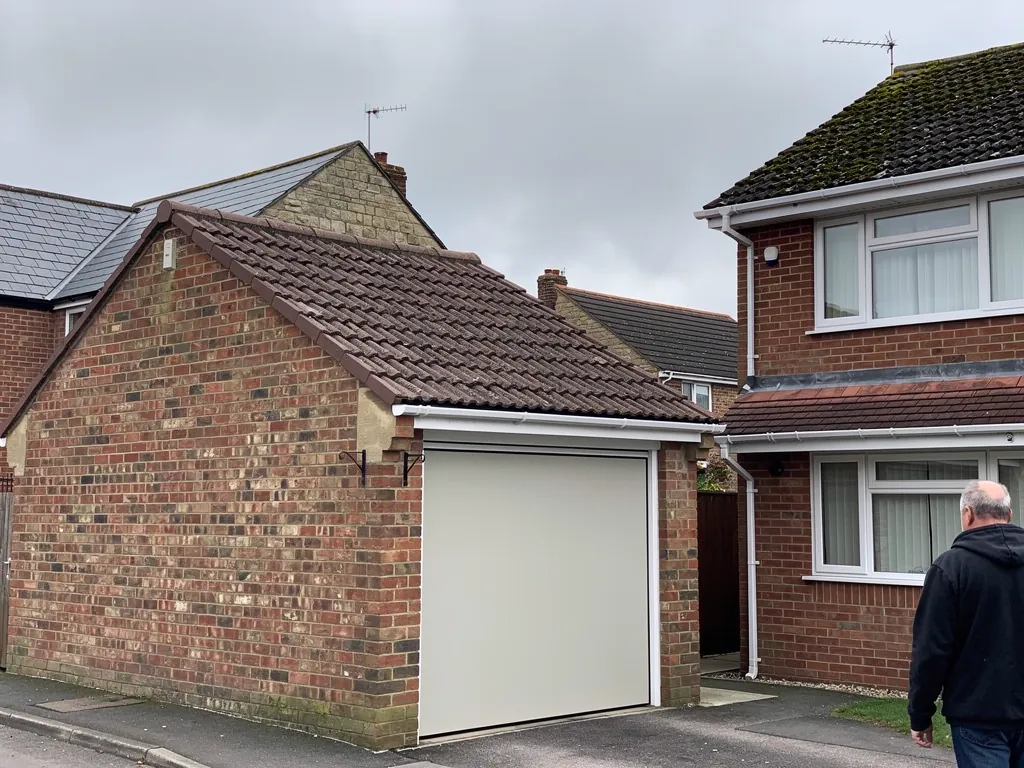
| Pitched garage roof | £2,500 to £4,500 |
Two things stand out. First, a double garage is not twice the price of a single one. The area roughly doubles, but the fixed parts of the job barely change: getting to the roof, stripping the old covering, dealing with the edges, and clearing the site. Second, the pitched roof sits in a different league. It has timbers to check, a covering that is laid in many small pieces, and a ridge, verges and eaves that all need finishing properly. A flat roof is mostly one waterproof membrane over a deck.
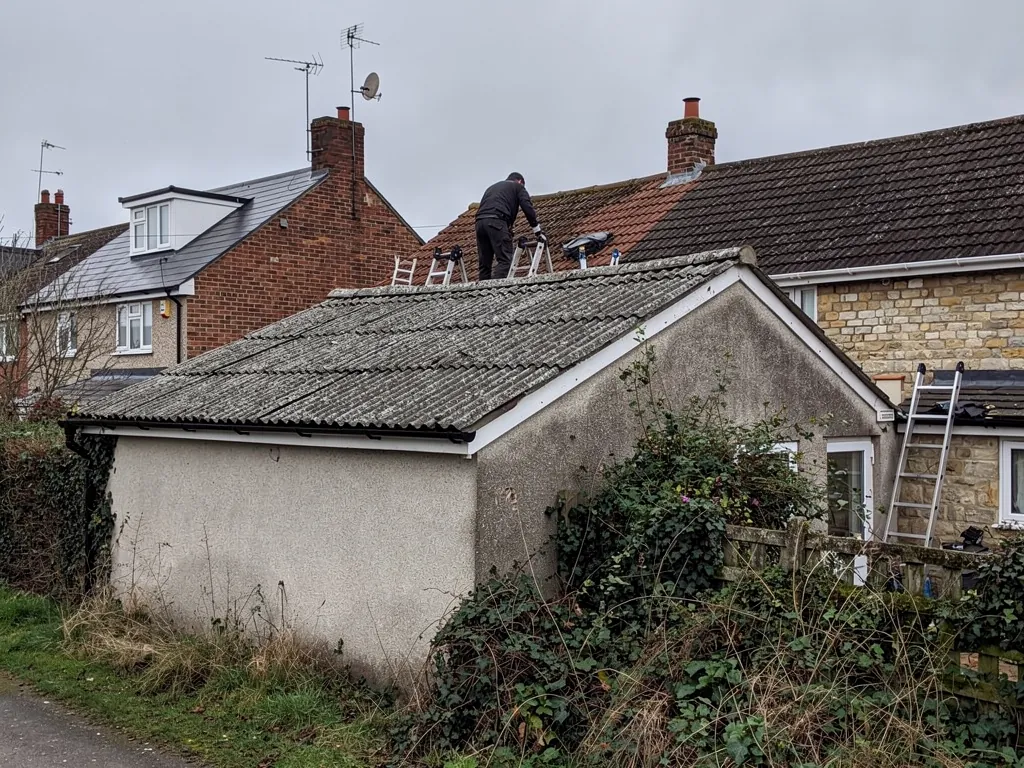
The third group, asbestos cement sheets, is not in the table because it is a separate task layered on top. Removal and disposal are priced on their own in the national guides, and the new roof is then added. That is why a garage with old corrugated sheets can cost far more than the same building with a felted flat roof. The relevant ranges follow below, and our page on asbestos garage roofs covers the material itself.
Felt, GRP and EPDM by the square metre
Many flat garage jobs are priced by area. The same MyBuilder guide quotes about £75 per m² for felt, £125 per m² for GRP and £70 to £100 per m² for EPDM. A quick glossary helps here. Felt in this context means a layered bitumen covering, usually torch-on. GRP stands for glass-reinforced plastic: fibreglass matting wetted with resin on the deck and left to cure there. EPDM is a synthetic rubber sheet, often supplied in one piece and stuck down.
You can see why the rates differ. Felt is quick and familiar. GRP takes more skill and cures into one continuous shell with no laps across the middle of the roof. EPDM can be the lowest per square metre on a simple rectangle because one sheet does the work, but the saving shrinks as soon as the roof has many upstands or awkward corners.
A word of caution about arithmetic. If a garage roof measures 3 m by 5 m, that is 15 m², and the per-square-metre rates multiplied through give about £1,125 for felt, £1,875 for GRP and £1,050 to £1,500 for EPDM. Those sums land above the headline single-garage total in the table. The totals and the rates come from different samples of jobs and will not always line up, so use both as markers, not as a quote. Our guide to garage roof materials goes through how each covering behaves once it is laid, which matters as much as the first price.
Re-felting a garage roof compared with replacing it
Checkatrade's roof replacement guide (updated October 2026) puts re-felting a garage roof at around £1,000 to £2,000, with an average of about £1,500. Re-felting means a new waterproof covering over a deck that is still sound. Replacement means the deck and sometimes the supporting joists come up as well, which is a bigger and dearer job.
Which one you need depends on what is under the felt. When we survey a flat garage we look at the deck first. Chipboard or old plywood that has soaked through for years goes soft, and a new membrane over soft boards covers the fault for a winter or so. Sound boards with a worn covering are a re-felt. Boards that flex underfoot, joists with dark staining, or a roof that holds water in the middle are a replacement, and our written quote says so, with pictures of the boards.
Why the cheaper repair is sometimes the right one
If the covering is sound except for a split along one edge or a failed joint at the wall, a repair is the lighter option that cures the problem, and it is what we would propose. Our page on felt garage roof repair explains where a patch holds and where it does not.
Why a second layer is rarely the answer
Laying new felt over old adds weight and traps whatever moisture is already in the build-up. It can be acceptable on a dry, flat, well-supported deck. It is poor value on a roof that has already ponded, because the low spots stay low.
What asbestos cement adds to the bill
From the mid twentieth century onwards a great many British garages were topped with corrugated cement sheets, and a number of those contain asbestos. HSE guidance says to presume asbestos for a building that dates from before 2000, so the first step is a sample or an expert opinion rather than guesswork.
The national guides price removal separately. MyBuilder (updated 21/08/2026) gives roughly £350 to £1,295 for removing a single garage roof, £650 to £1,800 for a double, and £1,100 to £3,750 for a full garage. Its survey line starts at £50. Checkatrade's roof replacement guide suggests setting aside £950 to £3,750 to remove and dispose of asbestos from a garage. The spread is wide because the real variables are access, how brittle the sheets are, how many there are, and how far the waste has to travel.
Careful removal of intact asbestos cement sheeting is classed by HSE as non-licensed work, but it still has rules. Broken or substantially damaged sheets can make the job notifiable, and household waste of this kind travels under a consignment note to a tip that accepts asbestos. We do not drop, smash or hose sheets down, and we do not ask you to climb up to check. Our page on fibre-cement sheets explains how to recognise the material, and the roof beneath the sheets is then priced in the usual way.
If your quote for a garage with cement sheets looks very low, check whether removal and tipping are actually in it, not just the new covering.
What moves a garage roof price up or down
Looking at the national ranges, the bottom and top of each group are separated by a handful of practical things. All of them come out in a survey.
Access
A garage on a drive with a clear side can be worked from a tower or ladders. One tucked behind a house with a narrow passage, or a block of garages in a rear court, may need materials carried a long way, or scaffolding that costs more than the covering saves. Always ask whether access equipment is in the price.
The deck and the structure
Rotten boards, undersized joists and sagging spans turn a covering job into a carpentry job. Falls matter too. Flat roof guidance based on BS 6229 is to design for a fall of 1:40 so that 1:80 is still achieved as a finished minimum once tolerances and deflection are allowed for. A garage built nearly level may need tapered firrings added, and that adds labour and timber.
Edges, walls and rainwater
Upstands against the house wall, fascias, drip trims and the guttering all take time. A garage that abuts the house needs a proper flashing, and a failed one is a frequent source of damp. The page on garage roof guttering covers the rainwater side.
Extras
Rooflights, insulation, new fascia boards, a change from flat to pitched, and waste disposal all add to the total. So does VAT, which some published ranges include and others do not. Check which applies to any figure you are given.
Reading a written quote for a garage roof
Once we have surveyed, the quote arrives in writing, with pictures of the roof itself. It is one total price. What matters is that you understand what that total covers, and the easiest way to do that is to ask a short list of plain questions of any firm, including us.
Is VAT in the figure? Is scaffolding or other access covered, should the roof need it? Is the old covering taken away and the site left clear? Should the deck prove worse than the photographs suggested, how is that handled and who decides? Where there are cement sheets, are removal and tipping covered, and who handles the waste paperwork?
With those answers written down, two quotes for the same garage become easy to compare, even when they use different coverings. If one firm proposes felt and another EPDM, the comparison is what each roof will be, how it is finished at the walls and edges, and what guarantee stands behind it. Skyline gives a 10-year workmanship guarantee, in writing.
Our advice is always the lightest repair that cures the fault, so a quote can land well under the national replacement ranges. If the job is notifiable under the Building Regulations, we set out what the council expects and file the notification, and our page on garage roof building regulations sets out when that applies. Our prices are good and fair, but the survey is what turns a range into a number.