The short answer
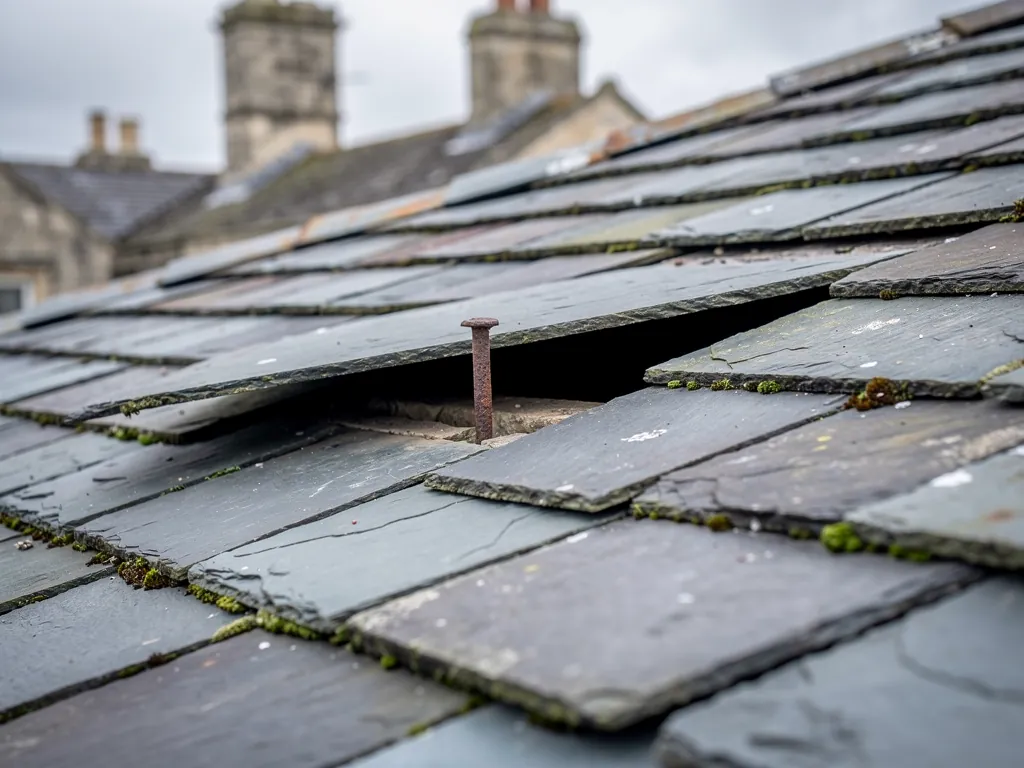
Repeated repairs in the same place, widespread slipped or crumbling pieces, a sagging roof line, and leaks that return after a patch all point to a covering near its end. A survey will tell you whether it needs a repair, a partial re-cover or a full replacement.
A roof does not fail all at once. It gives warnings over several winters, and the skill lies in reading them early. For an old Kingham house the signs are the same as anywhere, but ignoring them costs more because the walls and timbers beneath are older.
Q1.1Which signs say a patch is no longer enough?
If the same corner leaks twice, the fault is probably not the corner. Large numbers of loose, flaking or slipped pieces mean the fixings or the covering itself have aged out. A sagging ridge or a wave through a slope suggests timbers under strain. Daylight in the loft, rusty nails on the loft floor and damp insulation tell their own story.
Q1.2How long should a roof last?
The answer turns on the covering, the quality of the workmanship and the care it has had over the years, so there is no single number to give. MyBuilder, in a guide updated in August 2026, quotes natural slate at 80 to 100 years or more, and synthetic slate at 30 to 50 years. Any lifespan is a range and never a guarantee, so each roof is judged on the condition we find. Our roof replacement page sets out when a full re-cover starts to make more sense than another patch.
Q1.3What does the survey record?
The condition of the covering, the underlay, the ridge, the verges and every flashing, with photographs. If a repair genuinely cures the fault, you are offered the repair. Where it cannot, the photographs show why.
The written quote follows, and the decision stays with you. Nothing is booked until you are happy that the work matches the fault, and the smallest job that does the job properly is the one we put forward.