
Repointing sounds like a job with one right method: rake out the old mortar, push in new. On a brick chimney built before the early twentieth century, the choice of what goes in matters more than the neatness of the finish. Those stacks were laid in lime, usually with sand, and the bricks were fired at lower temperatures than modern ones. Lime and old brick behave as a pair. Swap one half for a harder material and the pair stops working.
The effect is not dramatic at first. A stack repointed in cement looks sharp for a few winters. Then the faces of the bricks begin to flake, because the softer material in the wall is now the brick. This guide explains the logic, what lime mortar is, how it is applied and what it costs to do it properly. If the stack is also leaning or cracked, the guide to the leaning chimney covers the structural side.
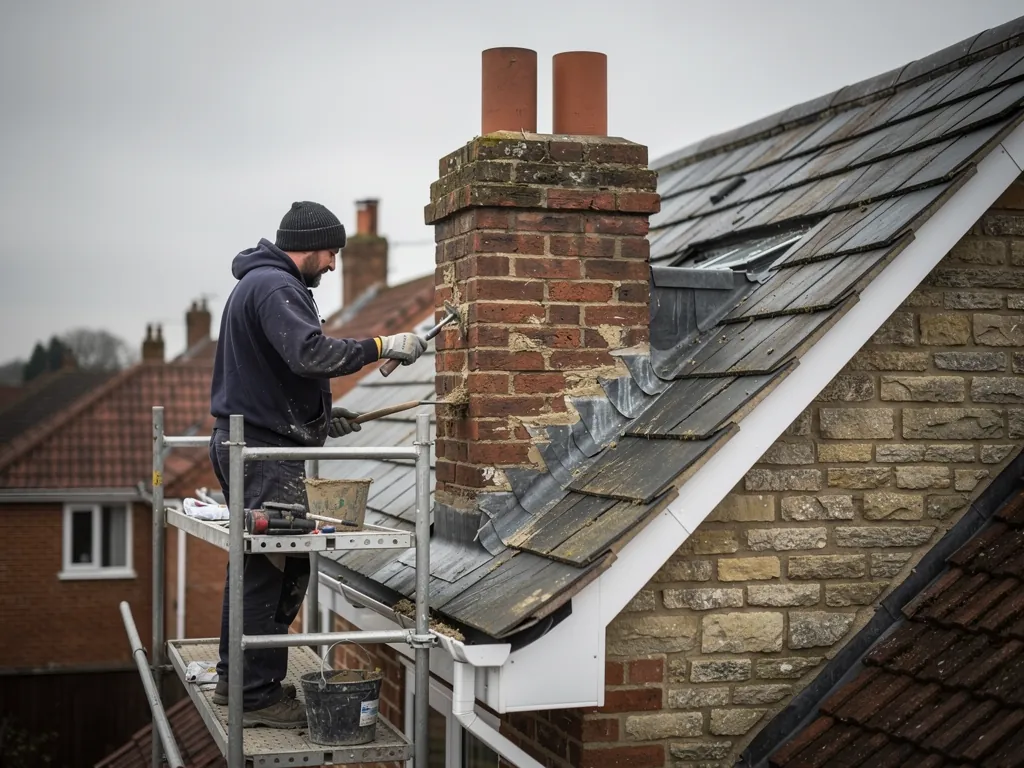
The rule that mortar should be weaker than the brick
Every masonry wall moves a little. It warms and cools, takes up water and dries again. Those movements have to go somewhere, and in a sound wall they go into the joints. The joint is the sacrificial part: it is softer, more porous and easier to renew than the brick it surrounds.
Water follows the same logic. Rain that soaks in has to dry out, and it leaves through the most open surface. In a lime-mortared stack that surface is the joint. The mortar takes the moisture, carries it out and lets it evaporate, and the brick stays comparatively dry. In a stack repointed with dense cement, the joint is tighter than the brick, so water leaves through the brick face instead. Salts carried with it crystallise just under the surface and push the skin off.
That is the real reason pre-1920s stacks want lime. It is not nostalgia, and it is not a rule about appearance. It is how the wall was designed to shed water.
What lime mortar is made of
Lime mortar is lime, sand and water. The lime is the binder; the sand is the bulk and gives the mix its colour and grain. Two kinds of lime are used in chimney work, and the difference between them matters.
Non-hydraulic lime putty
This is quicklime that has been slaked in water and left to mature for a period. It sets slowly by taking carbon dioxide from the air, a process called carbonation, and it stays soft and breathable. It is the closest match for early stacks, and it suits sheltered, drier conditions. Its slow set is a drawback in an exposed position, where fresh joints may be rained on or frosted before they harden.
Natural hydraulic lime
Natural hydraulic lime, or NHL, is made from limestone containing clay, and it sets partly by reacting with water. It is graded by strength, from NHL 2 at the softer end to NHL 5 at the harder, and it gains strength faster than putty. For a chimney stack, which is exposed on every face, a hydraulic lime is often the practical choice. A grade is chosen for the brick: the softer the brick, the softer the lime. We do not use NHL 5 on soft old brick.
The sand
Sand is not an afterthought. Its grain size, shape and colour control how the repair looks and how it performs. A sharp sand with a mix of grain sizes gives a stronger, denser joint; building sand is smoother. On older stacks, we pick sand to match the colour of the surviving mortar, then check a small sample once it has dried, because lime mortars lighten as they cure.
How to tell whether your stack needs lime
Age is the first clue, but not the only one. Houses built up to the early twentieth century were generally laid in lime, and cement mortar became standard as Portland cement spread. Stacks from the transition years can have either. A stack rebuilt or repointed in the past may have a cement face over a lime core.
These signs point to a lime stack.
- Soft, sandy mortar. If a screwdriver or a key scratches the joint easily and grains come away, it is probably lime or an old, weak mix. A hard, grey joint that rings under a tap is cement.
- Colour. Lime joints are cream to warm grey, with visible sand grains. Cement is a flat, uniform grey and often smooth.
- Brick character. Handmade or soft-fired bricks with slight irregularities, a rough face and soft edges suggest a house that predates the era of hard engineering brick.
- Previous repointing. A band of flat grey cement over older, cream mortar, or cement proud of the brick face (called ribbon pointing), is a sign that someone has already repaired the stack in the wrong material.
What if the stack was already repointed in cement?
It depends how much damage the cement has done. If the brick faces are sound, the cement can sometimes be carefully raked out, with care taken not to chip the arrises (the brick edges), and replaced with lime. If the faces have already begun to spall, the question becomes how many bricks need replacing and whether the stack should be rebuilt. We assess this on the survey, and our guide to spalling chimney bricks explains what to look for.
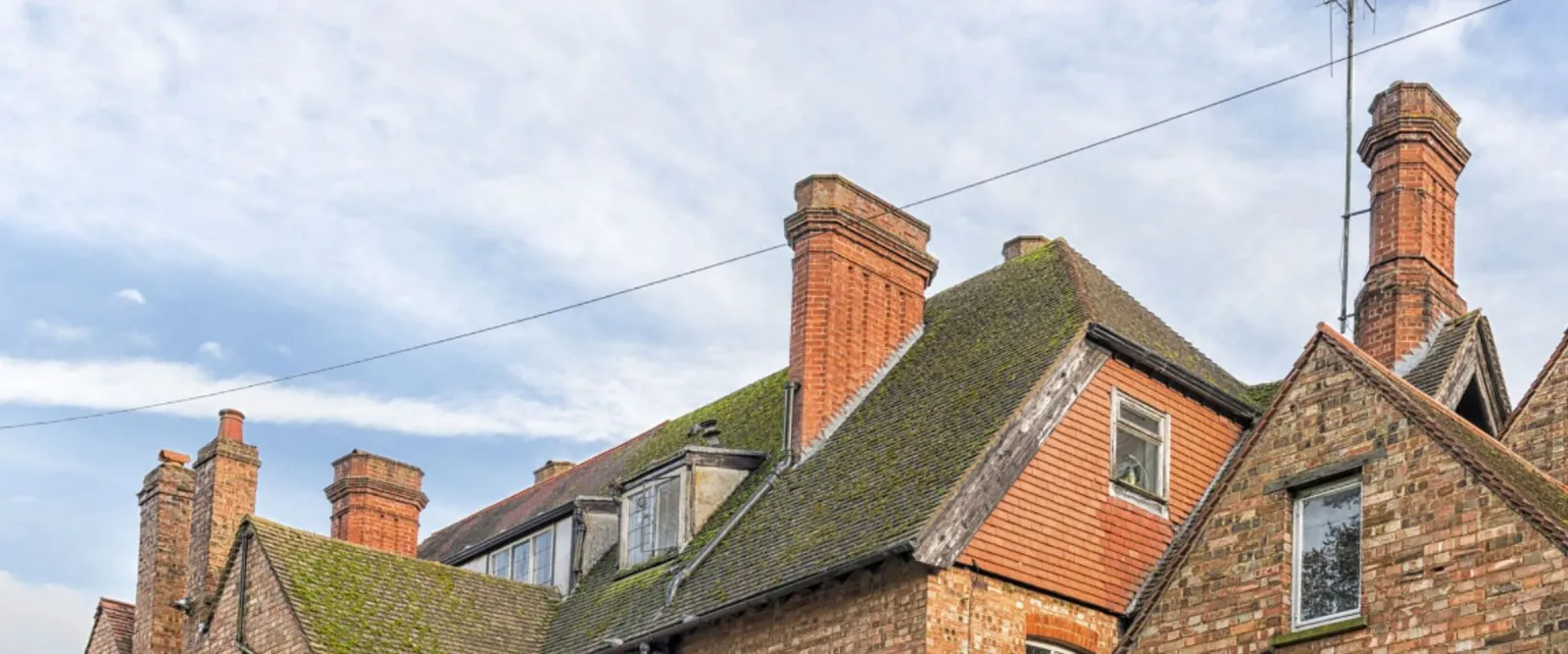
How lime repointing is done on a stack
Good lime work is slower than cement work, and the pace is part of why it lasts. The stages are the same each time.
First, the old mortar is raked out by hand to a depth of about twice the joint width, taking care not to widen the joint or chip the brick. Power tools can crack soft bricks, so on old stacks the work is done with hand tools. The joints are then brushed out and dampened. A dry brick pulls water out of fresh mortar and leaves it weak, so the wall is wetted before the mortar goes in.
The mortar is packed in firmly, in layers if the joint is deep, and left until it has stiffened enough to take the final finish. The joint is then dressed back flush or slightly recessed, and brushed to expose the sand. Lime should not be smeared proud of the brick or finished with a hard, glossy surface.
Curing and protection
Lime mortar needs to cure slowly. In hot, dry or windy weather it is kept damp with a fine mist, or covered with hessian. In cold or wet weather it must be protected, because fresh lime that freezes or is washed by rain before it sets can fail. This is why lime repointing on a chimney is timed to the weather. It is also why a stack repair may wait on a settled spell, even when the scaffold is up.
For the cost and the scaffolding, see chimney repointing, which sets out the stages and the access a stack needs.
What goes wrong when cement is used on an old stack
The symptoms of cement repointing on a soft brick stack usually show within a few winters. They are worth knowing because they are often put down to frost or age, when the cause is the mortar.
Brick faces flake in the shape of the joint. Bricks lose their skin right up to the edge of the cement, leaving the cement standing proud on a pitted, powdery face. Cracks run along the join between the brick and the mortar, because the two move at different rates. Damp patches appear on the chimney breast inside, because the stack can no longer dry out through its joints and water has more time to travel. Salts may stain the inside face as well as the outside.
Repair is harder at this point. The cement must be removed, which is slow on a hard mix, and any bricks that have lost their faces have to be replaced or turned. A cement problem on an older stack is one of the main reasons a repointing job turns into a partial rebuild, and it is much cheaper to get the mortar right the first time.
Cement is the right choice for some jobs, such as a modern engineering-brick stack. The point is to match the mortar to the brick, not to treat lime as a rule for every building.
Cement-based mortars are also not wrong on stacks that were originally laid in them. A 1970s estate house with a hard brick stack wants a mix that suits that brick. Older bricks tell us to use lime; newer bricks tell us to use cement-based mortar of an appropriate strength.
Lime on listed and conservation-area buildings
On older buildings, lime is often required rather than preferred. Where a house is listed, the council may expect like-for-like materials, and works that alter its character can need listed building consent. In a conservation area, repointing in a different material or style can change the look of a street. Our guide to listed chimney repairs explains the consent route.
Appearance is part of this. A repoint should echo the old work in colour, grain and joint shape. Wide, raised or ribbon-style joints change the look of a brick stack, and so do bright new mortars next to weathered bricks. We take a sample patch where that matters and ask you to look at it dry.
On the Railway Village and other old Swindon streets, the roofs and stacks form part of the character that the conservation area is meant to protect. If your house is in one, check with Swindon Borough Council's planning team before you change materials. Planning permission is not usually the issue for repair that matches what is there, but listing or an Article 4 direction alters the position.
Cost and how to compare quotes
Lime repointing costs more than cement work, because it takes longer and uses more skilled hands. National guides give a range for chimney repointing in general. MyBuilder's chimney repair guide, updated 21 August 2026, puts repointing at around £750 within a range of £500 to £2,000. Those figures are a typical UK guide, not our prices, and they do not distinguish between lime and cement. Our written quote comes once we have surveyed your stack.
The things that move a price are the size of the stack, its height above the roof, the number of faces to be done and how much of the old mortar must come out. Access is the other large item. High-level scaffolding is listed at £400 to £900 in MyBuilder's scaffolding guide, updated 21 August 2026. When you compare quotes, check which mortar each one proposes and how deep it will be raked out, and ask if the price takes in scaffolding and VAT. A quote that does not say which mortar is being used is missing the main fact.
If you are weighing a repoint against a rebuild, our guide to chimney pots and cowls covers what sits on top of the work, and the main chimney repairs page sets out the options.